Defending Your Life Forever

Oh man, I really love that, after an excruciating period of neglect, we finally seem to be in the heyday of Albert Brooks' films getting released in HD.  Modern Romance, The Muse, Lost In America and now Defending Your Life.  I only hope this trends holds up long enough for us to get the remaining three, because every one of his movies is one to treasure and revisit.  But whatever happens, for now I'm not looking a gift horse in the mouth; I'm just relishing my dive into this new release from Criterion.
You could accuse Albert Brooks of getting sappy with his fourth film.  But Brooks has always been a master of meshing heart with his satire, and you can't begrudge a writer letting the pendulum swing a little to the sentimental side every once in a while.  And there has to still be a little healthy cynicism to be found in a depiction of a world where, when you die, you're transported to another, larger bureaucracy of just slightly more advanced people who condescend and placate everyone into conformity.  And while passing through to the other side only to find your life is on trial is hardly an original concept in Hollywood - we've all heard of "Judgement Day," after all - the idea that you're not judged on morality or piety but your ability to overcome your personal fears so that you may become your further realized self is a very creative and thoughtful spin.
The hallmark of Albert Brooks' films is that of course they're very funny, but they would also work as smart, touching films even if all of his comedy was removed.  But rather than feeling joke his schtick has been squeezed in where it doesn't belong, he manages to make it thrive.  We all know what it's like to be stuck in the middle of a picture pulling us in two directions at once, but his work is so special because he manages to fully pull off both, where most filmmakers are lucky to manage one, and not have them feel discordant.  So on the one hand, it's always "The Albert Brooks Show," but at the same time, it's a Capra classic.  In this case, we've also got Meryl Streep, who's sweet and brings the degree of effervescent star power the story demands, but Lee Grant and especially Rip Torn take the reigns with far more impressive supporting roles.  There's also a funny celebrity cameo I won't spoil and some surprisingly good performances by the child actors.  How has this movie not hit blu-ray until now?
Warner Bros first released Defending on DVD in a snapper case in 2001.  They've repackaged it a few times with different covers - as a double bill with Looking for Comedy in 2008, again in 2010 and just recently this past December (on DVD-R) for Warner's Archives collection.  But Criterion's new blu is the first time it's been actually updated on disc, not just to HD but with a new 4k restoration from the original 35mm negative.
2001 WB DVD top; 2021 Criterion BD bottom.
As you might expect, Warner Brothers frame their DVD at a lazy 1.78:1, while Criterion apply the little mattes to make it exactly 1.85:1.  But what I was surprised to discover is that Criterion actually zooms in and crops information along all four sides.  Being "director-approved," one can only hope this tighter framing is more correct; but I think we've all learned over the years how little a director's stamp of approval necessarily means.  Still, it's minor enough that it doesn't hurt the viewing experience any either way; and after all, it very well might be the more accurate representation of the filmmaker's photography.
2001 WB DVD left; 2021 Criterion BD right.
Besides that, the colors are gently corrected and differentiated.  WB's DVD was actually rather good, especially for an older disc, so there wasn't that much to fix.  It's not interlaced, non-anamorphic or hideously compressed.  We're not suddenly discovering tons of small details.  This film always had a soft, gentle look anyhow.  But with that said, this is a nice healthy step forward to HD, with compression artifacts transformed into actual film grain.  Look at that colorful packet on the coffee machine behind Albert.  I don't know what that is, but it's much more distinct on the blu.  A very slight vertical pinch is also fixed.

The DVD already had the original English stereo mix with optional English subtitles, plus French, Portuguese and Spanish subs and a French dub.  Criterion dumps the foreign language options, but restores the English mix from the original elements for a bolder DTS-HD track.
Now, when Criterion announced a "new interview on the afterlife with theologian and critic Donna Bowman," I thought alrighty.  They're going to present us with some crazy incense-toting crackpot who was was going to explain to us what Brooks got right and wrong about the afterlife, because she's visited it personally a number of times.  But happily, no, it's an intelligent comparison of Hollywood's history of afterlife comparisons and the existentialist and Kierkegaardian concepts Brooks depicts in his script.  But more important than that is the all new retrospective interview with Albert Brooks, who takes a thoughtful look back the film.  Also included appears to be a re-edit of a promotional featurette with vintage interviews from Brooks (who thankfully says all different things from his separate interview), Torn and Lee.  And we get the trailer (Brooks is known for making creative, original theatrical trailers for his films... but this is just a regular one) and a fold-out insert with notes by horror director Ari Aster.
After I watch this movie, I think wow, this is his best film.  But then I watch Lost In America, or Real Life, or Mother and I think the same thing.  How has Netflix, Amazon, or any of the others not tapped this man for one of those "small budget and full creative freedom" deals yet?  Well, hopefully releases like this show that the world is finally catching on.

An American Werewolf In London, The 4k Ultra HD

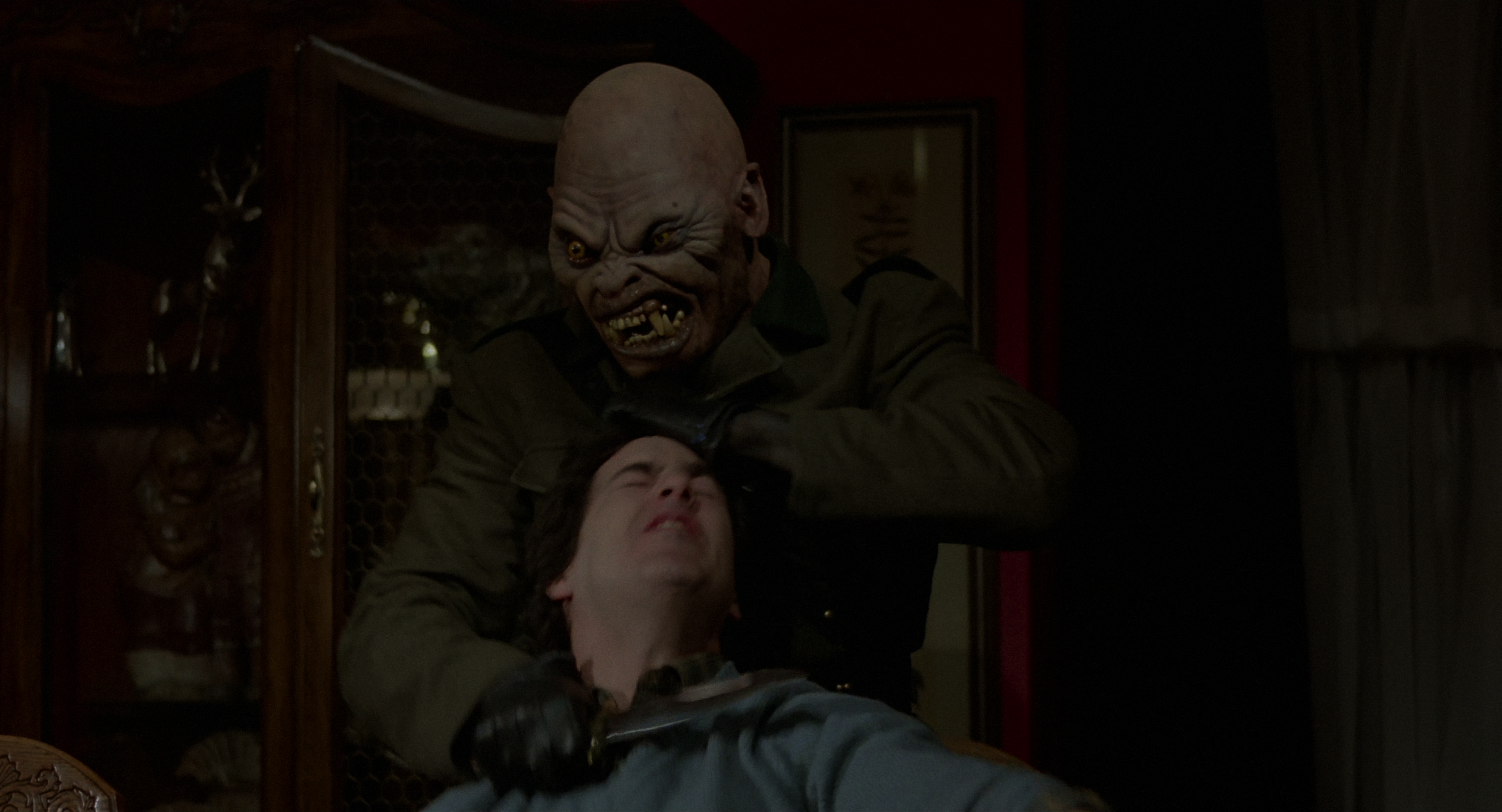
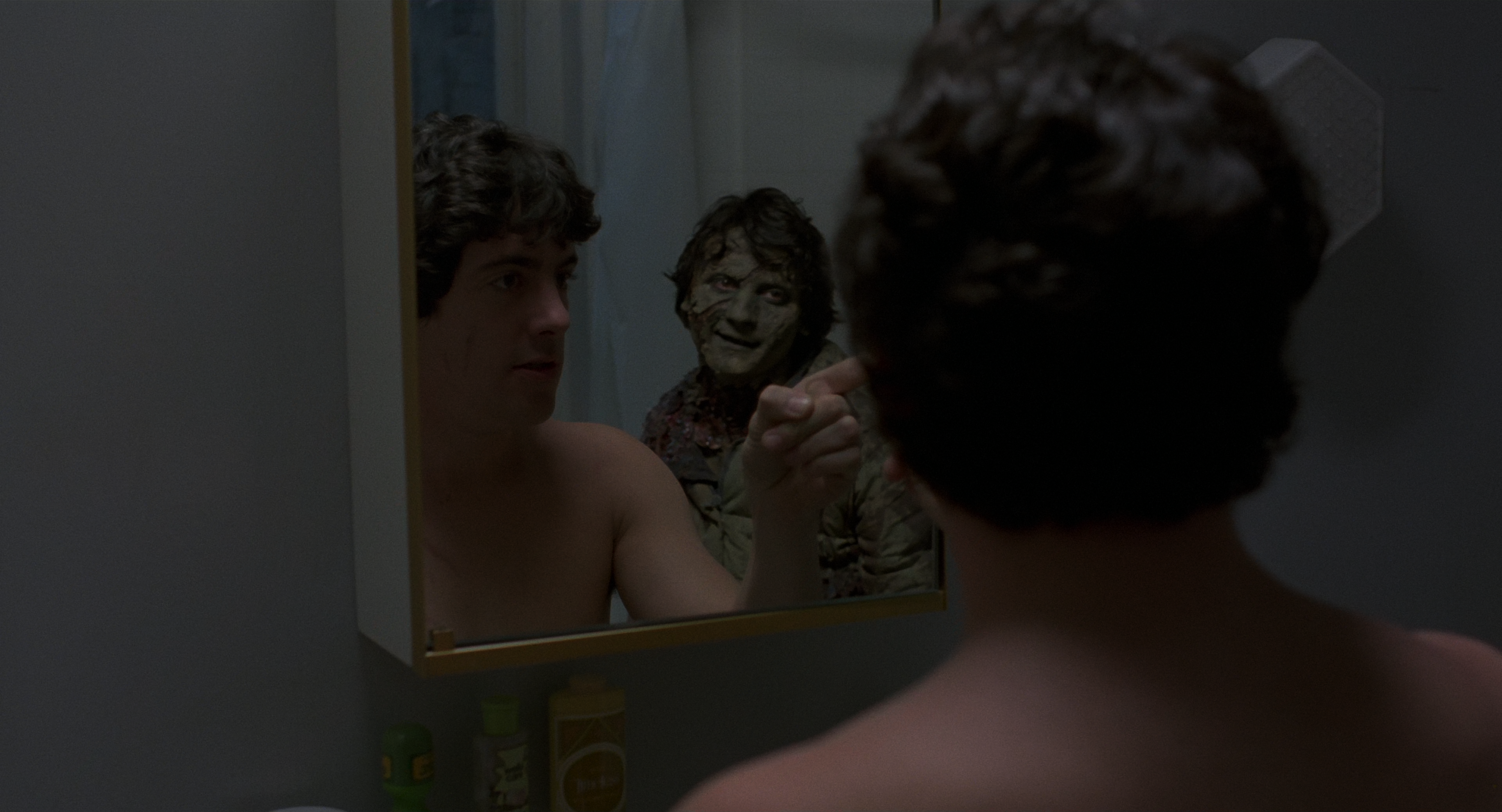
It's time for another edition of Controversial Blus!  Just released today is the brand new Restored Edition of An American Werewolf In London blu-ray from Paramount.  According to the sticker on the slip, it's "NEWLY RESTORED FOR IMPROVED HD PICTURE," so we're not just talking about a reissue of the previous release with different art masquerading as a new version to trap enthusiastic double-dippers like some other releases I can think of.  This is actually an all new transfer.  But is it actually better?  The new blu seems to be receiving more than its fair share criticisms...  I think it's time I did a direct comparison.  And as you can see from the picture above, I'll be looking at some of the older DVDs at the same time.

Update 9/28/16 - 10/22/19: And I'll also be looking at the even more recently restored and improved HD release from Arrow, scheduled to be released at the end of this month.  Spoiler alert: the controversy is now behind us.

Updated 4/12/21: I'm getting a little tired of updating this movie, but if we're being honest with ourselves, we all knew a proper UHD couldn't be too far behind those 4k BDs, right?  And this Turbine set should be the final chapter for a long time to comee now.  Right?
An American Werewolf In London is a pretty great movie, with a modern appeal yet a very traditional, throwback werewolf plot at its core.  Two friends go hiking across England and get attacked by a werewolf after being warned by the creepy locals to not go out on a full moon.  The survivor, of course, wakes up back in the city hospital with a nasty, lycanthropic curse.  While he falls in love with his nurse and tries to get on with his life, his primal nature breaks free as he transforms, spectacularly, into a werewolf and begins terrorizing London.  His doctor suspects and begins to investigate, and even his dead best friend returns(!) to warn him, but true love may be the only thing that can save our tragic protagonist.
John Landis has created one of the most successful blends of horror and comedy, where neither aspect spoils the other.  And it holds up really well, thanks largely to the well-crafted characters, not to mention the famous, cutting edge effects, which still look better than anything coming out today.  It's also a clever story with great use of music and some terrific locations.  Having a healthy budget clearly helped in all the right places, from big set pieces to music licensing.  American Werewolf is one of those rare horror movies that manages to appeal to mainstream audiences without losing the core genre fans.  They've tried to recapture the magic with some success - Landis with a vampire tale called Innocent Blood and the studio with a sequel: An American Werewolf In Paris, which wasn't terrible - but An American Werewolf In London still stands head and furry shoulders above.
Paramount has released An American Werewolf In London a number of times.  I don't it would be too cynical to say that they see this film as a cash cow that can always take a little more milking.  Even limiting it to just the United States, Paramount has issued it on disc an awful lot of times.  actually, Artisan put it out on DVD first in 1997, with a barebones fullscreen disc.  So Universal's widescreen Collector's Edition was a welcome upgrade in 2001.  There was also a bundle release in 2004 with the 2001 disc and the remake of Cat People.  Then the two-disc Full Moon edition added a couple more features, and also came out with a blu-ray edition, both in 2009, so that was a good upgrade.  Then they re-released the 2-disc set as a single disc release, shaving off some extras for a more budget release in 2012.  Okay.  Then in 2014, the blu-ray was released with a gold "Academy Award" winner cover, but it was the same disc as the original blu-ray.  That same year, they also released it in a limited edition steelbook.  In 2016, Universal released their Restored Edition before finally handing the property over to someone who knew what to do with it for Arrow's 2019 Limited Edition 4k remaster.  It was pretty much the definitive BD edition, but now BDs aren't the definitive discs anymore.  So at the end of 2020, Turbine released it on UHD as an "Ultimate Edition" 4-disc set (if you count the soundtrack CD).  And now in 2021, they've just reissued it as a Limited Special Edition 3-disc set, with all the same video content, but minus the swag.
1) 2001 DVD, 2) 2009 DVD, 3) 2009 BD, 4) 2016 BD;
5) 2019 BD; 6) 2021 BD; 7) 2021 UHD.
So, all seven releases are 1.85:1, but you'll notice the old 2001 DVD is missing a little around all four sides, particularly the left.  Actually, measuring it, that first DVD is more like 1.82:1.  Even just comparing the two DVDs, you can see the later one is sharper with more naturalistic colors, too, if maybe a tiny bit on the yellow side.  And then the old blu-ray is that same 2009 DVD transfer - note the white hole in the picture around the wolfman's wrist; it looks like he's wearing a fancy diamond bracelet - but a little cleaner because it's in HD.  The grain is really strong there, and it was definitely the best looking version up 'till then.  But then we come to the Restored Edition, and... where'd the grain go?
l to r: 2009 BD; 2016 BD; 2019 BD; 2021 UHD.
Apparently, the film was given a brand new, 6k(!) scan for this restoration, and my best guess is they figured if they scanned it that close, they could apply some DNR (digital noise reduction) and not lose all the usual detail that tends to go with heavy DNR application.  That's why seeing "DNR" is a bad sign in a blu-ray review.  It means the picture is going to be unnaturally smooth and waxy, with detail erased.  Peoples' hair will look like clear plastic helmets, etc.  So bye-bye American Werewolf grain, and it does look a little bit softer, but... they seem to have been right in that the actual detail has pretty much remained.  I've seen some people say there's even more detail than the old blu, but I wouldn't go that far.  Universal's 2016 BD is the most successful attempt I think I've ever seen to remove grain without smoothing away much of the image.  Still, it was a little weird to look knowing film grain should be there, and now that we can see the results of Arrow's even more recent 4k scan (finished in 2k), we see Universal's job wasn't perfect.  I've read allegations that the grain on the 2009 edition is "fake," or artificially enhanced (it was even brought up in the comments, below), and I was reluctant to buy into that notion, but Arrow's new scan seems to bear it out.  Now we finally see the natural levels of grain you'd expect to see in a 35mm film, making the 2009's look chunky and unnatural.  The 2019 image seems even more nuanced, and a tiny bit sharper, than even the 2016 blu, and it still has the clean-up (i.e. no diamond bracelet!).  How could a 4k scan look better than a 6k scan?  When you don't futz with it afterwards!
l to r: 2019 BD; 2021 UHD.
Now, just comparing BDs, I actually still prefer Arrow's, with an encode that thoroughly captures every speck of grain.  But of course, we didn't buy Turbine's set for the 1080 blu, we bought it for the UHD.  And there's just no competing with that boost in resolution.  Let's zoom in even further, and you can see where the eyeball, for example, breaks down into blocky pixels on the blu while it's still smooth and lifelike on the UHD.  That's not a knock on Arrow; it's just a fact of life when we're dealing with a superior format.  Grain looks a little gentler on the Turbine disc, but again, when you really zoom in, there's no question it's more authentically represented and less pixelated.  And of course now you've got the new HDR color timing, which is what you're really going to notice on your television, as opposed to an academic screenshot comparison, and it really does give the image a more alive, sometimes creepier, feel without ever becoming over saturated or tacky.  It's actually more subtle and nuanced.
For audio, both Universal blus pretty give us the same English DTS-HD 5.1 mix, plus both have a Spanish DTS dub in 5.1, and French, German and Italian DTS dubs in mono.  Both blus also have 16(!) subtitle options, which I won't bother to list out, but that's pretty much every language including both English and English SDH.  A number of fans were hoping for the original English mono track, but we didn't get that.  Landis created the updated 5.1 mix himself, so I imagine there was little interest in putting the old track back on the film.  Sorry, purists.  The older DVDs also only have the English in 5.1 (plus, English, Spanish and French subs), though I've read that the mix on the old Artisan DVD at least sounds closer to the original audio, with a higher pitch.  But you had to go all the way back to the old laserdiscs (there's a fullscreen one from Image and a widescreen one from Live) for the original mono audio.

I say "had," because Arrow have once again swooped in to save the day, because they've also restored and remastered the original mono from the original mag reels for their new disc!  So the pitch is finally correct.  That and the 5.1 mix are both included on the Arrow in DTS-HD, along with optional English subs.  and as for the Turbine?  Yes, they're pitch corrected, too.  Whew!  They've also got both the 2.0 and 5.1 mixes in DTS-HD, plus the German dub in same, with optional English and German subtitles.
For extras, once Universal got it, things were looking good.  The original 2001 DVD had a light but not too informative audio commentary by the two leads David Naughton and Griffin Dunne, a substantial on-camera interview with John Landis, another with Rick Baker, outtakes, a vintage 'making of' feature, and some archival footage of Baker working on the famous werewolf transformation.  Plus it had a photo gallery, storyboards, text bios, a bonus trailer for The Wolfman (the remake) and a nice little insert with notes.  The 2009 DVD and every subsequent release carried all of that over (except the bios, bonus trailer and junk), but also added a full length documentary on the film called Beware the Moon (that's the second disc of the 2-disc set that was dropped from the budget version in 2012), which is great and very thorough.  The blu also added Universal's usual junk like BD-Live and D-Box support for the two people who use that.  And no, the new 2016 doesn't have anything new to add, and even ditches the BD-Live and D-Box stuff.  It does come in a nice, shiny slipcover, though.

But who does have something new to add?  Arrow, of course!  First of all, yes, everything from all the past editions (except the D-Box and junk) has been carried over.  And what's new?  First and foremost an excellent full-length documentary on Universal's history with werewolf films by Ballyhoo, who really hit it out of the park.  This was clearly made with AAWIL in mind, because it starts out with Landis and never loses site of how all of this history is eventually leading to his film.  But it's a great look at the whole story (and even a bit of a postscript on the Del Toro film), interviewing a surprisingly vast collection of filmmakers and artists.  Beyond that, there's a new interview with Landis, which isn't too redundant because they ask him about British cinema and bits he hasn't touched on too much in the previous extras.  Then there's a new audio commentary by the director of Beware the Moon (who also wrote a book on AAWIL), which is rather good.  He's an undeniable expert on the film and manages to find new trivia info to share despite the wealth of content in all the other extras.  Plus, he does a pretty funny Landis impression.  But he does also slip into repeating a bunch of anecdotes we've heard elsewhere on the disc, often more than once.

Still want more?  Whew, okay!  There's a brief but quite neat look at surviving props from the film, including one of Baker's legendary "change-o heads."  There's a video essay on the Jewish aspects of this film, which are mostly quite interesting and well observed, though he does spend a chunk of time unwittingly repeating some Wolfman history that was already spelled out in the Ballyhoo doc, and he exaggerates a bit.   Then there's an interview with Corin Hardy, director of The Nun, which starts out kind of bland and uninteresting as he just shares his appreciation of the film.  But then he gets more interesting when he starts applying his own experience in filmmaking to discuss the hurdles he'd have trying to replicate what Landis achieved today.  Oh, and I even saw some forum guy post a strange video teaser for the film that he was disappointed never made it onto any of the Universal blus.  Well, that's on here, too, along with the main theatrical trailer and a TV spot.

The limited edition comes in a clear amary case with reversible artwork housed inside an attractive, thick slipbox.  It includes a two-sided poster, six lobby cards, a full-color 60-page book with notes by Travis Crawford and Simon Ward and one of Arrow's standard insert cards (mine's for Why Don't You Just Die!).
It's a little confusing, because the title of several featurettes were arbitrarily changed, but having gone through it all now, I'm happy to report that every single special feature from the Arrow set has been carried over to the Turbine.  And even better, though you wouldn't have thought it was possible, Turbine have included even more new stuff: five features totaling up to roughly another hour of content.  A nice start is a brief look at Piccadilly Circus today, with the film's first AD.  The longest is a Post Mortem retrospective with Mick Garris interviewing Landis, originally recorded, I believe, for his podcast series.  There's also a 2011 interview with David Naughton and a round-table discussion with Garris, Landis, John Carpenter and David Cronenberg, which has popped up on a few discs before, including Criterion's Videodrome and Turbine's edition of The Thing.  But it's nice to finally get it on a Landis release - a welcome addition to anyone who hasn't had a chance to see it yet.  And finally, there's a brief featurette with a fan who's collected a number of impressive props and memorabilia from the film that was created for the Arrow BD, but ultimately left off.  Now we finally get to see it.

Turbine's Limited Special Edition comes in a very stylish, embossed slipbox, and the inner case also includes reversible artwork.  Their initial 2020 Ultimate Edition also came with a soundtrack CD, double-sided poster, a 100-page book, art cards, stickers, and a Slaughtered Lamb "beer lid," whatever that is.  All the extras are completely English-friendly (except the book?  I just got the LSE, not the UE), and two of the trailers have also been boosted up to 4k resolution.
So the old debate of which blu is best is now handily closed: Arrow's beats all those that came before it with a long lead.  It brought the best picture, finally looking natural after all of Universal's odd experiments, the proper original audio (and the 5.1 remix, too, for those who still want that), and the fullest, most well-rounded set of extras.  It's not even missing some little thing where a die-hard collector might say, well, you might want to still hang onto your old copy.  And now Turbine have come along, and kicked it forward a generation, with a few more new extras to boot.  American Werewolf fans have nothing to complain about any more, it's one of the best served films on home video!

City Hall On Blu

It's been a slow year, so far, for new releases I'm particularly excited about, but we finally got one: Frederick Wiseman's City Hall.  It's a bit ironic, perhaps, as this is one of the least exciting movies in film history; but it works for me.  With the field of documentary film becoming more and more dominated by true crime, political pandering and celebrity garbage, watching a Wiseman flick feels like an increasingly zen experience.  As non-confrontational as his work has always been, it seems like he's been mellowing even further out in the last decade or so - it's hard to imagine the guy who's been giving us At Berkley, Ex Libris, Monrovia, Indiana and now this swinging back to create a Domestic Violence 3.  His shooting and editing formula has eased into a groove so predictable you can call out from your couch, "okay, now we're going to see two still shots of a city street at night and then onto the next meeting," right before it all unfolds on screen.
And that's not a criticism.  At this point he has to expect and want us to relax into a comfort zone.  After all, from the very beginning, Wiseman has been against showy camera tricks, gimmicks, leading narration, emotional score, etc.  The fact that the man behind the camera never leaves you guessing about what he's up to let's you settle in and think exclusively about the people in front of the camera.  For four and a half hours.  By the end of City Hall, you'll feel like a native citizen of Boston, all ready to vote in the next local election, which is the gift of this film.
I do have one complaint about City Hall, however.  One of the consistent strengths of Wiseman's films is what he discovers.  It might be too neat to say each of his films documents a system, but it's pretty true, giving us a keen, insider's view into the world around us we never had before.  From Meat to High School, we're given a deeper insight into what we've already thoroughly experienced (vegans excluded).  "Meetings" are famously dull, but the meetings Wiseman meticulously observes are fascinating because it exposes the inner workings we're usually excluded from.  You could have toured London's National Gallery hundreds of times in your life as a patron, but National Gallery shows gives you the tour only the top level insiders would get to experience.  So City Hall is positioned to be a perfect, multi-tiered exploration of local government, just like his other films have shown us the full cross section of every other system he's turned his camera to.
But unfortunately, this film is really, to use a technical term, up the mayor's butt.  Look, I'm not expecting a scandalous take-down expose from a Wiseman film.  But even in just about every other film he's done, we'd be seeing meetings of the faculty debating what to tell the protesting students or the curators deciding what to charge the patrons.  But outside of one very brief introductory scene, we're not seeing the mayor talking to his staff about what to say at an event or rally, we're just seeing the public speeches he gives there.  I kept thinking, this is what I'd switch off of on my access news channel.  And the mayor isn't just one character in this complex sea of local government, this film follows him around to dozens of events; we're barely given any time away from him before he steps back in front of the camera with another prewritten speech.  I can only assume Wiseman was given very limited access, which would explain barely getting behind the curtain, but even then I can't imagine why he wanted to film all of the mayor's speeches so doggedly.  You start to get the impression that only one person works at city hall.
Not that there's nothing worth discovering; far from it!  There's a frank and charged talk between impoverished locals and business owners who want to open a dispensary in their neighborhood.  We see a number of cases where mostly younger people of color are trying to push diversity movements into their government.  We get an eye-opening glimpse into small room of technicians who monitor and control local traffic with real-time surveillance.  A charming retiree tries to get his landlord to help with a rat problem.  There's a montage of 311 calls that could have been an entire film all to itself.  Nervous scenes where people try to beat their parking tickets or just a calm moment watching a crew slowly pave a road are all great.  Building inspectors, fireman, garbage collectors.  Everything you want from a Wiseman film is here.  Endless indulgent footage of mayoral speeches just happens to be slathered all over it.
2021 Zipporah Films BDR.
Zipporah Films offers this film on either DVDR or BDR, naturally I've chosen the latter.  I've said it before and I'll say it again: their prices are exorbitant for burned discs (they're even high for professionally pressed discs), but at least they do a first class job.  Framed at 1.78:1, City Hall is spread across two dual-layer discs with a clear and vibrant image.  I don't need to compare it to the DVD edition to see from it's obvious sharpness and fine detail that this is pristine HD picture.  Playback can be a little dodgy with BDRs, but I've played these on two different players with zero issues.  We're given the choice of two audio options, both lossless (rare to see on burned discs): stereo in LPCM and 5.1 Surround in DTS-HD.  Optional English subtitles are also included.
So yes, I'd prefer pressed discs, but otherwise you can't say they didn't do a great job.  Obviously, Wiseman is as staunchly against extras as ever[??? I don't get that attitude, but it is what it is], but in terms of presentation, Zipporah has done everything you could ask for.  And City Hall really is a good movie; don't let my complaints put you off.  Yes, I'd have liked to see more of the mayor in the office and certainly a higher ratio of other city employees to him.  But this is still on the level of work most issue-of-the-week documentary filmmakers today should be aspiring to.  I'm already looking forward to his next one!

The Other Essential Bergman Set

So admittedly it took me ages, but I did eventually work my way through comprehensively covering the entirety of Criterion's massive 30-disc boxed set of Ingmar Bergman films.  However there's one more must-have Bergman set I still need to cover.  Of course this isn't the only other collection of Ingmar Bergman blu-rays.  There was the 100th Anniversary box from Germany in 2018, a 10-disc "Essential" set in France a few years before that, etc etc.  But there's nothing in any other Bergman box that isn't in Criterion's.  Ingmar Bergman's Cinema has made all the Bergman sets obsolete, except this one: Classic Bergman, 5 Films By the Master of Cinema from Artificial Eye in the UK.

Four of those films?  Not exclusive.  They're covered in the Criterion, and I've just updated their pages to make detailed comparisons between the releases here:


In brief, only AE's release of Brink of Life, here titled So Close To Life, could be said to have any advantage over the Criterion, which wiped the floor with the other three.  One film, though, is not included in Ingmar Bergman's Cinema, or any other box.  It's not sold separately either.  It's only available in this AE set: 1946's It Rains On Our Love.  So if you're trying to get every Bergman film there is on blu, you have to get this set.  But to sweeten the pot, AE also has a very good, exclusive documentary that covers all new ground, and interviews several actors, that all the Criterion extras somehow missed.
So let's talk about It Rains On Our Love.  It's a sort of fanciful melodrama with a lot of very bleak social realism, which, if you're a Bergman fan, won't sound so unusual.  Bergman's first regular leading man Birger Malmsten stars as a mysterious drifter who hangs out at the local bus station and picks up Barbro Kollberg who's so down on her luck, she decides to throw her whole life in with him on a fleeting romantic whim.  Unfortunately, as Ingmar is keen to show us in an incremental, spirit-crushing series of seemingly never-ending unfair events, modern society has it out for young lovers who try to make their own way in life.  Every kind old farmer and small shop owner turns out to be just dying to take advantage of them and then cast them further out of society once they've bled them dry.  The whole film is essentially an indictment of capitalist culture.
But then there's the fanciful side.  Our story is narrated by an old man with an umbrella who repeatedly interjects himself into the young couple's lives to help out.  When our friends finally do find genuine, trust-worthy friends, they're a trio of balloon-carrying comic relief fools right out of a Shakespeare play.  Their most faithful companion of all turns out to be a small dog who walks everywhere on its hind legs unprovoked.  And it all ends in an implausible trial scene straight out of I Accuse My Parents.  You really get a sense of Bergman's history with classic literature in his unnatural blend of neo-realistic tragedy and with comic fantasy.  Mainstream audiences looking to have their conventional dramatic expectations met will be put off for sure, but Bergman enthusiasts will feel right at home.
It Rains On Our Love has always been a rare find on home video.  The only English-friendly DVD as far as I'm aware (and believe me, I searched) was the Klubb Super 8 Swedish import released in 2007.  But in the summer of 2012, the clouds parted and Artificial Eye included in their 5-disc blu-ray set called Classic Bergman.  To this date, it remains the only HD version of this film on disc, and thankfully it's rather good.
2007 Klubb Super 8 DVD top; 2012 Artificial Eye BD bottom.
In fact, this is quite a big upgrade, although Super Klubb 8 deserves as much blame as AE earns credit for that.  Their print is heavily damaged and soft, seemingly taken from a VHS copy of a worn out film print, and framed oddly at 1.28:1.  The blu comes in at a more natural 1.33:1, revealing more around the image and delivering a far clearer and cleaner film scan in HD.  Grain is clear and authentic.  My one note would be that it's a little heavy on the contrast, bordering on flared out whites and crushed blacks, but it's not too bad and is a far superior viewing experience to the bowl of mushy gray soup that is the DVD.

Both discs include the original Swedish mono track with optional English subtitles, but I'm happy to report - given AE's history with often lossy soundtracks - the blu provides a much stronger LPCM track.
For It Rains On Our Love, the only special features either disc offers is a brief stills gallery from Klubb Super 8.  But as part of Classic Bergman, we do get two very nice documentaries on other discs in the set.  I've already written about one of them, Women and Bergman, here, as it was also included in Criterion's extensive Bergman box.  But that documentary has a twin, Men and Bergman, which is still only available in this set.  It's another round table with some of Bergman's actors, again extra rewarding for including key players who don't appear in any other Bergman extra or doc.  Women and Bergman is about half an hour and Men is just under a full hour.  Men includes Thommy Berggren, Borje Ahlstedt and Thorsten Flinck, and as you might guess from that line-up, gets into his stage work as much as his cinematic.  It goes another step further, too, by also including a separately taped one-on-one talk with Erland Josephson.
It Rains On Our Love isn't one of Bergman's all-time greats, but it isn't bottom of the barrel either.  Once you've made your way through Ingmar Bergman's Cinema, you're going to want this one in your collection, too.  And Men and Bergman is both good and original enough to substantially sweeten the pot.  Don't think of it as a set with a lot of repeats, think of it as one great disc with some excessive packaging.  Unfortunately, AE's box is out of print now, but if you spot it for a reasonable price, definitely snatch it up.