Return To the Nightmare: Scream Factory Brings Us The Gate II

This is a weird one.  I won't be comparing Scream Factory's new blu of Gate 2, which comes out this Tuesday, to the old Canadian DVD because, even though I always knew abut it, I never picked it up.  Because I've never really liked this movie.  But we're looking at the blu today because I kinda had to have it.

The Gate, as far as I'm concerned, is one of the truly great horror classics of its decade.  I loved it as a kid, and not only did it hold up revisiting it as an adult; my appreciation for it grew.  So as soon as this sequel hit the video shelves back in '92, I was all over.  The Gate never felt like a franchise film, like a Freddy or Jason film, so I wasn't expecting it, and I was super excited.  And then that excitement just slowly drained out of me from minute 1 to minute 90 as Gate 2 wandered further and further from the promise of the original.
Not that it's all bad news.  They were only able to bring back one of the two kids from the original, but they brought back the most interesting one.  And the same core monsters were back, or at least one was, and the special effects definitely delivered.  So for the opening minutes, I was in.  The troubled preteen from the original is a little older, and understandably still obsessed over the literal Hell they raised in the previous film.  So he's back at it, trying to master the heavy metal magic they'd unleashed before in a controlled, semi-scientific way.  This time he intends to master it, but of course that blows up in his face right away.  So far so good.
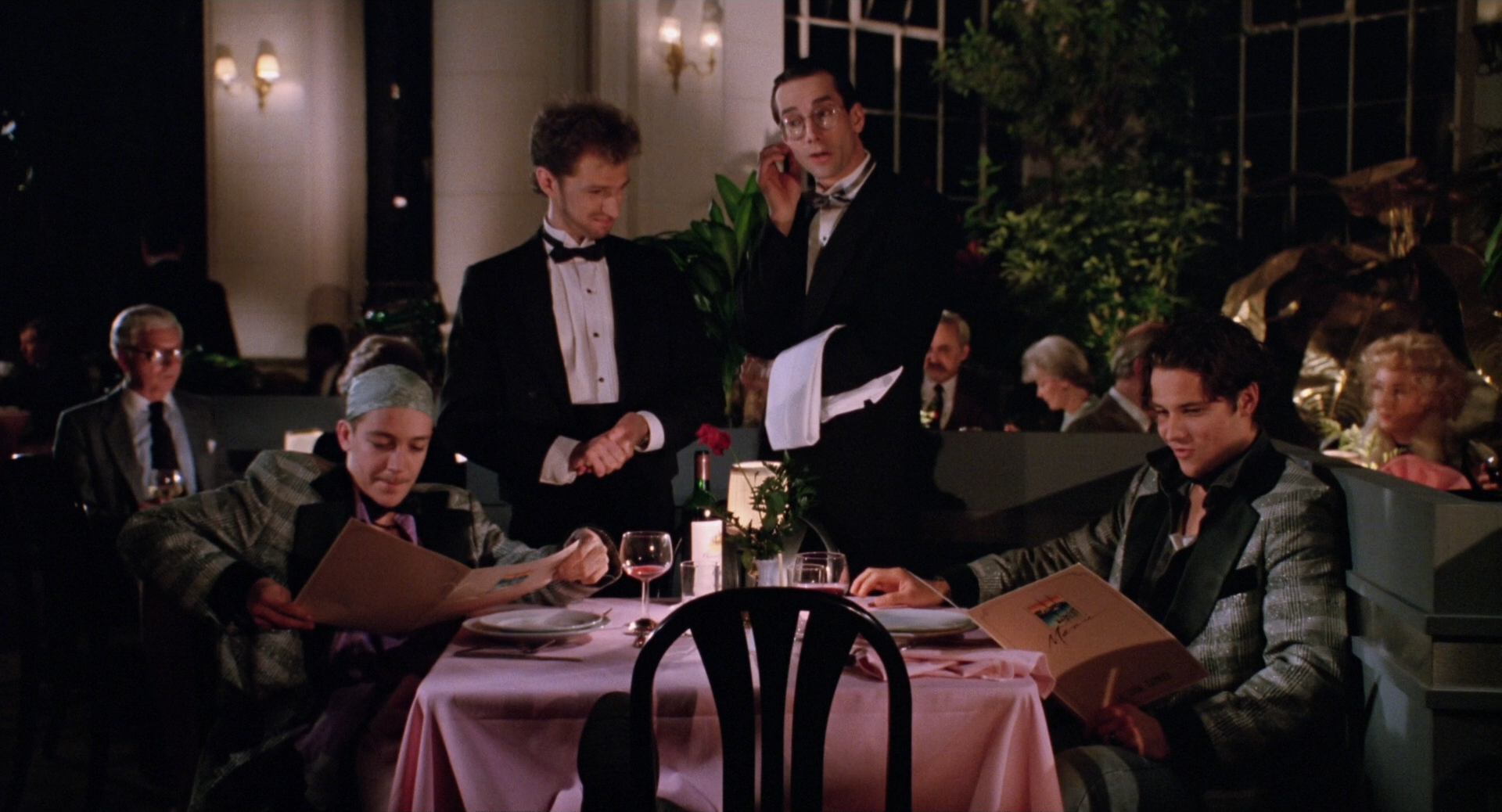
But I could tell things were beginning to go South as soon as the bullies entered the picture.  These were a pair of goofy, greaser punks straight out of an 80s sitcom.  Certainly, The Gate played with the mixture of horror and humor; but it grew increasingly obvious the horror was being chucked out the window in order to double down on the comedy.  And this time the comedy was way more broad.  Instead of an army of small creatures spreading terror to lead the way for their dark master, this time we basically just have one little monster, who our characters capture and discover it can grant wishes.  So the bullies steal it, and they get a cool hot rod car and then go raise a ruckus at a fancy, upscale restaurant, replete with evening gowns, a small string orchestra and a snooty maitre d'.  The bully named Moe puts his feet up on the table, mispronounces the names of the fancy food and winds up pushing a waiter into a cart of trays as everyone gasps.  That's the kind of movie Gate 2 turned into.
So why did I have to have this one?  Well, partially because Vestron finally made a proper special edition of the original, and this makes a swell companion piece.  And, hey, I hadn't seen it since the old VHS days, when it was murky and fullscreen.  Maybe finally seeing it the way it was meant to be seen would raise the film in my estimation all these years later.  And it does a little bit.  It actually is photographed fairly well, and knowing the film I was walking into helped me past my initial disappointments and appreciate all the little touches and moments that do work.  It's not just the original kid who's back, who does deliver another worthwhile performance; it's pretty much the same filmmaking team.  The same director, the same writer.  So more of the character's personal story from the original is brought back here, making it feel like more of a full continuation than most horror sequels.  And this film still has a fun mixture of stop motion, prosthetics and rubber creature effects.  And I was surprised to recognize a young Pamela Adlon (of Louie and Better Things fame) as the young girlfriend character.
2018 US Scream Factory blu.
Scream's new HD transfer is made from a 2k scan of the interpositive.  For those keeping score, that's better than a print, but not as ideal as the original camera negatives.  So maybe it's not quite as crisp, but honestly, it's a very attractive picture.  Grain is visible but light, the image, well, obviously an entire world apart from anything we've seen before.  Admittedly, I've never seen the DVD, but I do know it was fullscreen.  Anyway, the blu here is slightly matted to 1.85:1 and what really stuck out to me the most was the colors.  You expect to see a little shelf-wear along the edges of a low budget flick from this many years ago, but it looks surprisingly good here.  I was impressed.

For audio, we get the original stereo mix (which sounds like what it is, a little low budget and dated) in DTS-HD and optional English subtitles.
This being a questionable sequel, what really drew me into this release was the special features.  Again, it was mostly the same team as the original, so that Vestron disc had me hungry for what these guys had to say about their follow-up.  And probably because Scream Factory could smell an under-performer with this title, the disc is a little light on extras, but what it has is pretty much just what I wanted.  The main feature is an almost half hour discussion between the director, screenwriter and one of the special effects artists: Randall William Cook.  It's co-produced by Red Shirt Pictures and pretty much addresses everything you want to hear.  Then one of the other effects artists, Craig Reardon, gets a second featurette all to himself, where he goes over his contributions to the film.

Those are both pretty great, but unfortunately that's pretty much it.  No commentary or anything.  Again, I think Scream wanted to keep their budget low in this one.  But what we got works.  There's also a few promotional items, like a video trailer, a brief promo video, a stills gallery, and a fun vintage audio recording for a $1000 contest that was run in conjunction with the film's original VHS release.  As you can see, Scream's cover uses the original VHS art, but it also has reversible artwork, using an old German video tape cover on the flip.  Two pretty neat options, with neither being that cheesy comic book style stuff they usually produce.
So look, Gate 2 is Gate 2.  Not everything in Scream Factory's line-up is a masterpiece.  If you're a fan and grew up with the film, though, you should be super happy with this release.  I doubt we'll ever see a better edition in our lifetimes.  And even if you're not particularly impressed with it - hey, it's not entirely unamusing.  And like I said, when combined with Vestron's special edition of the original Gate, it feels like one complete, satisfying package.

Dueling Blus: Oliver Stone's Forgotten Horror Masterpiece, Seizure

Here's a film you missed out on if you bought Warner Bros' big 15-disc Oliver Stone Collection in 2001 or their subsequent, revamped Ultimate Oliver Stone Collection in 2004.  1974's Seizure is one of Oliver Stone's least known but still arguably one of his absolute best feature films.  It's basically been languishing in obscurity until Scorpion rescued it in 2014; but being a smaller cult label, it still hasn't blipped on all the radars it should.  I've just been looking back at my old copy of Video Watchdog #26 devoted to the film, which Lucas called "unbelievably good" and "the most remarkable horror film to emerge since William Friedkin's The Exorcist."  That's high praised for sure, but not unwarranted.  There have long been rumors that Stone is ashamed of this film, but when you read his interview you can tell he was proud of it and was very frustrated that so few people saw it because the distributors let it languish.  Even the generic title, Seizure, was a forced replacement for his much more descriptive and alluring title The Queen of Evil.  In fact, I've been going back through Stone's catalog, and some of his most famous films are starting to feel a little creaky and dated.  But I feel Seizure, on the other hand (and Salvador, too; but that's for a whole other post), is only getting better with age.
Admittedly, Seizure is a bit of a dream logic horror film like, say, Inferno; so it's going to frustrate a lot of viewers.  In fact, according to Stone's VW interview, it's based very directly on a dream of his, but enhanced with some great ideas and fleshed out characterization.  In short, Jonathan Frid (Dark Shadows) is an author struggling to finish his latest horror story for children.  He invites all his friends to stay with him and his family for the weekend, when they're visited upon by three figures of death.  It's declared that only one shall survive the night, and he's powerless to stop them.  I was just talking in a recent post about how tiresome it can get when movies continually dangle the supernatural question in front of the audience: are the ghosts real or imaginary?  The Turn Of the Screw is a literary classic and deservedly so; but in lesser hands, it can be pretty tedious as the writer keeps yanking your chain back and forth between "it's real! No, it's a dream!"  We don't really know here either, but the power of this film is that it doesn't fucking matter.  We're trapped in this primal darkness no matter what.
There's a great contrast in this film between its bleak nihilism - we're going to watch a group of people twist and die unhappily, in the vein of films like Wolf Creek or House On the Edge Of the Park - and the almost childish vision of Seizure's iconic villains: their wicked leader The Queen of Evil, the giant executioner The Jackal, and a sadistic dwarf known as The Spider, played by a pre-Fantasy Island Hervé Villechaize, who's just terrific.  Really, the whole cast is great, which really serves to elevate the proceedings.  Martine Beswick plays the Queen (that's right, not Mary Woronov, who's actually cast as a fairly normal person for a change!), Joseph Sirola goes over the top but in all the right ways; and even though I was prepared for a wooden turn by the infamous Troy Donahue, he actually delivers a very naturalistic, convincing portrayal in Stone's hands.  All of his famous filmmaking strengths can be found in this early, overlooked work, including some bold editing choices and certainly the writing (Stone shares a credit with a co-writer, but he told Lucas that re-writer only did a little editorial clean-up and was really involved more in a business aspect).  One of the moments that elevates this script from good to great comes right near the end and is a huge spoiler, so I won't say it here; but wait 'till you get to it.
Stone made a second horror film after this, The Hand, which is a little better known and respected.  It's certainly a good film with an excellent lead role by Michael Caine.  But to me it feels like a more conventional, watered down version of Seizure, which he essentially had to remake because his first effort had been practically buried.  I mean, don't get me wrong, it's a completely different premise and the story is told very differently.  But it feels like it revisits all the same core themes and emotions because his first attempt to exorcise them before the public here was stymied.  So The Hand might be a little more polished and satisfying for the casual viewer who isn't interested in being confronted by their Friday night flick.  But to me, Seizure is the more important and powerful work of the two.
So, like I said, Seizure hasn't had a big life on home video.  I took a film course and the professor who was talking about Stone's body of work hadn't even seen this film.  It was released on VHS a couple of times by some smaller labels, but all we had of it on DVD was that same VHS transfer ripped onto a grey market disc by Substance.  Still, you put up with it because it was all we got.  Until 2014, that is, when Scorpion saved the day and released DVD and blu-ray editions of an all new, high-def master from the original vault elements.  Unless you caught it during its rare original screenings in the early 70s, this was your first time seeing it in widescreen!  Old reviews constantly deride this film for its bad lighting in the night scenes, but that's surely due to its dupey, dark video transfer, because it all looks very clear and professional now.  Coming from Scorpion and not Universal, you can bet they didn't exactly get Stone in for an audio commentary or feature length documentary, but they did scare up a couple, very good special features.  It's been the definitive, must-have edition until just recently, when a German challenger entered the scene.  Their blu is a longer cut of the film, a composite cut of HD footage and restored scenes from German VHS release that runs about five minutes longer.
So let's talk about this longer cut.  As you can see, it's fullscreen and obviously lower quality, taken from a video tape rather than original film elements.  Though, for VHS-sourced footage, it's not looking too bad.  Yes, the aspect ratio changes for the additional footage (a curious choice, since it's basically open matte... I'm surprised they didn't matte to match the rest of the film).  But what's this extra footage?  How essential to the film is it?  Well, it's not absolutely critical, but it isn't superfluous fluff that deserved to be cut either.  Some of the changes are minor... When Woronov comes out of the gas station bathroom, in the extended cut we just get a quick extra shot of dirty graffiti on the walls, showing us what a dive it is.  But if this movie left you puzzled and longing for answers about "what the heck did I just watch" - and it is that kind of movie - this version definitely gives you some more towards that, in particular a large chunk of dialogue between Frid and Roger De Koven that really delves into the questions at the heart of the film, but still without giving away too much.  Check out movie-censorship's breakdown for every single detail, but in short, I'd say the longer cut is superior, but not drastically so.  It's not an eye-opening revelation... or chock full of additional exploitation elements if that's what you're after.  But it's certainly the one I'll always go back to now for future watches.

Oh, and it has to be noted that Schroder Media's disc gives you the option of watching the longer or shorter cut - both versions on on their disc.
2014 US Scorpion blu on top; 2017 German Schroder Media blu bottom.
Apart from the added inserts, it's clear both blus are taken from the same master.  The film is presented in 1.78:1 with bold colors and natural, filmic look.  Grain is visible and genuine, though predating the cutting edge clarity of today's 4k scans.  But it looks beautiful, and thankfully hasn't been tampered with an any of the common pitfall ways like edge enhancement.  It has a very natural look with attractive coloring.  There are a few cases of film damage, but they're rare and not too distracting.  Actually, one review I read online suggested Stone purposefully crafted them into the film as an artistic decision, but I haven't been able to confirm this; and from the German videotape footage, it appears the damage wasn't present on the German VHS... and I wouldn't think Stone was still tweaking the film after those tapes was released.  Anyway, I have to point out that the two blus aren't 100% completely identical.  Upon direct comparison, the blacks and shadows of the Scorpion disc are noticeably darker than the Schroder disc, which lightens them just a tad.  It never actually reveals any additional picture information, though; they're not correcting crushed blacks or anything.  It's just a slight distinction, and it's hard to really pick a preference.  I guess Scorpion's blacks are "truer," so I'd go with that one; but it's really a pretty arbitrary call.

Audio options are pretty much the same across the board.  We're given the original mono track in DTS-HD 2.0.  It's very strong, though there's some hiss from the vintage elements.  It's not distracting, but very evident when stopping and starting the film mid-viewing.  Both discs have offer the complete English audio (yes, the added VHS scenes also have their original English audio despite being supposedly taken from a German tape), and neither disc offers subtitles of any kind.  The Schroder disc offers an additional German dub, of course, also in DTS-HD, and it's completely clean, without any hiss.
So far it sounds like the Scorpion used to be the disc to get, but Schroder has thoroughly unseated it as the definitive release, right?  And that may be absolutely true, but here's where Scorpion still makes a case for itself.  They've got some great, exclusive extras.  The highlight is absolutely Mary Woronov's, roughly fifteen minute on-camera interview.  There is forthcoming and then there's this.  She's very funny and very no-holds barred.  She has great memories and anecdotes about this film, and it's a joy to watch.  They also interview co-star Richard Cox, which is good, although they do that thing where they spend a most of the time just having him run through every film on his imdb page; and he winds up talking more about Cruising than Seizure.  But he does have some good stuff to say about this film, and it's a good watch... just not on the same level as the Woronov talk.

So Scorpion has two interviews and the trailer.  Not a ton, but substantially more than the German blu, which just has the trailer.  It does also come in a slip sleeve, and has reversible artwork (typical of German discs, it's the same art, just without the large ratings logo).  It's a numbered, limited release of 1000 (mine's #338).  But I'm not sure if the whole disc is limited, or - probably more likely - just the initial run with the slip sleeve.  I say "slip sleeve" instead of slipcover, because it opens from the side as opposed to the top and bottom.
So okay, let's make some final tallies.  I do believe the longer cut is the preferred cut of the film, so if you don't have either disc, you're going to want to import the German blu for that.  Especially since it still lets you watch the short cut, just in case you wind up disagreeing with me, or if the inserts' dip in quality really bothers you.  But do the added scenes add so much that it's worth double-dipping if you already own the Scorpion version?  Very possibly not, unless like me you're a really big fan of this film.  And if you have the German disc, do Scorpion's extras warrant a double-dip in the other direction?  Again, if you're a big fan: yes, because those extras are good 'uns.  But if you just kinda like this film and want it in your collection, but aren't really in love with it, you can probably sleep at night with just one of these blus.  Anyway, that's where the chips fall, so now what to get or not is up to you.  But personally, I'm happy I've got both.  It was the right call for me.

M.I.A.: The Great, Creepy TV Ghost Story, Don't Go To Sleep

Man, I've got so many discs backed up I want to cover, I kind of forgot about about covering M.I.A. films.  That is to say, discs that have never been released on DVD or blu anywhere in the world and really deserve to be... just in case you've forgotten, too.  And this is one I've had on my list since I first came up with the concept: 1982's Don't Go To Sleep, a genuinely disturbing, long neglected ABC TV movie of the week that's better than most ghost-themed horror movies that get released theatrically today.

Scream Factory got my hopes up in 2013 when they announced their TV Terrors line.  There's only so many vintage TV horror movies that hold up this well; surely it had to be on the short list.  But unfortunately, they picked such klunkers.  The Initiation of Sarah is at least mildly amusing in a campy way, but I'm not sure I even accept that Are You In the House Alone? qualifies as horror (or "terror"); it's more like an after school special with basically one brief scene that plays like anything from a horror movie.  And look at the packaging.  They're not marketing the films to their fans or selling unfamiliar horror fans with what good movies these are; it's just big pictures of televisions with the word "TV" all over it.  Like that's a selling point.  Nobody's going to be excited because the movies were made for TV; people need to know what's compelling about the actual films themselves.  Oh, and making it DVD only well into the days when most serious collectors have gone exclusively blu probably didn't help.

So naturally, it flopped.  I read an interview where someone from SF said it was one of their worst sellers.  In fact, SF pretty much hung up DVD editions entirely around then.  Later on, they figured it out I guess, because they released Body Bags with full-size artwork for the film and John Carpenter's name emblazoned on the top.  They didn't put "TELEVISION" in giant letters across the top and a little Body Bags logo in the corner.  So hopefully maybe some day they'll balls up and take another stab at releasing some cool, vintage made for TV horror.  If they do, may I suggest this one?
Admittedly Don't Go To Sleep does start a bit stiffly, and it does have all the inherent flaws of a made for TV movie from the 80s.  It's got boxy, fullscreen framing (unless it turns out they did film for a potential theatrical release - wouldn't that be exciting?) and it routinely, awkwardly fades to black for commercial break.  Like I said, this film was never released on DVD or blu in any region, but it was released on VHS by Unicorn Video way back, so we can see how it's properly cut together without ads and TV junk.  Rips of that tape are all over the internet and still widely sold as pirated DVDRs on various grey market sites, which should show the labels that there's an active market for this movie even to this day.
So let me stop griping and finally get down to what's so good about this flick.  As an ABC program from the 80s, it's obviously not gory.  But it's surprisingly dark and edgy.  It's well written and goes places you'd never expect this movie to have the courage to go to.  It's got a fantastic cast, and while again, the editing is a little clunky and you can tell this had a short production schedule, once this film gets going, we get some strong performances.  Valerie Harper goes beyond her sitcom roots to deliver some strong, sincere moments as a grieving mother, we get Dennis Weaver, star of Speilberg's Duel and Ruth Gordon - Maude from Harold and Maude for God's sake.  And impressively, the little boy, who was also the son in Poltergeist, steals every scene he's in.
The story's quite serious and intelligently walks the line between a ghost being a genuine supernatural and a psychological representation like few ghost stories besides Henry James' Turn Of the Screw manage.  Briefly, a small nuclear family move back in with their aging grandmother, ostensibly to care for her as she grows senile.  But we soon learn the entire family is in need of this regrouping because they've just suffered the loss of a young daughter, and each one of them holds themselves in some way responsible.  They struggle but manage to get along until the youngest daughter, Mary, is visited by her deceased sister, who urges her to take revenge on her family, one by one.
Now, usually in any horror film where a nuclear family is under duress, they all survive okay.  Maybe a nosy neighbor will get it, but a family isn't like a group of teen counselors; they usually all live.  But oh no, ABC goes for it.  I don't want to get into spoilers, but nobody's safe.  Of course, you shouldn't expect Tom Savini-level slasher kills - although this film does make great, memorable use of a pizza cutter - this is a ghost story, meant to hit you in the emotions and generate a slow, building disturbance.  So even though you might be nonplussed by the droll first act, it's worth sticking with it as it worms its way in.  And while you might expect, canned, cliched library cues; they producers (including Aaron Spelling, if you can believe it) clearly sprung for a big, orchestral score.
There's no video quality to scrutinize here, as there isn't a release to judge.  I've just got a DVDR I made of a VHS rip I found someplace online years and years ago.  You can tell it's from video-tape, with the VHS lines along the bottom.  And it's got big, chunky macroblocks, suggesting this was probably uploaded at 320p at best.  It looks awful.  But imagine if somebody went back and scanned the original film elements?  Visually, it would be an entirely different world.  No film deserves to be seen looking like this, and Don't Go To Sleep definitely deserves to be seen.