Showing posts with label AlbertBrooks. Show all posts

Rounding Out Our Albert Brooks' Collections, Part 2: Mother

Concurrent with their 4k restoration of Real Life, Criterion has released a BD/ UHD combo-pack of Albert Brooks' Mother from 1996.  It's a film that often gets dismissed as being his schmaltzy attempt at mainstream, family-friendly light comedy... and maybe it is.  Albert Brooks was never exactly a "From the Twisted Mind of" filmmaker.  Some of the capital r Relatable humor of dealing with the elderly is a bit easy and admittedly feels like it would be equally at home in an ABC sitcom, or even a margarine commercial.  But it's consistently smart, elevated by Brooks' distinct humor, and a mile above what might be considered its peers, like say, Dad, Corrina Corrina or Stepmom.  This is what those movies dream of being.
Debbie Reynolds is a perfect comic and dramatic foil for Brooks, and Rob Morrow is bravely uncharismatic in his quasi-antagonistic role.  Lisa Kudrow and John C McGinley also have winsome cameos, and it's both impressive and bemusing that they got Paul Simon to agree to a remake of his song for an utterly indulgent homage to The Graduate.  Maybe this isn't his most bold or important work, but it's still a lasting work of art and good for a consistent run of laughs.

Anyway, Paramount first released Mother as a barebones DVD in 2001.  And that's been the whole, underwhelming story until Criterion rescued it with their impressive new 4k restoration from the original camera negative in HD, plus HDR10 for their UHD edition.
1) 2001 Paramount DVD; 2) 2024 Criterion BD; 3) 2024 Criterion UHD.
Let's start by pointing out how Criterion has corrected Paramount's aspect ratio from 1.78:1 to 1.85:1, unveiling a tiny bit more information along the sides and slightly readjusting the framing vertically.  The DVD also has a funky red hue Criterion collections, along with some messy compression, even by SD standards.  There's some edge enhancement, too, which has thankfully been left behind in the new transfer.  Grain is completely absent on the DVD, a little digitized on the BD, and perfect on the UHD.  And fine detail is greatly improved.  So much of the smaller writing on the food products in the first set of shots is illegible on the DVD but easy to read on the BD.  Not only can you can now read that the salt in Reynolds' hand is labeled "SPECIAL VALUE," but that the top of the can reads, "IODIZED," which wasn't even recognizable as text on the 2001 release!

Both discs feature the original mono audio in Dolby Digital with optional English subtitles, but Criterion kicks it up to DTS-HD.
Paramount's DVD had nothing else to offer but the trailer.  Criterion, on the other hand, has another great interview with Brooks - wait'll you hear the lengths and permutations they went to in order to cast the titular role - plus another with Rob Morrow.  It still has the trailer, too, but importantly also includes the novel teaser that pays ironic tribute to Mission Impossible.  It's not as funny as some of his others, but it's cute.  And there's another fold-out booklet, this time with notes by critic Carrie Rickey.

And as I wrote in Part 1, these Criterion releases now leave us with Brooks' entire catalog now available in HD, save one: his last film (to date), 2005's Looking For Comedy In the Muslim World.  If Mother was Brooks playing softball, this may be the one more egregious case.  The title might send up a lot of red flags for modern audiences, but this film actually sees Brooks bending over backwards to deliver wholesome messaging.

Brooks brings his career full circle here by featuring many of his early pre-Hollywood stand-up routines to the silver screen.  And watching him play another self-effacing version of himself, bombing with his own real life material, brings to mind the parody of himself he portrayed in SNL and Real Life.  For that matter, Penny Marshall's cameo as herself feels like a scene lifted from The Muse, though Fred Thompson's is more impressive and perfectly suited to this crossroads of modern politics and Hollywood fantasy here.
With so much attention devoted to the romance between his supporting characters, this is perhaps an overly sweet celebration of cultural differences, along the lines of The Best Exotic Marigold Hotel, but Albert brings enough of himself, and some gentle satire of American foreign policy, to again raise his film above his peers.  And come on, who wouldn't be entertained watching Albert Brooks undertake an illegal border crossing into Pakistan in the middle of the night?  That premise is like a crazy SNL short he never got to make, but he finally goes for it in his 60s.

Warner Bros released it on DVD as a new release in 2006, followed by a 2008 double-feature with Defending Your Life, and most recently reissued it as part of their Warner Archives collection in 2017. But in a massively disappointing move, that was DVD-only, too.  Oh well, at least this disc isn't too bad.
2006 Warner Bros DVD.
Typical for Warner Bros in those days, they present a 1.85:1 in 1.78:1.  God forbid we see "black bars" on our widescreen TVs.  But it's a slim distinction.  And while Warners' Looking DVD is better than Paramount's Mother, without the edge enhancement and seemingly more accurate color timing (I say with nothing to compare it to), it's easy to imagine how much better this would be in HD with clean lines and crisper detail.  Looking for Comedy was shot on 35, so there's no question Warners could easily make this look a whole lot better if they ponied up.

At least they provide the original clear, but naturally lossy, 5.1 mix with optional English, French and Spanish subtitles.
And their disc isn't entirely barebones.  Besides the trailer, they include five minutes of deleted scenes, which are nearly on par with the rest of the movie, albeit non-anamorphic.  It's enough to make us serious Brooks heads need to own the DVD, even though it's not the disc we, or this film, deserve.  Maybe some day we'll get it.  I could see a label like Kino releasing Looking, but Warners don't usually like to license out their titles.  But that could change.  And then what would we need?  A better Muse?  Hey, at least we have it on blu, with the featurette.  And even this DVD more or less does the job.  If you don't already have it, pick one up cheap and round out your Brooks collection.

Rounding Out Our Albert Brooks' Collections, Part 1: Real Life

Thanks to two recent Criterion 4ks, we now have almost every Albert Brooks film in HD.  ...At least the films he wrote and directed.  If you're looking to complete a collection of every film he's acted in, that's a much more formidable project.  But for his proper directorial work, yeah, we've got Real Life and Mother restored on BD and UHD in semi-special editions.  And then that just leaves Looking For Comedy In the Muslim World, which is still DVD-only; and with that title, there's a good chance it'll stay that way.
1979's Real Life is Brooks' first film outside of the shorts he made for the first year of SNL.  And the way he plays this cynical, satirical take on himself - filmmaker become truly mad scientist - it feels like a direct extension of those.  The experiment he undertakes here is just the next step from that one where he decides to perform open heart surgery for television.  In this case, he's doing a play on the infamous PBS documentary series, An American Family, that purported to document the real, every day life of a suburban family, though it apparently had a destructive effect (they ended up getting divorced by episode 9).  It only ran for one season.
Here, Brooks plays himself as a filmmaker looking to expand on the idea, and find a greater truth, by also including the filmmakers in the movie they're making.  But far more important than truth is the possibility of winning an Academy Award, getting written up in The Journal of American Psychology and who knows, maybe even a Nobel.  Charles Grodin is perfect as the head of the psycho-scrutinized household; but really the whole cast is spot on.  So is every line of dialogue and every moment in this ingenious comedy that is so much more than a send up of any old program (although, honestly, I recommend going back and catching American Family, too, even all these decades later).
Real Life has had a pretty nice DVD from Paramount since 2001: anamorphic widescreen, not exactly a special edition, but a few nice extras.  But we've been waiting for an HD option for a while now, and Criterion is really looking out for us Brooks heads.  If you missed it, they've already given us top shelf releases of Lost In America, Defending Your Life and Broadcast News.  And now they've hitting us up with these new 4k editions.
1) 2001 Paramount DVD; 2) 2024 Criterion BD; 3) 2024 Criterion UHD.
Paramount's DVD is ever so slightly pillarboxed to 1.75:1, which admittedly, we always knew couldn't be exactly right.  Criterion's new restoration puts it in its proper 1.85:1 aspect ratio, though comparing the framing, we see the difference is really very subtle.  Again, Paramount's DVD was already quite good.  But Criterion's new 4k scan from the original 35mm negative (with HDR10 on the UHD) is obviously in a whole new league.  The 2001 SDR transfer was never equipped to capture and render actual film grain, but it's here and glorious on the UHD (and to a lesser extent on the BD).  The colors aren't vastly different, but the contrast has been normalized and we can certainly see detail, like on James Brooks' lab coat above, that's washed out in the DVD's whites, returned to the picture on the new discs, giving the film a much more complete, lifelike image.  Now it really feels like we're watching an honest to gosh movie.

And while both discs feature the original mono audio in Dolby Digital with optional English subtitles, Criterion naturally bumps it up to a lossless track (LPCM).
2001 interview
So, like I said, Paramount's DVD wasn't quite a special edition, but it had some important features.  It included the original teaser trailer, which is actually a wholly distinct short comedy film by Brooks... in 3D!  And then there's a new (at the time) on-camera interview with Brooks, detailing the story behind the project.

Disappointingly, Criterion doesn't retain Paramount's interview with Brooks (though yes, they have the trailer), but that's no big deal, since they conduct their own, brand new interview with him.  He says much of the same stuff in both, and this new one runs longer, but there are a few bits in the old one.  So both would have been ideally, but the new one is the better of the two.  We also get an interview with co-star Frances Lee McCain, who is kind of an unsung hero of this project.  And where the old DVD came with a basic insert listing the chapter stops, Criterion includes a fold-out booklet with an essay by critic A.S. Hamrah.
2024 interview
A little more would've been sweet (how about a chat with co-writer Harry Shearer?), but I can't be mad at this being the final, definitive edition of Real Life.  The DVD wasn't enough, but this is.  And besides, Criterion had their hands full with another Brooks restoration this month.  So come back soon for Part 2.

Let's Talk About Twilight Zone: The Movie

I've talked plenty about controversial blu-rays, but today's post is about a film that's controversial itself, Twilight Zone: the Movie, the 1985 anthology film based, of course, on Rod Serling's classic television series.  In fact, it follows some specific episodes quite closely, which I'll detail below.  But it opens with a great, completely original Prologue by John Landis that's surprisingly dark, despite starring Dan Aykroyd and Albert Brooks, and sets the mood perfectly.  If anything, it sets the bar so high, everything that follows struggles to live up to it.
Segment I, also by Landis, is sometimes described as being an original story, and sometimes as being based on the season 3 episode, A Quality of Mercy starring Dean Stockwell.  Having watched both, I'll say it's pretty far removed, though they share a very basic core.  Both depict war where one man learns an important when he has to see things from the opposing point of view.  But that's really it.  In Quality, Stockwell is a WWII army lieutenant who joins a new platoon and orders them on an excessively dangerous and blood thirsty mission to destroy a cave filled with Japanese stories... until he suddenly finds himself general of the Japanese unit, being fired upon by his own men.

In the movie, Vic Morrow (R.I.P.) is a civilian in contemporary America, who makes racist comments about black, Asian and Jewish people before finding himself being put violently in their place: starting out being chased by the KKK, then finding himself being shot at by American troops in the Vietnam war and finally pursued by Nazi Germans during WWII.  So, basically, both spend at least a little time in WWII, and more critically have a leading person who finds himself in somebody else's place to learn a lesson, but otherwise they're very different.  They don't even learn the same lessons.  One is about respecting human life over the glory of war, and the other is about recognizing the dignity in all races.  So unlike the latter segments, this has a lot to offer in terms of original ideas.
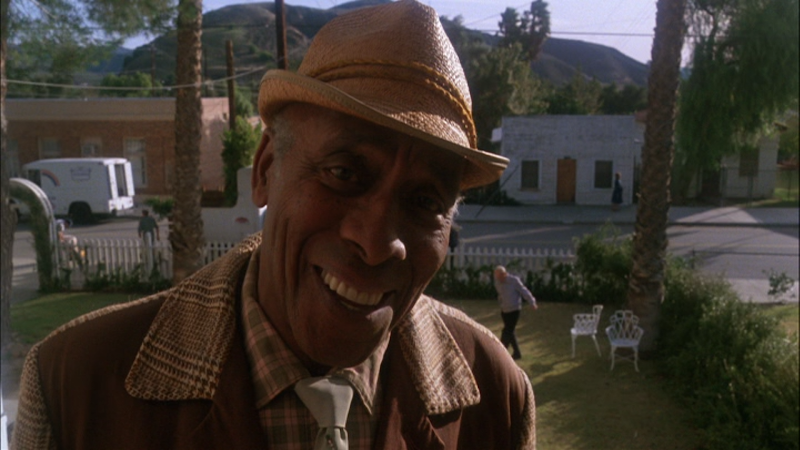
Segment II is based on the season 3 episode Kick the Can, and it's absolutely the sappiest and eye-rollingly nostalgic.  Of course Steven Speilberg did this one.  It's also the most boring, although to be fair; there are plenty of worse episodes he could've chosen.  People forget, between the unforgettable classics, Twilight Zone had some real duds in its day.  Both versions are set in a retirement home where most of the residents have pretty much given up on life and are passing their final moments waiting to die until someone suggests they play kick the can, like they did when they were kids.  When they eventually concede, they become young again - literally.  But in the original series, this character was one of the residents who was naturally pushing back against his fellows' despondence.  Here, Scatman Crothers is well cast put poorly written as a mysterious, magical figure who travels from retirement home to retirement home, restoring everyone's love of life.  As a consequence, I found the original episode more poignant, and the film segment cornier, the one dud in the line-up.
You can take it as a given that the movie has higher production values than the old television episodes, but nowhere is it more apparent than in Joe Dante's Segment III.  In the season 3 episode, It's a Good Life, "the monster" creates a 3-headed gopher and then kills it with his mind... entirely off camera.  But Dante brings to wind life his inhuman creations with ambitious animatronic effects and big, bold colors.  The premises are the same in both: a group of adults live in constant terror of a young boy with unlimited mental powers.  If they displease him in any way, even just in their thoughts that he can read, he can wish them out of existence, or infinitely worse.  Interestingly, the movie narrows the scope to a single family in the boy's house, whereas it's an entire town that lives under his thumb.  Dante also focuses the story with a clear protagonist: a young nanny who gets roped into taking care of the monster and learns along with the audience just what a nightmare she's walking into.  And he gives it a resolution - the show basically explores the scenario and then quietly steps out.  Dante also envisions a delectably madcap, Looney Tunes-inspired world as only he could.  So overall, I'd say this segment is a real upgrade over the original.
I'm not sure I can say the same about the final Segment, based on the season 5 episode, Nightmare At 20,000 Feet, despite it being the big crowd-pleasing show-stopper of the film.  It's by Mad Max's George Miller, so that's to be expected.  But it adheres surprisingly closely to the original, with John Lithgow taking the place of William Shatner as a man with a debilitating fear of flying trying to get through a commercial flight, even as he sees a monster destroying the engines on the wing of their plane.  I suppose the special effects are better - the original monster looked like a man in a fuzzy monkey Halloween costume - and Lithgow is probably a better actor; although Shatner was actually quite effective the first go around.  This is an episode so expertly crafted it didn't need a remake, but it got one anyway.  Therefore this is the least essential segment, but still generally the most entertaining.

But we can't talk about this film without addressing the controversy.  In fact, some potential viewers may feel they still can't view or support this film to this day, because Vic Morrow and two young children died during the filming of the first segment.  Worse, their deaths were not just a tragic accident (though it certainly was that), but the result of negligence, where the actors were working under illegal conditions.  There's been a whole written about the case if you really want to get into it all, and it does have to be said that Landis and the other filmmakers involved were ultimately acquitted of manslaughter charges.  But it's certainly always going to be an awful stain on this film's legacy.
2007 WB DVD top; 2007 WB BD bottom.
And that's probably why it took so long for Warners Bros to to release this on DVD.  But they eventually put it out concurrently with an early (and now quite out of print) blu-ray and HD-DVD all in 2007.  Both the DVD and BD present the film in 1.78:1, though the DVD is slightly stretched vertically, which the blu fixes, revealing extra slivers along the top and bottom.  Over all, this is a decent but slightly dated presentation.  The HD is free of any unwanted glitches or tweaking, but the image is soft and film grain is only lightly hinted at.  It's certainly sharper than the DVD, though.  For a 2007 blu, this is quite good, but it's easy to imagine how much nicer a 1.85 4k scan would be today.  However that's probably going to have to stay in our imaginations.

The DVD includes the original stereo track, a 5.1 remix, plus French and Spanish dubs, as well as optional English, Chinese and Portuguese subs.  The blu bumps the 5.1 remix up to LPCM, but the stereo track stays lossy, which is a disappointment.  It keeps all the foreign language dubs and subtitle options (including, to be clear, the English), and even adds French and Spanish subs.
The only extra found on either edition is the theatrical trailer.  Horror's Hallowed Grounds recently made a video visiting the locations of this film, including yes, the infamous crash site.  But I can't imagine that'll find it's way onto a Collector's Edition anytime soon.  And there was a brief Shudder documentary series called Cursed Films that did an episode about Twilight Zone that sounded promising.  But it turns the series proposes that the films they cover were literally cursed and wind up talking to clairvoyants and all types of silly nonsense rather than just taking credible looks into the unfortunate stories behind these troubled films.  So feel free to skip that.  But given the "cursed" nature of this film, I wouldn't expect a new edition of this film anytime soon, so if you come across one of these blu-rays for an affordable price, jump on it, because they've gotten rather scarce.  Even if you can't bring yourself to watch it, the resale value will be worth it.

The Definitive Taxi Driver

Martin Scorsese's masterpiece, Taxi Driver, has been restored in 4k and released as such on blu for a long time now.  But it's only available on an actual 4k Ultra HD disc now, exclusively as a part of the Columbia Classics Vol. 2 boxed set.  It seems like a surprisingly popular title to hide away in an over one hundred dollar collection, but most of the titles from Vol. 1 are still only available in 4k via that set, so I guess this is how it's going to be for a while.
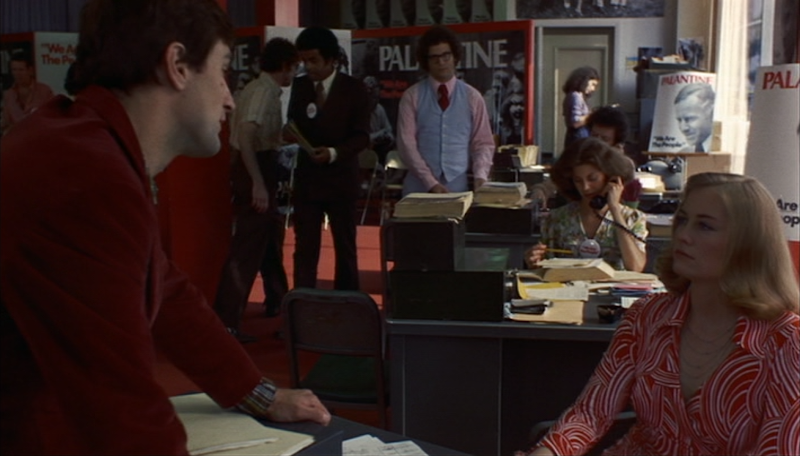
Even 45 years later, Taxi Driver still digs under the skin to probe facets of human nature few other films have even thought to hint at, marking it as one of the indisputable pinnacles of cinematic art; and this is coming from someone who's seen The Killing of Satan.  Writer Paul Schrader and the Mean Streets team proved ideal collaborators, and all the other elements managed to fall just perfectly into place.  There's Bernard Herrmann's final score, NYC's inimitable personality, and all the brilliant supporting players including Albert Brooks, Young Frankenstein's Peter Boyle, a very young Jodie Foster and yes, that's Maniac's own Joe Spinell in that shot above.  People give Cybill Shepard a hard time, but every note she hits is as pitch perfect as everyone else's here.  Obviously, there's a huge pool of talent behind and in front of the camera here (it's easy to forget how powerful an actor DeNiro was when you see all the silly stuff he's committed himself to in recent years), but the planets still had to align just right to achieve these results.
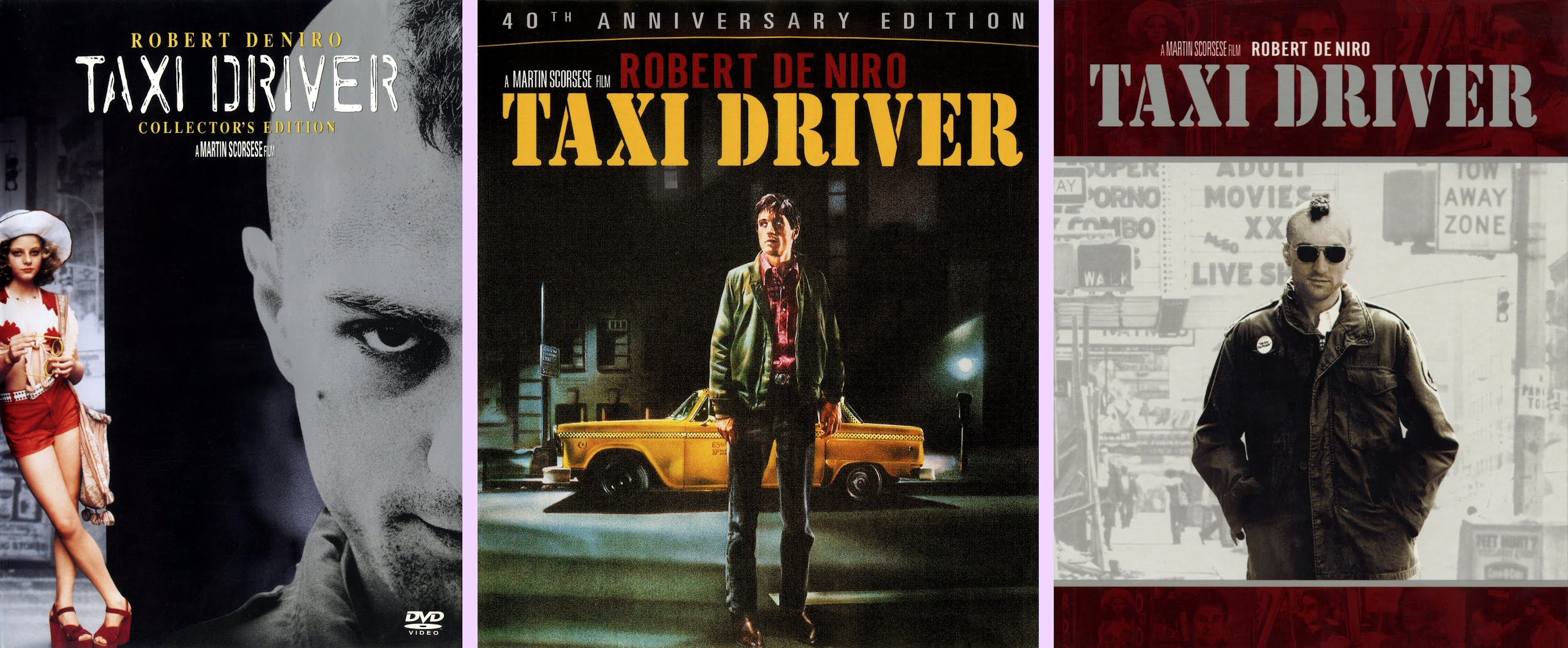
Columbia Tri-Star first released Taxi Driver as an anamorphic widescreen, but completely barebones DVD in 1997.  A disappointing half step backwards for owners of Criterion's special edition laserdisc.  They had to've realized that was pretty paltry, and released a souped-up collector's edition in 1999.  It still didn't have the Criterion commentary, but it had an impressive documentary.  They improved on that further in 2007, with a 2-disc Collector's Edition, this time with a wealth of new extras.  Then it was HD time, and in 2011 came their first Taxi Driver blu-ray.  They released it again in 2013 as a surprisingly barebones "mastered in 4k edition."  It wasn't until 2016 when they really got it right with the 40th Anniversary 2-disc set, which had the 4k master in HD and all the previous extras, including for the first time since laserdisc, that Criterion commentary.  And that was the definitive edition, until now, as Sony has released an ultimate 3-disc set in their Columbia Classics Vol. 2 box, with the film finally on true 4k Ultra HD, plus standard blu and with all the past extras (yes, including the Criterion commentary again).  This is it, assuming they didn't screw anything up.
1) 1999 DVD; 2) 2016 BD; 3) 2021 BD; 4) 2021 UHD.
So yes, like I said before, this film has been restored in 4k for a long time.  In fact, the Columbia Classic book tells us the OCN got its 4k scan back in 2010, and this latest release is still presenting that same restoration, albeit newly color timed for HDR on the UHD.  But first we have a slightly pillar-boxed, distinctly pre-4k 1.75:1 DVD.  The resolution doesn't matter so much when we're talking about a transfer that's going to get mushed down to standard def anyway, and the framing really isn't too different from the properly matted 1.85:1 BDs and UHD (just a little off the left and a bit of extra headroom).  As far as DVDs go, it's fine except for the heavy red push over the whole picture.  So it's nice to see that get corrected along with the much clearer HD boost of the BDs, and again, the minor framing correction.  There's also a slight vertical stretching that gets fixed.  But for 1999, you could've done a lot worse.

Now, the 2016 and 2021 BDs are exactly the same, right down to the 27.1GB encode.  But what's new is the UHD.  Yes, it's the same root transfer.  And it's also true that the previous BD's encode kicks ass, finely capturing grain without the frequent macroblocking.  But look at any portion of any of the UHD screenshots, and the grain is so much clearer and more distinct.  In terms of detail, there's not a lot more to pull out, but in terms of the image matching the original film as opposed to a pixelated digitization, the UHD really succeeds.  The only question is if you'll notice it in motion.  Like, just how big is your TV?  But the difference is there when you look closely enough.
The DVD just features the original audio in 2.0, but it's got a bunch (6) of subtitle options, including English.  The 2016 blu replaces that audio with a DTS-HD 5.1 remix, and adds 11 lossy foreign dubs and offers 22 subtitle tracks, including standard English and English HoH.  So here's where the UHD gets good again.  It adds a couple more foreign dubs and subs, keeps the lossless 5.1 mix, but best of all, it brings back the original mono mix - lossless for the very first time.
So the DVD starts us off with a feature length documentary that talks to just about everybody: Deniro, Scorsese, Foster, Brooks, Schrader, Sheppard, etc.  It's pretty great, and honestly, if this was Taxi Driver's only special feature anywhere, that'd be pretty fine.  The DVD has a couple other odds and ends, including the trailer, storyboards and most interestingly, a 9-minute photo gallery with an uncredited audio commentary by the DVD producer who relays all the interesting anecdotes that didn't make it into the doc.

Jumping ahead to the 2016 doc and the 2021 set (which have all the same extras, except the UHD adds a 20th Anniversary rerelease trailer), we now have everything.  Well except for that photo gallery commentary, but all of those anecdotes wind up getting told, and often retold, in the other extras.  In fact, it's kind of a real problem.  With the Criterion commentary restored, we now have three commentaries, the doc, seven featurettes, an intro by Scorsese, a 40th Anniversary reunion panel, five galleries and two trailers, plus the notes in the book.  So we here the same stories repeated again and again.  By the third or fourth time, it's no longer cute to hear how DeNiro drove a taxi in NY for a week to prepare for the role and was recognized by another actor.  I just wish someone who was overseeing these releases paid attention to what was in these extras and edited how all the redundancy... because there is a wealth of great stuff here, talking to pretty much everybody, revisiting the shooting locations, go over Scorsese's entire career, and even a few weird odds and ends, like a featurette where they interview working NYC cab drivers or talk to Ed Koch.  Some of that's a little excessive, too.  All told, it's both terrific and a real slog, but at least erring towards too much beats erring towards too little.
If you want the best, this is it.  The increased resolution and HDR give us the most authentic picture yet, if you have the set-up to appreciate it.  And even if you don't, getting the original mono track back is a nice little coup for the purists.  Or if you need Icelandic subtitles... those are only on the new UHD.  It may be annoying that this is only available in the box, but fortunately, the whole set is more than worth it.  Could be a good Christmas present for yourself.