Showing posts with label MartinScorsese. Show all posts

Killers Of the Flower Moon Freed From Streaming Jail

Killers Of the Flower Moon, of course, is Martin Scorsese's big, Oscar-nominated epic for Apple TV.  Yup, ten noms but no wins.  My mother asked me if I thought Lily Gladstone got robbed, but nah.  This is by far the superior picture, but in all fairness, Emma Stone really went to great lengths for that role and earned every award she got.  But I digress.  The point is, I was able to watch Killers Of the Flower Moon with my mother this Mother's Day despite not having Apple TV because there's actually an official 4K Ultra HD and 1080p BD combo-pack importable from Italy.  It's not available in any other country around the world, but for whatever reason, Italy's Eagle Pictures have got it.  And like all UHDs, it's region free.  Well, not this one, but there's a region free edition now.  It's complicated.  I'll get into it.
Flower Moon is based on the 2017 non-fiction novel Killers Of the Flower Moon: The Osage Murders and the Birth of the FBI by David Grann.  I haven't read it, but my mother has, so I can tell you it's basically faithful but the big difference is that the book tells the story of the many(!) murders of Oklahoman Osage Indians in the 1920s from the perspective of the FBI investigators.  But in the film, they don't roll in until the final act.  The film really shifts gears at that point, with Jesse Plemons as the lead agent and John Lithgow & Brendan Fraser duking it out in the court room.  Up until that point, and indeed through to the end, the film is really with the victims and the two central perpetrators, played by Robert DeNiro & Leonardo DiCaprio in a very atypical role.  It takes its time at three and a half hours, with this deep, thudding bassline like a perpetual drum beat pounding through the entire picture as it builds to a grim, inevitably unjust peak, where it's pointed out you'd have better hope convicting a man of kicking a dog than killing an Indian.  Yeah, it's grim stuff.  Welcome to America.
So yes, Eagle Pictures released this in January, and they really did it right.  It's a 100GB triple-layer disc (and 50GB BD).  There's the regular combo-pack, a steelbook, and a BD-only version.  They're fully English-friendly, even including English language menus.  But there's one problem: all UHDs are supposed to be region free, but this is one of those rare cases where they were accidentally pressed locked to region B.  If you're on this site, there's a good chance you're region free anyway and can play whatever.  I've got it and it's fine for me.  But Eagle has said this was a genuine mistake and have already released a corrected, truly region free version as part of their 4Kult line.  You can see on the new cover[right], it's got a big "4KULT" printed on the top left-hand corner.  There's no other difference between the two discs, but that's the one you want if you can't play region B discs.  Oh, and yes, all the 1080p BDs are region B locked in every set, which is how they were intended to be.
2024 Eagle BD top; 2024 Eagle UHD bottom.

BD left; UHD right.
As you can see, these are beautiful transfers; Eagle has done a first rate job.  They're presented in the original 2.39:1, with deep, rich colors.  Remember, HDR screenshots (this UHD has Dolby Vision/ HDR10) look darker on a standard def screen like on this blog - though, fun fact: if you click through to the uncompressed full-sized screenshots on an HD monitor, like an IMac, the screenshots do match the original video in color and brightness, too.  The UHD is actually more vivid than the BD.  The brights are more natural and edges are more naturally rendered in the 4k.  You can see in the close-up how details that get eaten away and blocky on the blu-ray are more nuanced and photo-realistic on the UHD.

The film is has lossless DTS-HD 5.1 mixes of the original English track as well as an Italian dub.  There are three subtitle tracks, all removable: full Italian, Italian just for the Osage dialogue, and yes, English subtitles for the Osage dialogue.  So the movie is fully English friendly and can be watched without any foreign subs.  There are a handful of Italian title cards early in the film, but the English subtitles cover those, too.
And yes, there are extras, too... although not much.  There are three brief interviews, with Scorsese, DiCaprio and Gladstone.  They're in English with removable Italian subtitles.  And there are five even briefer featurettes, just one to two minutes each, with interviews, glimpses behind the scenes and clips from the film.  These do have burnt in Italian subtitles below the letterbox and are clearly promotional pieces.  A couple of the interview soundbites even repeat in the featurettes, but they do include a few bits of worthwhile info, like why Scorsese chose to not subtitle certain Osage lines of dialogue, or introducing us to the principal chief of the Osage nation who consulted on this movie.
I'm just happy to be able to be to add this film to my collection... or in this case, my mother's.  It's in full 4k, looks and sounds great, completely English friendly, and the extras aren't anything to get excited about, but better than nothing.  There's been no indication of a US or other release.  Criterion put out The Irishman, so there's hope they'd want to do this film, too.  But that was Netflix and this is Apple, so who knows?  And considering what an expert job Eagle's already done of it, who cares?

The Definitive Taxi Driver

Martin Scorsese's masterpiece, Taxi Driver, has been restored in 4k and released as such on blu for a long time now.  But it's only available on an actual 4k Ultra HD disc now, exclusively as a part of the Columbia Classics Vol. 2 boxed set.  It seems like a surprisingly popular title to hide away in an over one hundred dollar collection, but most of the titles from Vol. 1 are still only available in 4k via that set, so I guess this is how it's going to be for a while.
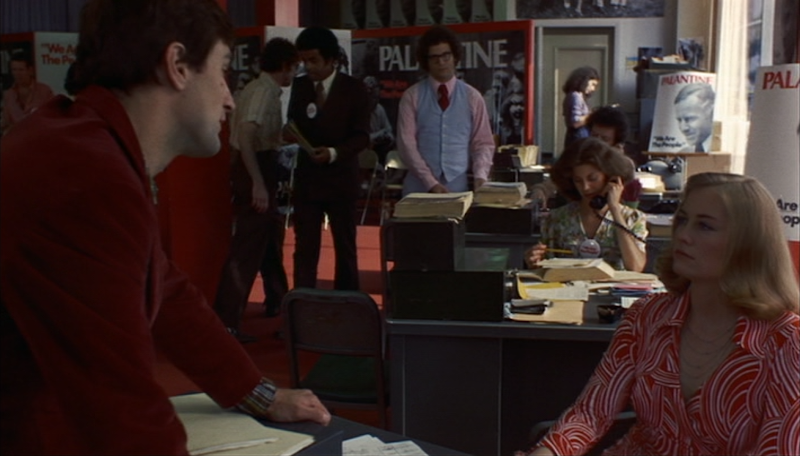
Even 45 years later, Taxi Driver still digs under the skin to probe facets of human nature few other films have even thought to hint at, marking it as one of the indisputable pinnacles of cinematic art; and this is coming from someone who's seen The Killing of Satan.  Writer Paul Schrader and the Mean Streets team proved ideal collaborators, and all the other elements managed to fall just perfectly into place.  There's Bernard Herrmann's final score, NYC's inimitable personality, and all the brilliant supporting players including Albert Brooks, Young Frankenstein's Peter Boyle, a very young Jodie Foster and yes, that's Maniac's own Joe Spinell in that shot above.  People give Cybill Shepard a hard time, but every note she hits is as pitch perfect as everyone else's here.  Obviously, there's a huge pool of talent behind and in front of the camera here (it's easy to forget how powerful an actor DeNiro was when you see all the silly stuff he's committed himself to in recent years), but the planets still had to align just right to achieve these results.
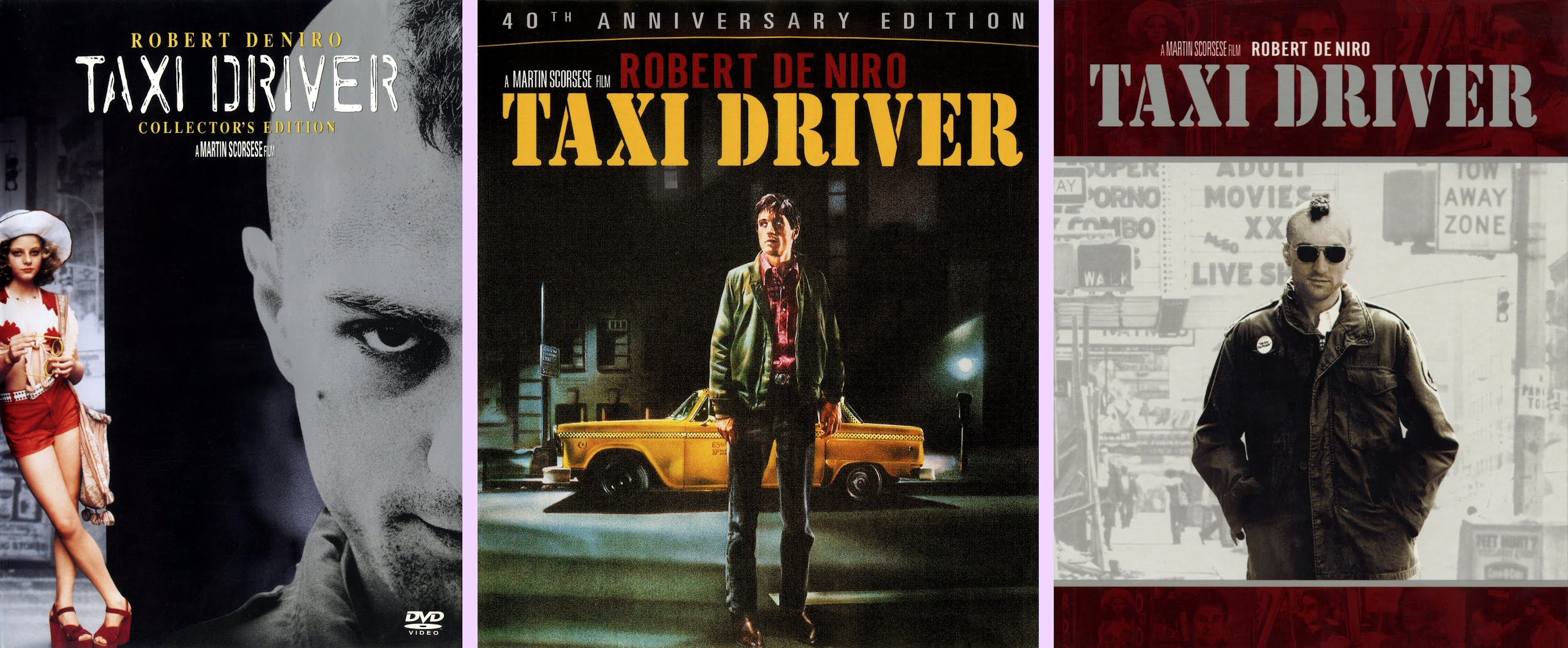
Columbia Tri-Star first released Taxi Driver as an anamorphic widescreen, but completely barebones DVD in 1997.  A disappointing half step backwards for owners of Criterion's special edition laserdisc.  They had to've realized that was pretty paltry, and released a souped-up collector's edition in 1999.  It still didn't have the Criterion commentary, but it had an impressive documentary.  They improved on that further in 2007, with a 2-disc Collector's Edition, this time with a wealth of new extras.  Then it was HD time, and in 2011 came their first Taxi Driver blu-ray.  They released it again in 2013 as a surprisingly barebones "mastered in 4k edition."  It wasn't until 2016 when they really got it right with the 40th Anniversary 2-disc set, which had the 4k master in HD and all the previous extras, including for the first time since laserdisc, that Criterion commentary.  And that was the definitive edition, until now, as Sony has released an ultimate 3-disc set in their Columbia Classics Vol. 2 box, with the film finally on true 4k Ultra HD, plus standard blu and with all the past extras (yes, including the Criterion commentary again).  This is it, assuming they didn't screw anything up.
1) 1999 DVD; 2) 2016 BD; 3) 2021 BD; 4) 2021 UHD.
So yes, like I said before, this film has been restored in 4k for a long time.  In fact, the Columbia Classic book tells us the OCN got its 4k scan back in 2010, and this latest release is still presenting that same restoration, albeit newly color timed for HDR on the UHD.  But first we have a slightly pillar-boxed, distinctly pre-4k 1.75:1 DVD.  The resolution doesn't matter so much when we're talking about a transfer that's going to get mushed down to standard def anyway, and the framing really isn't too different from the properly matted 1.85:1 BDs and UHD (just a little off the left and a bit of extra headroom).  As far as DVDs go, it's fine except for the heavy red push over the whole picture.  So it's nice to see that get corrected along with the much clearer HD boost of the BDs, and again, the minor framing correction.  There's also a slight vertical stretching that gets fixed.  But for 1999, you could've done a lot worse.

Now, the 2016 and 2021 BDs are exactly the same, right down to the 27.1GB encode.  But what's new is the UHD.  Yes, it's the same root transfer.  And it's also true that the previous BD's encode kicks ass, finely capturing grain without the frequent macroblocking.  But look at any portion of any of the UHD screenshots, and the grain is so much clearer and more distinct.  In terms of detail, there's not a lot more to pull out, but in terms of the image matching the original film as opposed to a pixelated digitization, the UHD really succeeds.  The only question is if you'll notice it in motion.  Like, just how big is your TV?  But the difference is there when you look closely enough.
The DVD just features the original audio in 2.0, but it's got a bunch (6) of subtitle options, including English.  The 2016 blu replaces that audio with a DTS-HD 5.1 remix, and adds 11 lossy foreign dubs and offers 22 subtitle tracks, including standard English and English HoH.  So here's where the UHD gets good again.  It adds a couple more foreign dubs and subs, keeps the lossless 5.1 mix, but best of all, it brings back the original mono mix - lossless for the very first time.
So the DVD starts us off with a feature length documentary that talks to just about everybody: Deniro, Scorsese, Foster, Brooks, Schrader, Sheppard, etc.  It's pretty great, and honestly, if this was Taxi Driver's only special feature anywhere, that'd be pretty fine.  The DVD has a couple other odds and ends, including the trailer, storyboards and most interestingly, a 9-minute photo gallery with an uncredited audio commentary by the DVD producer who relays all the interesting anecdotes that didn't make it into the doc.

Jumping ahead to the 2016 doc and the 2021 set (which have all the same extras, except the UHD adds a 20th Anniversary rerelease trailer), we now have everything.  Well except for that photo gallery commentary, but all of those anecdotes wind up getting told, and often retold, in the other extras.  In fact, it's kind of a real problem.  With the Criterion commentary restored, we now have three commentaries, the doc, seven featurettes, an intro by Scorsese, a 40th Anniversary reunion panel, five galleries and two trailers, plus the notes in the book.  So we here the same stories repeated again and again.  By the third or fourth time, it's no longer cute to hear how DeNiro drove a taxi in NY for a week to prepare for the role and was recognized by another actor.  I just wish someone who was overseeing these releases paid attention to what was in these extras and edited how all the redundancy... because there is a wealth of great stuff here, talking to pretty much everybody, revisiting the shooting locations, go over Scorsese's entire career, and even a few weird odds and ends, like a featurette where they interview working NYC cab drivers or talk to Ed Koch.  Some of that's a little excessive, too.  All told, it's both terrific and a real slog, but at least erring towards too much beats erring towards too little.
If you want the best, this is it.  The increased resolution and HDR give us the most authentic picture yet, if you have the set-up to appreciate it.  And even if you don't, getting the original mono track back is a nice little coup for the purists.  Or if you need Icelandic subtitles... those are only on the new UHD.  It may be annoying that this is only available in the box, but fortunately, the whole set is more than worth it.  Could be a good Christmas present for yourself.

Scorsese, Coppola, Allen... Dueling Blus: New York Stories

I remember impatiently waiting for New York Stories to be released on DVD.  I needed it to complete my Woody Allen collection, and I was reasonably fond of Martin Scorsese's segment as well. But then, when it finally came out from Touchstone/ Buena Vista in 2003, it was fullscreen. Really? That's how the combined work of Scorsese, Allen and Francis Ford Coppola was being treated on DVD? You'd expect an edition of these guys' combined work to be on like a solid gold disc in a boxset with a three hundred page, hardbound photo book. But, no, that was all we got, and subsequent foreign releases were no better. I even looked into going back to score an old laserdisc, but it was fullscreen there, too. And the situation stayed that way all the way through the advent of HD until finally, one blu-ray company picked up the title to finally take a second crack at it: Mill Creek.

Update 3/21/16 - 6/27/20: And now Kino's come along with an all new Special Edition.  Or, well, so they claim...
If you haven't seen it yet, New York Stories is a trilogy, with each director making essentially their own short film connected only by the loose theme of taking place in, and capturing the spirit of, New York. There's no wraparound story or goofy bellhop that appears in each story, one film just fades to black and then the next one starts, with its own set of opening credits. There's a general New York Stories title shot at the front and they share closing credits, but otherwise they're really just three completely distinct short films under one title.
Scorsese is up first with a character study about a celebrated painter (Nick Nolte) and his volatile affair with the much younger Rosanna Arquette. She's an aspiring artist, too, and he uses his position to become her lover and mentor. She's untalented and drives him crazy, but he seems to need the conflict of their relationship to make his art, creating an unhealthy trap for them both. Scorsese's technical prowess is on full display here, from the camerawork to the music. Even the character's actual paintings are compelling. And the story's fine, too, constantly moving in the only direction it can go until it reaches its inevitable conclusion. But at the end of the day, I'm not sure we've really learned much or enjoyed our time with these unpleasant characters. There's a pretty powerful scene where Arquette tests her own power over Nolte in front of some police officers, and then he gives short monologue about how he's nothing to her. But most of the rest of the story is just kind of waiting for everything that we know will happen to play itself out.
Then we come to Coppola's film, which is downright infamous. It's co-written by his daughter Sofia Coppola, and plays like a silly children's fantasy. It almost seems charmingly forgivable that he's filming the story his little girl. It's about a super rich eleven year-old who lives a lavish, fanciful life in the city. She has a giant costume party inside a hotel with elephants and a thousand friends. It's basically one big party rather than a story, except there's some kind of tacked on children's movie plot tagged on where she somehow winds up in possession of a prince's jewels and so some cartoonish thugs, including Chris Elliot, are after her. I used to think Sofia wrote the party stuff as a toddler and Francis added the jewel heist thing, like a necessary adult alteration to make the film more conventional. But then I realized she was fully grown at the time of New York Stories, and they did this just the year before Godfather III.
Still, I don't hate it. If you look past the royal jewels bit, it's still a fun exploration of a child's fantasy life, where her servants are also her friends and everybody performs choreographed dance numbers. She fixes her father's life, helps the homeless by giving them candy and organizes the most opulent party, filmed with all of the production values at Francis's command. The fact that it just stops in its tracks to roll around in celebration of its mise en scene actually reminds me of Sofia Coppola's later film, Marie Antoinette. And of course the biggest criticism is that it's self indulgent wish fulfillment, but just like Asia (who was also in Marie Antoinette) Argento's Scarlet Diva, that's what makes it interesting. Because it lets you see inside their psyche in a way they're probably not even intending. But, on the other hand, it's still pretty bad in a lot of critical ways and often feels like one of a hundred direct-to-video Home Alone knock-offs.
In contrast to that, Woody Allen's segment is everything his fans want in a film. It's delightful. Allen his having problems in his relationship because of his overbearing mother. But when she gets called on stage at a magic show, the magician makes her disappear - but can't make her reappear! At first it's a perfect stroke of impossible luck, but it turns into a nightmare when she reappears as a giant, floating head that looms over the city, taking her interfering nosiness to a God-like level. It's a perfect short film, and has a wonderful cast including Allen himself, Mia Farrow of course, Julie Kavner, Christmas Vacation's Mae Questel as the mother, a young Larry David, and a cameo by Ed Koch as himself. I mean, come on, you couldn't do a film called New York Stories in the 80s without putting him in at some point.
1) 2003 Buena Vista DVD; 2) 2012 Mill Creek BD; 3) 2019 Kino BD.
Yes, Mill Creek has finally released New York Stories in widescreen! The DVD is kind of an open matte pan & scan mess, but it at least gives you some extra picture on the top and bottom for novelty value. But it also cuts a lot off the sides, and Mill Creek's restores that by presenting the film in its OAR of 1.85:1. Colors are also warmer and more natural, and while there's not a wealth of new detail, the picture is stronger and clearer in HD. For example, you can finally read the numbers on that camera's digital display in the second set of shots. Sure, I could see this being improved with a new 4k scan, but this blu here is 1080p, no interlacing, and perfectly respectable.

I guess that's why Kino felt they didn't need to make a fresh scan for their new Special Edition.  They've made the image slightly darker, but that's it.  Same transfer.  They have bumped the disc itself up from single layer to dual layer, but MC's encode was actually fine, so it's hard to pick up any real improvements in the encode.  The slightly darker picture does make grain a little easier to discern in bright areas, but outside of a direct side-by-side comparison, you'll never notice a difference.
One way you can usually trump a Mill Creek release is to give it lossless audio and English subtitles, but Mill Creek actually did New York Stories up right this time and had both, which is more than you can say for the DVD, which just had a lossy version of the English, a French dub and no subs.  So Kino does have the lossless DTS-HD track and optional English subtitles, exactly the same as Mill Creek.

And yeah, unfortunately this film has always been barebones. Sure, Woody Allen has never been one for extras, but Coppola and Scorsese are usually good for them. But it's just not to be for this film, I guess. Mill Creek has at least secured the theatrical trailer, which is something the DVD didn't even have.  And Kino's Special Edition?  Also, nothing but the trailer.  Yeah, you read that right.  When they announced this title and released the specs, they promised an "Audio Commentary by Film Historian Jim Hemphill," which is thin grounds to dub a release a "Special Edition" on its own, but it ain't here anyway.  All they have is the same trailer as the Mill Creek, plus two bonus trailers.  But yes, even after the commentary was dropped, to this day in 2020, Kino still lists this as New York Stories (Special Edition) on their website.
And so concludes The Case Of the Special Edition That Never Was.  Still, Kino's blu is a fine blu-ray edition of New York Stories.  Technically, it's even better than Mill Creek's... I mean, the slightly darker image is a matter of personal preference, but dual-layer beats single-layer, right?  That's just science.  For a single film with no extras, though, you're probably paying more for the extra peace of mind rather than an actual upgrade.  I mean, do not double-dip.  This is only if you don't already own the film, Kino's is the marginally superior option.  And even then, you may still want to spring for the Mill Creek to save a few bucks.

What To Get the Movie Lover Who Thinks He Has Everything?

How do you shop for the die-hard cinephile who already has a massively impenetrable movie collection?  How about a set of otherwise completely unavailable short films by Woody Allen, Martin Scorsese, Spike Lee, Ed Burns, Kevin Smith and even Jerry Seinfeld?  You've probably never even heard of 'em, but yes, such a collection exists!  It's a DVD set of The Concert for New York City, a huge concert that was held and filmed to benefit victims of the 9/11 attack.  And yeah, most of it's what you'd expect: a big stadium concert featuring a ton of musical performances by major acts like Elton John, The Rolling Stones, Bon Jovi, Jay-Z, David Bowie and Paul McCartney.  It's hosted by Billy Crystal and features little speeches and bits by celebrities like Richard Gere, Mike Myers, Mark Wahlberg and Hillary Clinton.  It's almost five hours long, spread across 2 discs.  It's all for a great cause, but in 2020, even if you're a big fan of these bands, you're probably going to want to play their properly recorded and mastered albums rather than load up these live versions on an interlaced DVD with fifteen minutes of jingoism between every two songs, right?
But here's where it gets interesting.  Besides all the rock stars, politicians, comedians and movie stars they got to appear at this concert, they signed up some of New York's (and NY adjacent) best filmmakers to contribute new, original films.  And thankfully, they don't just show us the films projected up on the monitors from far away as the live audience would've seen them.  The DVDs intercut the actual films into the concert footage.  So, in short, we get to just watch the movies properly.  And these are proper films.  They didn't just film Woody Allen sitting in front of a fireplace giving his best wishes and urging everyone to donate.  And unlike these festivals which just ask their attending filmmakers to film a little something on their iphones for them to stitch together into an exclusive program, they've actually produced legit short films, with scripts and actors.  Well... some more than others, but we'll get into that.
First up is Martin Scorcsese.  Leonardo Dicaprio and Robert Deniro introduce it on stage, and then we cut away to his film, The Neighborhood.  He's made a documentary about, obviously, the neighborhood he grew up in.  These are all pretty brief, but he includes vintage footage and then goes around visiting locations and people that inspired, or were directly depicted, in his early features.  For example, he shows the first shot on his first film, a shot looking down at a woman chopping meat in a butcher shop.  Then, he goes and finds her, now 97 years old, to visit the shop she still owns.  Sure, all these films are here to celebrate New York, but you don't have to be in the market for flag waving to get something out of this film.  Anyone interested in the films of Scorsese should find this microcosmic look into origins should enjoy this.
The best of these films, I'd say, is Woody Allen's Sounds From the Town I Love, where he gets a whole ton of great New York actors like Bebe Neuwirth and Griffin Dunne to read brief snippets of humorous dialogue one might theoretically overhear in the Manhattan.  It's certainly not his only one, but it's probably his sweetest love letter to NY, and it showcases his great comic writing.  I guess Woody knew this would play for a large, broad audience, because this is a real crowd pleaser.  And yes, that is Tony Roberts coming back for one final (his seventh) appearance in a Woody Allen film!
After that, admittedly, the films become more for completists only.  Spike Lee makes an attractive looking ode to the New York Yankees with his film, Come Rain Or Shine.  It's the only film to go wide for a 1.83:1 aspect ratio (everything else is 1.31:1).  But it's essentially a silent documentary set to a single song.  That brings me to Ed Burns low effort Lovely Day, which is essentially a music video for the song "Lovely Day" set to stock footage of smiling New Yorkers.  That was the only entry I found genuinely disappointing.  Kevin Smith's film, Why I Love #%!&@ New York, reminds me of those man-on-the-street segments he used to do for Leno, except this is clearly scripted with actors.  He goes around asking people what they think of "the bridge and tunnel" crown of New Jerseyians who routinely invade their city's hot spots on the weekend, and they trash them.  But then it ends sweetly when they all remember how New Jersey rescue workers contributed to the 9/11 disaster recovery.  Finally, Jerry Seinfeld apparently actually filmed his own film, The Greatest City On Earth, where he does some reasonably amusing comic bits on the street with locals.
So really, the Scorsese and Allen films are the only two essentials in this collection.  But most of them (as in: all apart from Burns') are at least worth the watch once you've got the set.  There's also a brief excerpt from a documentary called New York by Nic Burns, brother and frequent collaborator of Ken Burns.  Unfortunately, the films are interlaced just like the concert footage.  And when Spike Lee goes widescreen, I'm sure you don't need me to tell you it's non-anamorphic.  The DVD menus happily allow you to jump easily to each individual film, or to watch a version of the concert that only plays the musical performances.  There are no extras apart from a fold-out insert that gives credits for all the songs but doesn't cover the films; and apparently this DVD set includes several songs that were cut out of the CD set.  This is long out of print, so unfortunately your purchase won't go to help the relief fund anymore, but you can find this used pretty cheap, and it's a great way to get some genuinely worthwhile short films by some of your favorite filmmakers you won't find anywhere else.  For the serious cinephile, that's a neat little stocking stuffer.