Let's shake things up for the conclusion of
Fellini Week, shall we? Besides covering one of Fellini's best known and well regarded films, 1963's
8 1/2, which I think would be a worthy conclusion on its own, I thought I'd pair it up with
Ingmar Bergman's barbed 1964 response,
All These Women.
Wikipedia calls it a "parody" of
8 1/2, which I wouldn't say is quite accurate, and
theretroset.com describes it as "a plot largely inspired by Federico Fellini's
8 1/2," which is getting warmer. The relationship between the two films is both more distant and indirect, yet more critically pointed than that. On the surface, they're entirely different and essentially unrelated, but the film seems to exist as a criticism of the attitude Fellini displays towards women in his picture.
Update 12/24/19 - 6/4/21: Adding the
Essential Fellini boxed set edition.
Update 4/29/26: What's up, film nerds? Not satisfied until your Fellini is in 4k? Me neither! I got your back with Criterion's 2024 UHD release of
8 1/2. What's that? Not nerdy enough? Well, guess what? Since it's Update Megaweek, I went back and wrote a whole, long thing on the 1986 version of
Northanger Abbey. How ya like me now?
There have been other filmmakers to wrestle with
8 1/2 as well.
Peter Greenaway's
8 1/2 Women is an obvious one, and
Woody Allen practically remade the film with
Stardust Memories. And it's been argued that nearly any self-reflexive film about filmmaking is inherently some sort of nod to
8 1/2, from
The Pickle to
Lucio Fulci's
Cat In the Brain. Now, it has to be said that Fellini didn't exactly invent narrative movies about movie making... a couple of the more obvious examples include
Singin' In the Rain,
Sullivan's Travels and heck, even
King Kong. But he definitely blurred the meta lines even further between the picture and the frame by making his movie about his own (albeit somewhat fictionalized) specific struggles to create the particular film we're watching, and we meet multiple versions of the same characters and events: as they're depicted in the film, and how they're depicted in the film they're creating within the film.
But what makes
8 1/2 so compelling is that, even if you took all of that invention and novelty which causes
8 1/2 to be so recognized and put it aside, the film still works as a dramatically potent character study. It's ability to capture humanity is up there with the greats,
Nino Rota delivers one of his most iconic scores, and
Marcello Mastrionni is a master at multi-dimensionalizing the role of the director, while still projecting a kind of unreal, hyper-cool Hollywood mask of a man as the same character - the perfect performance for the sort of conflicted, multi-tiered storytelling Fellini is experimenting with. And sure, Fellini's portrayal of women here is... not great. I mean, to some degree I'd argue that the most infamous scene, where Mastrionni whips at the women in his life who are all living in a personal harem isn't a depiction of a literal man and whipping actual women but someone fighting with the images he has of them in his own mind. It's clear in the film this isn't meant to happen outside of his own head, and there are a few nods towards objective fairness pushing back against the character's sexism (for example, Mastrionni is told he's being a hypocrite because he, too, has past the age that he considers worthy of amorous obsession). But, yeah, to watch it today, you do have to bear in mind that this was made by an older man in 1960's Italy when the culture was still struggling with equal rights and its relationship to women (the International Feminist Collective wasn't even started there until almost a decade later); Bergman wasn't keying into nuthin'.

So now
8 1/2's history on US DVD has a bit of a curve ball in it. Criterion first issued it in 2001 as a 2-disc special edition. And when it was time for the film to come out on blu, Criterion was ready with their 2010 blu, with additional extras and everything. Standard story. Oh, and they also included a barebones edition in vol 5 of their hefty Essential Art House DVD sets. But for whatever reason, in 2002, Image also released
8 1/2 on DVD in the US. Widescreen, but no extras, single disc, just a year after Criterion's. Why? As a budget alternative? Maybe, but it's list price wasn't particularly low. The rights for
8 1/2 must've just been a little freer than usual, I guess. You don't see that happening with most other Criterion titles. Anyway, it's an odd little curiosity, so I just had to get all three versions to compare for Fellini Week. And then, of course, I also had to include the new and improved 2020 BD edition, still only available in their Essential Fellini box set. and their latest 4k Ultra HD set from 2024.
 |
1) 2001 Criterion DVD, 2) 2002 Image DVD, 3) 2010 Criterion BD,
4) 2020 Criterion BD, 5) 2024 Criterion BD, 6) 2024 Criterion UHD. |
First off, there's nothing egregiously wrong with any edition. They're all uncut, widescreen, anamorphic and progressive (as opposed to interlaced). Size-wise, though, each iteration of
8 1/2 seems to fluctuate a bit. Criterion started us off with a reasonably credible aspect ratio of 1.78:1, just slightly windowboxed to protect for overscan, as Criterion was wont to do in their early days. Image's DVD then zooms in tighter for a clearly inaccurate AR 1.75:1. In 2010, then Criterion widened their image even further to 1.85:1, revealing more on all four sides compared to Image's disc, but primarily just on the left compared to their initial DVD. Criterion's DVD is a bit brighter than the others, and Image's has dirt and debris (look at
Barbara Steele's cheek) that Criterion cleaned up.
As for the HD, well, Criterion's booklet tells us the blu was "created on a Spirit Datacine from a restored 35mm fine grain master positive made from the original negative." And it's obviously a substantial boost in clarity compared to the DVDs, which look fairly equivalent in this regard. But in terms of film grain and fine detail, well it's inconsistently captured and occasionally blocky, and some shots seem to have been artificially sharpened or otherwise tinkered with... A thoroughly satisfying upgrade in 2010, but not quite up to the top standards of today.
 |
| ltr: 2010 Criterion BD, 2020 Criterion BD. |
Criterion's 2020 blu is a 4k scan taken from the original 35mm camera
negative. Probably the first thing you'll notice is brighter shadows,
revealing detail that was harder to discern (though to be fair, wasn't
crushed) on the older disc without over-brightening the whole picture.
Still matted to 1.85:1, the framing pulls out to reveal even more picture. The slight
blocky pixelation I mentioned has been improved, and the tinkering (you
won't notice it in the shot of Barbara, but look at Marcello and the
tiles behind him in the first set of shots) is gone, which is a relief. Look at the haloing on the left. So, yes, it's now
been brought up to the standards of today.
...Which is why I was so surprised to see the haloing back in 2024! Yes, for whatever reason, the 2024 2-disc doesn't include a new blu, or even the 2020 blu, but the old 2010 blu. WTF? Fortunately, it's just the secondary disc packaged with a superior, next gen disc. So I'll only really use the 1080p disc for the extras. But if you haven't gone 4k yet, be prepared not to get the newer transfer in the latest set. The important thing is that the UHD has the new scan, and on an actual 4k disc, making it the best available version available. No HDR, but grain is much clearer and more distinct, and the boost in resolution is genuine for anyone with a set big enough to appreciate it.
All these editions simply offer the original Italian mono track with
optional English subtitles, though the blu-rays and UHD bump it up to lossless
LPCM and take a second pass at translating the subs for a more natural,
grammatical read.
 |
| Fellini: A Director's Notebook |
Image's DVD is barebones - not even the trailer - but Criterion gives
this film the treatment it deserves. Their 2-disc set starts out with
an enthusiastic introduction by
Terry Gilliam, followed by an audio commentary by Fellini's friend
Gideon Bachmann combined with essays by scholar
Antonio Monda read by an actress. It's quite impressive, but not so much as the inclusion of
Fellini: A Director's Notebook,
a 1969 TV movie by Fellini where he goes over his process of making
films. I've seen this described as a documentary, but in fact, it's as
fanciful and unreal as
Roma or
Intervista, with scenes of
truckers magically becoming Roman centurions and a host of far-out
characters who are presented as being authentic (i.e. hippies who've
crashed his film set) but are clearly actors playing scripted roles.
Unfortunately, the picture quality leaves a lot to be desired
[see above], but the impression I get is that we're lucky any version of it survives at all.
Anyway, that's far from all. There's a substantial, 48 minute
documentary on Nino Rota, and excellent on-camera interviews with
Sandra Milo,
Lina Wertmüller and cinematographer
Vittorio Storaro. There are also two photo galleries, the trailer, and a booklet with notes by Fellini himself,
Tullio Kezich and
Alexander Sesonske.
Criterion's blu, then, includes all of that but also adds a new, almost
hour long documentary about Fellini's original intended ending for the
film (including photos) and all the changes that were made along the
way.
The 2020 blu has all the same extras (except technically,
Fellini's Notebook has been moved to another disc in the set), with nothing new except, you know, all the other films and stuff in the collection. But nothing more for
8 1/2. And the same goes for the 2024 combopack, nothing new, nothing taken away. In fact, that may well be why they gave us the 2010 BD instead of the 2024 BD: because
Notebook was moved off the 2020 BD and they didn't want to lose any extras in 2024. So, um, thanks?
Now the first time I saw
All These Women, I wasn't aware of any connection to Fellini.
Roger Ebert
famously called this the worst film Bergman ever made, and I wonder if
he knew the intention either. Because it's certainly never overtly
stated, or even hinted at enough to suggest Bergman could feel the
audience has to be acquainted with
8 1/2 to appreciate
All These Women. There's no nod to the meta aspect of
8 1/2
at all, nobody's a filmmaker or speaks of filmmaking in the story, and
the look and tone of the film are worlds apart. This one's about a
stuffy music critic who arrives at the estate of a revered composer to
interview him, but is constantly being lead around and misdirected by
the collection of devoted women who all live there with him. The women
in
8 1/2 never all lived with the director like that, or fawned
over him in such a way, except in that one sequence which was presented
as a fantasy. So the attitude Bergman seems to be rebelling against
(and arguably with delusional levels of hypocrisy, given what we know of
his own love life and relationships with his various leading ladies) is
more just a general attitude, which could be found in any number of
films just as much, if not moreso, than in
8 1/2. But still, revisiting
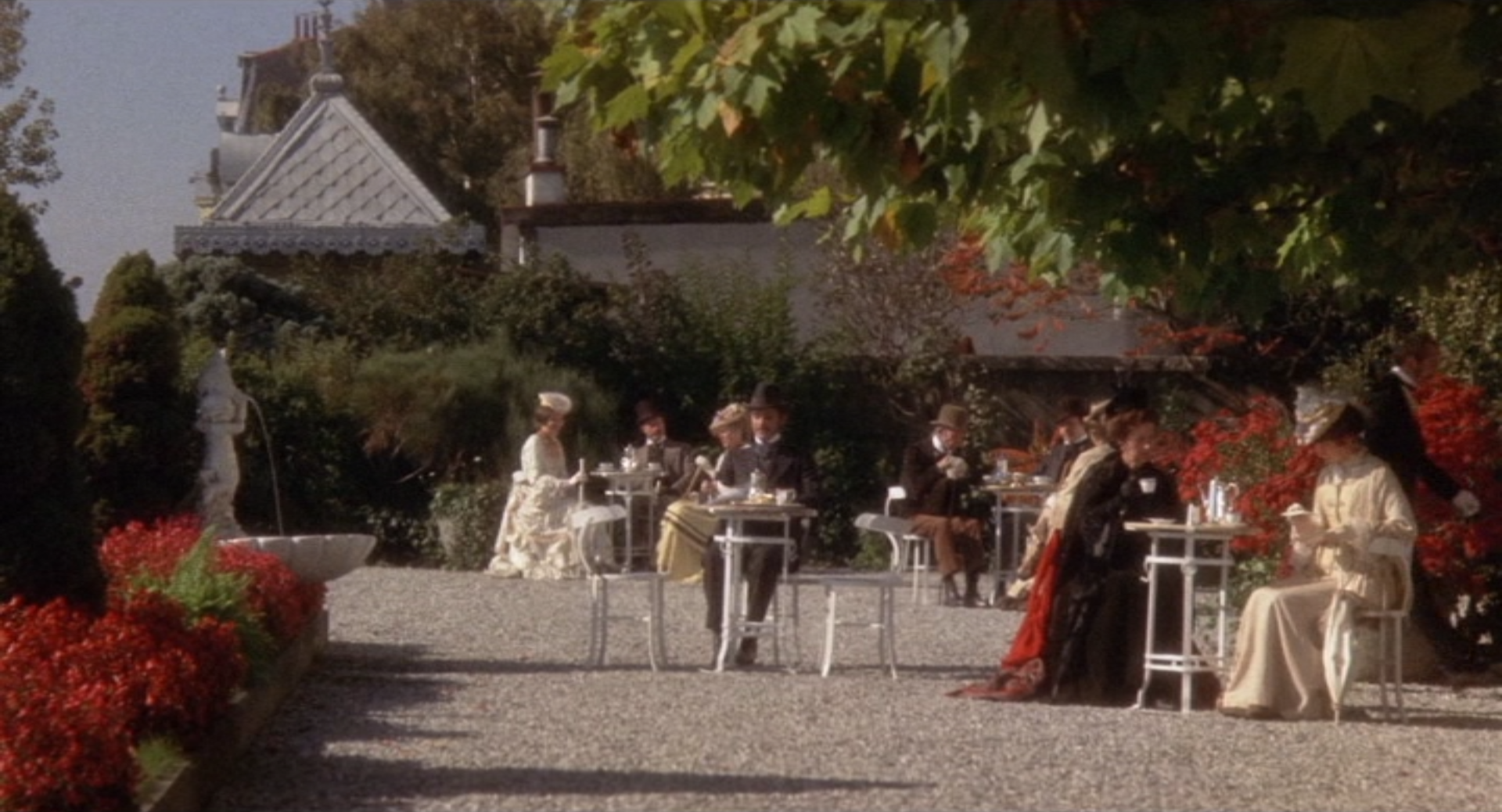
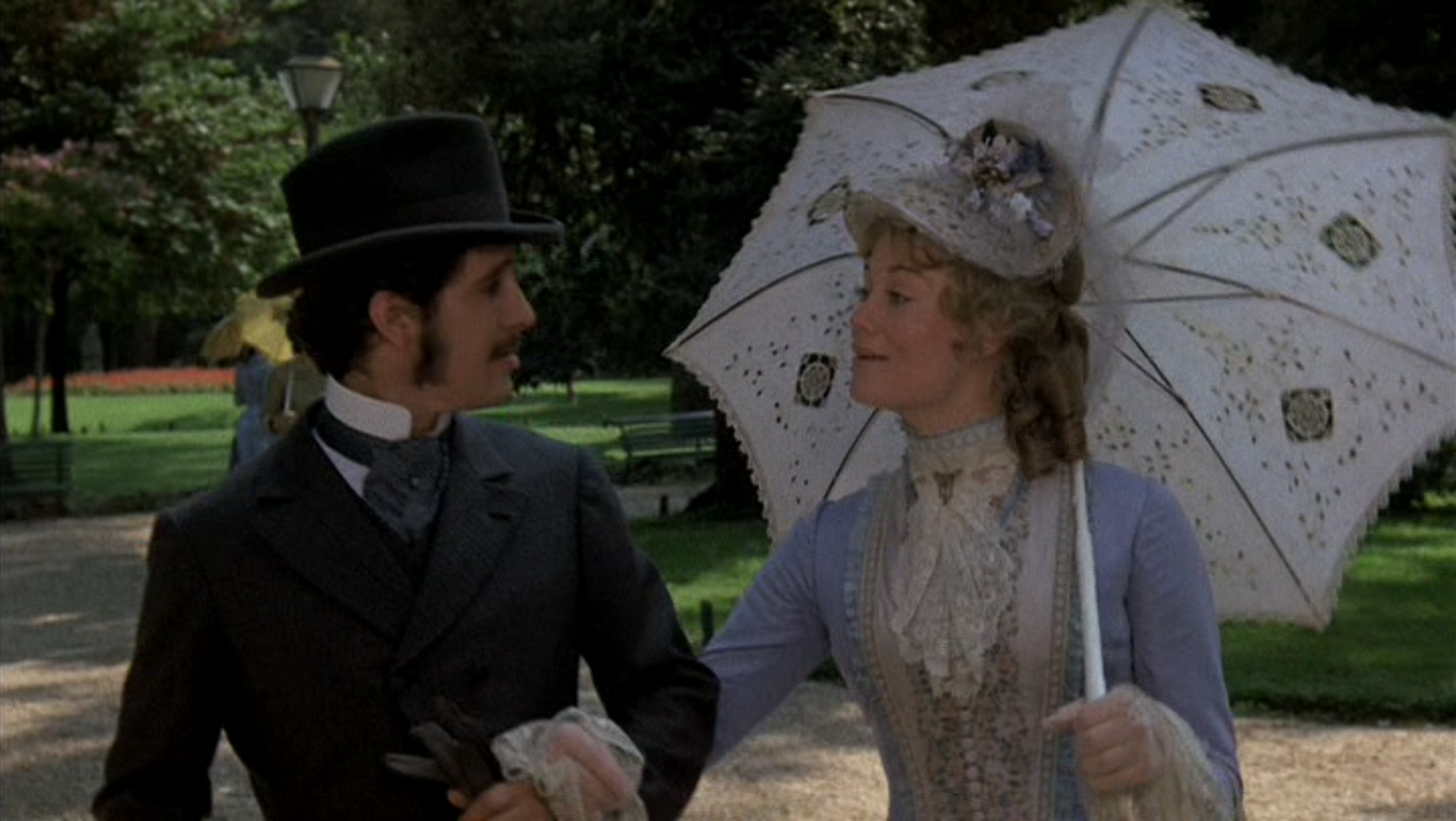
All These Women with Bergman's targeted intentions in mind, things do feel a little clearer and the satire a little more pointed.
This film's certainly an odd duck. It has a very still look, almost
like a film in tableau, where the camera delicately frames each shot and
then does not move until the next scene. This style is nothing like
what we see in
8 1/2, so it doesn't come from that, but it's a
style that absolutely draws attention to itself (including one or two
sequences in black and white). The script was actually co-written by
one of Bergman's greatest actors,
Erland Josephson, who doesn't appear in this one. But we do get both
Andersson sisters and the criminally underrated
Eva Dahlbeck.
This is one of Bergman's rare comedies, a very heavy-handed slapstick
farce, with the score repeatedly reverting back to the tune of "Yes! We
Have No Bananas" as our leading man knocks over statues or stumbles down
stairs. It's sometimes amusing, but most of the humor (when it works,
which isn't consistently) is more understated and hidden in the subtext.
It's frantic enough to always hold your interest, and it's undeniably
attractive to gaze at, so even if it's Bergman's worst film, that still
places far above a great many other films out there with far fewer
merits.
For ages,
All These Women only had one English-friendly release:
the region-locked 2004 Tartan DVD in the UK from their Bergman
Collection. But Criterion changed all that by giving the film it's
first US release and the HD debut by including it in their massive
Ingmar Bergman's Cinema boxed set in late 2018.
 |
| 1) 2004 Tartan DVD; 2) 2018 Criterion BD. |


Criterion widens out Tartan's ever-so-slightly windowboxed 1.33:1
fullscreen transfer just a tad to 1.38:1, which reveals a tiny sliver
along the edges, but mostly crops in the bottom edge. Criterion's book
informs us that this one is a 2k scan of the 35mm interpositive, and
while it isn't the most impressive transfer in their box (grain at times
seems smoothed away, as if their scan didn't even capture it, and the
bright white areas might've yielded a little more detail if they had the
OCN), it's a huge leap beyond what we've had before. Their BD displays
more natural colors and much sharper detail compared to the old DVD
with it's excessive contrast and a softness which suggests a videotape
source overlayed with a little edge enhancement. It's a fine BD
transfer, just not on the cutting edge. Meanwhile, the DVD was crying
for an upgrade. I mean, look at the first set of shots. You can't even
tell the men are wearing different color suits on Tartan's disc.

Both editions just include the original Swedish mono track with optional
English subtitles, though Criterion's BD bumps theirs up to a heartier
LPCM track.
Disappointingly, both discs are also essentially barebones. Tartan
threw in a couple of bonus Bergman trailers and an insert with notes by
Philip Strick.
And Criterion... well it includes all the other films and generally
Bergman-related extras that are part of the box, but nothing
All These Women-specific
except for the essay in their massive book. An expert commentary or
"visual essay" talking about the film's connection to
8 1/2 would've been nice, even if they couldn't have solicited any interviews, but oh well.
If it were any kind of competition, Fellini obviously won this round,
but they both earned their place in cinema history. Like, if you bought
the big Criterion box but skipped
All These Women because of its reputation, don't do that. It's fun, just not on the same level as, say,
The Seventh Seal. And however much
8 1/2 might've gotten Bergman's back up at the time, his rejoinder couldn't have been too spitefully meant, as the pair
announced a few years later that they planned to make a film together. ...It didn't happen, but still.