Showing posts with label AndreiTarkovsky. Show all posts

Andrei Rublev Sanity Check

Andrei Rublev is a medieval painter known for his Catholic frescoes, and this is his three and a half hour, black and white life story.  Wait, where are you going?  No, 1966's Andrei Rublev is actually a fascinating early work by Andrei Tarkovsky that's full of life.  We've got naked pagans, invading mongrels, exhilarating balloon rides reminiscent of the opening of 8 1/2, sadistic torture and great art.  Not to over-promise on the cheap thrills, this is a beautifully shot art film with lots of discourse on religious philosophy.  But it's not some boring biopic; it's a vibrant, impassioned film; a genuine masterwork if ever there was one.
a grim moment only seen in The Passion of Andrei cut
Criterion first released it on DVD back in 1999.  Artificial Eye later released it in the UK in 2002, and eventually beat Criterion to the blu-ray punch in 2016.  But both of their releases was a shorter cut, which... well, let's get into that.  Tarkovsky first released a 205 minute version (alternatively titled The Passion According To Andrei), which the Russian government censored, and made him make a 185 minute version.  So Criterion had released the uncut version and Artificial Eye released the cut version.  BUT, in later years, Tarkovsky has said in interviews that he prefers the shorter, tighter cut, so that's arguably his director's cut.  Fans were divided.  But in 2018, Criterion made the best choice and released both cuts on blu-ray in a definitive new, 2-disc set.
1) 1999 Criterion DVD; 2) 2018 Criterion 185m BD; 3) 2018 Criterion 205m BD.
All three discs present the film in roughly 2.35:1 (the 1999 DVD is 2.37:1), though you can see the original DVD was non-anamorphic, which is why I left the negative space around the first set of shots.  It's also cropped tighter around the sides compared to the blu-rays, both of which were restored in 2k. All the booklet says is that, "[t]his new digital transfer was created in high-definition resolution on a Spirit Datacine film scanner from a 35mm internegative and restored by Mosfilm."  It doesn't even hint at there being two different transfers, though these scans are clearly dissimilar (though they're both 2.35; you can see the framing is not identical).  My guess is that the longer version was scanned from a film print; it's much lower contrast, shows considerably more weathering, and fine detail like film grain is smoothed over, unlike the shorter cut.  They both blow the old DVD away, though, so even though it's inferior, you won't be dissatisfied cranking up either disc.

All three discs have the original Russian mono, in LPCM on the two blus, with optional English subtitles.  The subs on the extended cut blu-ray, unfortunately, are burnt in.  Though it's not too offensive, as we English speakers are unlikely to ever watch this film without subtitles, but they're optional on the shorter cut and the original DVD, which tells us the probably had a different source for the extended cut in 1999 than in 2018.
Now, the original DVD featured a partial (understandable, given this film's length) audio commentary by film scholar Vlada Petric.  It also had a featurette where Petric addresses the camera directly, interspersed with excerpts of Tarkovski being interviewed, taken from the 1984 documentary A Poet In the Cinema.  And it includes a fold-out booklet with notes by critic J. Hoberman.

Criterion updated their release for 2018 with a bunch of new stuff.  There;s a new featurette that interviews cinematographer Vadim Yusov and actor Nikolai Burlyaev (he played Boriska and had previously performed the titular leading role in Ivan's Childhood) and two vintage 1966 featurettes: one about the writing of the script, and a shorter one showing Tarkovski at work on location.  Then there's an interview with one expert and a visual essay by another.  There's the trailer, and they've also included Tarkovski's entire student film (many previous Tarkovsky films included a five minute clip), 1961's The Steamroller and the Violin.
1) 2002 Facets DVD; 2) 2018 Criterion BD.
Steamroller
had previously been available as a stand-alone DVD release from Facets Video, which yes, I do have.  It's completely barebones (except for some text menu stuff), so we just had the 46-minute film itself on the disc.  And as we can see here, it's clearly been restored since then.  Facets presents the film in 1.30:1, while Criterion offers it at 1.41:1.  Perhaps the biggest distinction is that the DVD was interlaced, which the BD corrects.  But we can also see the colors are less washed out, detail is clearer and there's even some soft film grain, which has been totally smoothed out of the SD transfer.  The two transfers seem to be taken from the same source, noting the identical film damage, but this is clearly a new scan giving us the film in proper HD.  Both discs just present the original Russian mono in lossy 2.0, but the subtitles are now removable, where they were previously burnt into the Facets.

Steamroller's not a terribly moving film or anything.  It's more of interest to Tarkovski scholars than general film fans (though I'm sure it's much better than anything most of us smart-ass critics could make, 'ey?), but it does display some of his talents and artistry that would flourish in his later works.  So it's nice to finally get it in HD.  The blu-ray also carries over the commentary, and upgrades the booklet to a fold-out poster with the same notes on the back.  But they did lose the featurette, which is a shame, since that gave us a chance to hear about this movie from Tarkovsky himself.  Maybe Criterion plans to slap the entire Poet In the Cinema doc on a future release?  Anyway, this is such an essential release that never seemed to get the coverage it deserved.  Blu-ray.com didn't even review it.  Are we living in crazy times?

Tarkovsky's Mirror

This summer is a hot one for exciting new releases.  It had been a bit of a dry season this year, but my last couple of posts have been new releases, and believe me, they're gonna keep on rolling for the next month and beyond.  For today we've got Criterion's brand new and long awaited release of Andrei Tarkovsky's Mirror from 1975, my personal favorite, and probably his objectively best film (though I'd hear arguments for Andrei Rublev).  2021 is finally taking off!

Update 8/24/24: Update Week 2024 winds to a close, but not before we squeeze in one more vintage DVD edition.  Today we're including the original US DVD of Mirror from Kino Lorber to our comparisons.  I had already discussed their alternate color timing in relation to the Ruscico and Criterion releases, so it's good to finally have shots of it on the page.
It's certainly his most simple and focused story, without the artier abstractions of Sacrifice or the mystifying sci-fi of his most famous films, but deeper than his Ivan's Childhood or his early works.  Well, I guess on paper it could be seen as a lot to work through. You've got the film traversing through two distinct timelines at once: the protagonist's adult age with his ex-wife, and his childhood age with his mother, who's (mostly) played by the same actress.  And you've got dream sequences, black and white scenes and documentary footage providing historical backdrop.  So if you watch movies by scrolling through socmed on your phone and sporadically glancing up at the screen, yes, it's very easy to get completely lost.  But if you're paying proper attention from beginning to end, the film actually keeps you clued in the whole way, even to the point of following the film's first dream sequence with a character explaining on screen that he'd just had this dream.  This is no Inland Empire; you shouldn't be guessing at interpretations or opaque meaning.  It's a very straight-forward emotional journey.
And a damn enriching one.  All of Tarkovsky's films are great, but none are quite so flawless.  Like, Nostalghia is a beautiful movie, but it feels a little "back to the well" with its imagery, Some of its overt artistic statements feel pretentious (and that's an allegation I'll almost never lodge at a piece of art), and Domiziana Giordano's character feels like a clumsy chauvinist attempt to write a female character.  Mirror on the other hand, is written with real empathy and maturity.  If you had to boil his whole body of work to one piece, this is the quintessential masterpiece.
Mirror has been available on a fairly maligned, barebones DVD from Kino Lorber since 2000.  I was quick to replace it with the highly touted Ruscico international special edition that came out in 2013.  Then in 2016, Artificial Eye released it on blu, and I've been tempted to upgrade again, but rumors floated for years about Criterion putting out a better edition.  I almost broke down before it was finally officially announced, this summer they were putting out a 2-BD set with a new 2k restoration from the 35mm original camera negative. 
1) 2000 Kino DVD; 2) 2013 Ruscico DVD; 3) 2021 Criterion BD.
Mirror was always an Academy Ratio film, so Kino's 1.32:1 and Ruscico's 1.34 weren't too far off the mark.  Criterion tweaks it to 1.37:1, though, and each new scan actually pulls out to reveal extra a little extra information along all the edges.  The main drawback of the DVDs is that they're both interlaced, and of course that's been cleared away in this film's journey to HD.  Criterion's image is sharper and clearer, better retaining its filmic origins.  But honestly, the old Ruscico disc didn't look too bad, with similar brightness levels and color timing.  Kino's color timing, on the other hand, is decidedly different, as you can see.  Now, I have read a few criticisms of the highlights on Criterion's disc, occasionally being blown out.  The first set of shots has bluer skies on the old Kino transfer.  But the clouds aren't totally flared out to pure white here; you can still just barely make them out still (try lowering the gamma if you don't see them as is).  Even if they have gotten it wrong, it's the kind of thing to turn an A rating to an A-; but honestly, I'm not sure this isn't just how it should look.  It's certainly striking and compelling as they have it here, and again, pretty aligned with how Ruscico had it a decade earlier.

Another thing about Ruscico's DVDs: they're always great with language options.  They have the original Russian mono track, and in a fit of over-ambition, a 5.1 mix, but with optional English, French, Spanish, Italian, Dutch, Russian, Japanese, Swedish, German, Portuguese, Hebrew, Chinese and Arabic subtitles.  And the same subs apply to all of their special features.  Kino unfortunately opted to burn in their subtitles, though their Dolby mono track is pretty similar to Ruscico's... maybe a little muddier.  Criterion drops all the foreign stuff, but keeps the removable English subs and bumps the mono track up to a more robust LPCM.
So Kino's DVD is completely barebones, not even the trailer, but Ruscico's DVD was a pretty full special edition, although it feels a little desultory in what it includes.  The star inclusion is a lengthy on-camera interview with Tarkovsky's co-writer, who's got a lot of great memories and anecdotes about their work together.  After that, there's a ten-minute interview with Grigory Yavlinsky about Tarkovsky, but you'll probably spend most of it being distracted trying to figure out who this guy is (apparently a Russian economist?) and why he's being interviewed here.  Then there's vintage stuff from Russian television, like a 3 minute featurette on Nikolay Grinko.  He's an actor who has a bit part in Mirror, but this TV piece never mentions it, just some of his other work.  There are slightly longer but otherwise  very similar ones for bit players Anatoliy Solonitsyn and Innokenty Smoktunovsky, and again their TV pieces focus only on other, unrelated works.  More on topic is an 20-minute interview with composer Eduard Artemyev, but even here he's talking more about other Tarkovsky films, and it doesn't seem like this was conducted with Mirror in mind.  Finally, there's a ten minute tribute to Tarkovsky, which sets interlaced, non-anamorphic clips from his films to music, and the trailer for Solaris
Andrei Tarkovsky: A Cinema Prayer
Most of that stuff's not uninteresting, but hardly fitting, so I wasn't surprised to see Criterion chuck it.  Thankfully, they did hang onto the screenwriter interview, and they've conducted their own, new talk with the conductor that does focus on Mirror.  But oh, there's so much more.  There's a feature length 2019 documentary about Tarkovsky made by his son, which happily focuses on his work rather than drab biographical details (as in all that trite "he grew up in a shack with a handmade camera and a dream" stuff), making for a very engrossing overview of his career.  Then there's another excellent, hour-long documentary on Mirror itself, which divides itself between interviews with surviving cast and crew members and critical experts.  It's really smart and well made, with some particularly keen insights from Tarkovsky's sister.  Then there's a third documentary, this time on the film's DP, Georgy Rergerb, which is another surprising delight, thanks in part to what a character Rerberg apparently was.  There are also two brief, vintage interviews with Tarkovsky and a whopping 98-page booklet that reproduces the original screenplay and 1968 film pitch, along with a new essay by Carmen Gray.
So this is a pretty definitive release in my book, and the documentaries rise above the level of special features to works worthy of our collections in their own rights.  In other words, even if you're perfectly satisfied with your previous edition of Mirror and don't feel inclined to replace it, you should still get this just for the other docs.  But this is also a fantastic edition of Mirror, looking and sounding great; a real must-have from Criterion this summer.  You might want to hang onto your DVD, just for the odds and ends; but if you don't already have it, I wouldn't seek it out.  This is all you need.

Biting Into Tarkovsky's Stalker

This site's almost four years old, what do you mean there hasn't been any Tarkovsky on it yet?  We've got to fix that, stat!  And well, Stalker's been on my mind ever since I saw Annihilation at the beginning of the year, so let's go with that.  That gives us a nice Criterion blu-ray, plus a couple of interesting DVD editions that are still worth exploring.  And it's one of his two sci-fi titles, so even non-devotees might take an interest.

Update 12/15/22: Just going back to add the 2017 Criterion DVD. I already covered the 2017 Criterion BD on here, so don't expect any huge revelations... just being thorough.
Stalker is a story set in a dystopian(?) future, freely adapted from a Russian novel called Roadside Picnic by the Strugatsky brothers (they also wrote the screenplay).  See if this premise sounds familiar.  Some kind of mysterious alien presence once landed on Earth and transformed an isolated area into what's simply become known as "The Zone," possessed with supernatural powers and the terrain itself changes minute to minute.  Now it's been cordoned off by the military, but a small group of people go in to explore the zone, which people rarely escape from, and those who do are unalterably changed.  So while our protagonists are ostensibly journeying to explore this strange alien landscape, what they're really going to face is within themselves.
Here's where Stalker stands out, not just from Annihilation, but pretty much all science fiction.  This zone isn't the compilation of a myriad colorful and glossy special effects.  And I don't just mean, hey, this was the 70s, so it predates an Avatar-like CGI world.  There are no big Logan's Run sets, Blade Runner-style miniatures of futuristic cityscapes, 2001 space ships, Forbidden Planet matte painting composites, Star Wars robots or Barbarella costumes.  Tarkovsky creates an even more captivating alien environment just shooting naturally existing locations, using what already exists: old sewer tunnels, burnt out buildings, oil-ridden rivers, overgrown vehicles being taken back by nature... it's all the more fascinating A) because it's all real, and B) because of Tarkovsky's ability to transform anything he photographs into a unique piece of art.
But it's not just visually arresting; it's in the writing.  The film was already pretty far removed from its more conventional source material.  But the famous story behind this film is that the footage was nearly all destroyed and the film had to be re-shot virtually from scratch, during which time Tarkovsky evolved the story even further.  The naturalism of "the zone" lends another aspect to the plot: are these people being lead through the zone really being taken for a ride?  Is the zone's ever-changing supernatural force nothing more than superstition?  The lead character went from being much more of a rogue in the first version to a tortured disciple, and the characters of the writer and professor reportedly were given further fleshed out, deeper psychologies than the simpler archetypes they started out as.  Stalker is no simple one-to-one analogy.  It seems fairly certain that the film is in some ways a meditation on the meaning and suppression of religion in Tarkovsky's home country; but it also works, for example, as a powerful allegory for the struggle of the artist and the inner world he creates to travel into.  It's too complex to nail down to a simple message or metaphor; it exists to twist and struggle in our psyches, with film lovers forty years later still endlessly debating the significance of the dog or the intentions behind the film's final shots.
But Stalker definitely isn't for everybody, and I don't just mean that in a pretentious "it's a smart movie that stupid people won't be able to appreciate" kind of way.  Tarkovsky is the king of long and pensive cinema, and Stalker might be his slowest moving yet.  For example, there is a presumably intentional nod to The Wizard of Oz, where the drab civilian world is depicted in monochromatic sepia tone, with the film only kicking into color once our characters have reached the zone.  It takes about forty minutes to see our first color frame.  More than that, the final step of reaching the zone involves riding a cart along abandoned train rails, and there is a series of simple, single close-up shots of our three silent characters, background out of focus, as they ride in quiet contemplation.  So we see nothing but their faces and the back of their heads, bereft of even color, listening to nothing but the rhythmical clanging of the wheels, for four solid minutes straight.  If that doesn't send you running for the hills, than Stalker is probably for you; but you've gotta admit, you're in a particular subset of audience members.
So Stalker's been released plenty of times around the world, but I think the first was from Russico in 2001, which was then imported into the US by Image and the UK by Artificial Eye, both in 2002.  These were all 2-DVD sets.  The Image set was later released in the US by Kino International in 2006, with a few differences, including one key addition, which we'll get to later.  Anyway, those were our go-to discs until the last couple years, when the film started coming out in HD.  The most recent example of that is the 2017 blu from Criterion, which is a new, original 2k restoration in advance of even the previous blu-ray releases.
1) 2002 Artificial Eye DVD; 2) 2006 Kino DVD;
3) 2017 Criterion DVD; 4) 2017 Criterion blu.
So, okay, it's almost 2019.  The pre-2017 DVDs are old news, so I won't waste too much of your time parsing the details of the old discs.  They're virtually identical in most respects, but I will point out that the 2006 Kino DVD took the frustrating step backwards of interlacing the clean Artificial Eye image.  It also crushes the blacks a little.  So strictly in terms of picture quality, the oldest DVD was better than the newer re-release and anyone who double-dipped was probably pretty PO'd.  But even compared to the superior DVD, Criterion's new blu (and to a lesser degree, their DVD) is a revelation.  The framing is slightly wider, going from the old DVDs' 1.33:1 to 1.35:1 on the slightly windowboxed DVD and 1.37:1 on the blu.  Surprisingly, Criterion's DVD actually shows slivers more along all four sides compared to their blu.  But the most obvious difference pre- and post- 2017 is just how much more photo realistic the image is.  Contrast is restrained, colors are richer (though often more restrained... the greenery looks artificially saturated on the older DVDs), and the sepia tone is returned to the scenes that are presented as almost straight black and white, with a strange pink hue to it.  Criterion's discs have a natural vitality to it that makes the old DVDs look like a cathode television broadcast.
1) 2002 Artificial Eye DVD; 2) 2006 Kino DVD; 3) 2017 Criterion blu.

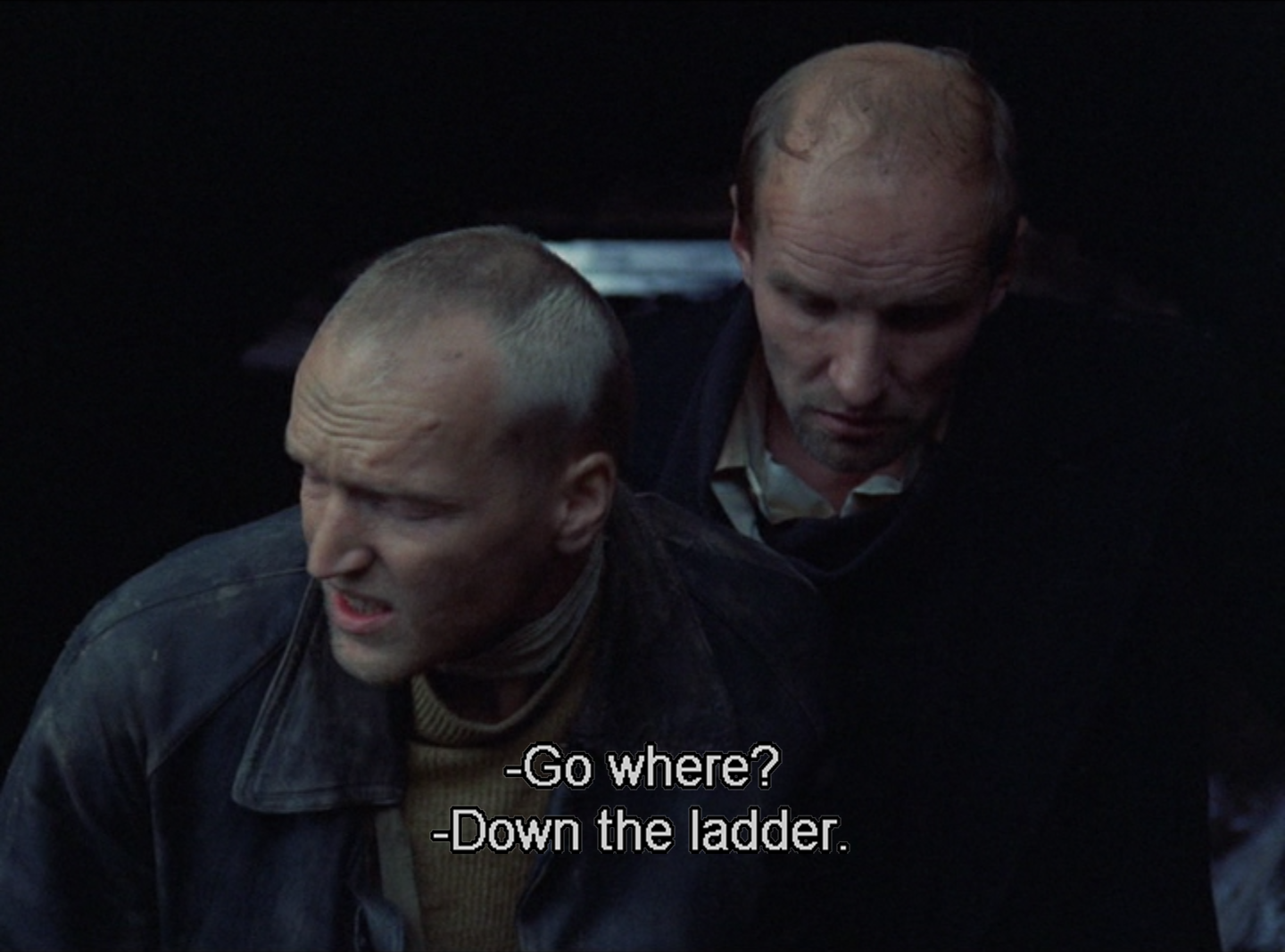
Another advancement is the freshly translated subtitles; it's a very noticeable improvement with substantial changes, like the line "up these stairs" becoming "down that ladder."  Those are two very different statements with very different meanings; and, indeed, the characters do proceed to go down a rickety metal ladder, not up a flight of stairs.

Interestingly, Russico created a new 5.1 mix for the film, which nearly every DVD, including the two here, have in addition to the original mono track.  Criterion ditches that and just goes with the mono, which they also restored from the original elements and present in lossless LPCM on their blu.  And all of the discs' English subtitles are optional/ removable.  But here's what the Kino disc has, which no other release seems to have included before or since: an English dub track (and a French one, too).  It's a bit unusual, with only only two actors doing all of the characters' voices, and you can still hear the original Russian performances in the background.  I presume it's largely meant for visually impaired viewers, but it's kind of a neat option, regardless.  And leaving the original dialogue in the track means you can still "get" the qualities and nuances of the original actors.  So that's one reason someone might want to score a copy of the old Kino DVDs even in 2018.
Memory
One thing we can thank Russico for is that Stalker's always had some pretty decent special features.  All the DVDs from Image, Artificial Eye and even the later Kino set all had the same stuff.  First, was a five minute clip from Tarkovsky's first film, The Steamroller and the Violin.  Cool for the very first Russico disc, I guess, but not too thrilling since, because the entire film's been available on DVD since 2002.  Cooler is a short film called Memory, which is a mostly silent (there's about three sentences of narration) documentary about Tarkovsky's childhood home, filmed in the style of Stalker, and even incorporating a bit of footage from it.  And then there were three excellent on-camera interviews with the cameraman, the production designer and the composer (though, curiously, the last of these was always hidden away as an easter egg).  There's a lot of great first-hand accounts of the tumultuous filing of Stalker, including even a tiny bit of behind-the-scenes footage.  Again, all of that and a stills gallery appeared on pretty much every DVD release there was of this film until the blu-ray days.

Criterion carried over most of the important stuff, specifically the three on-camera interviews.  And again, the Steamroller clip was no great loss (Criterion even includes that entire film with their recent release of Andrei Rublev), and the photo gallery's pretty minimal; but it's a shame they dropped Memory.  It's not an amazing cinematic experience on the level of Stalker, but it was pretty neat.  And if it's not being packaged with Stalker, it's unlikely to come out anywhere else as it's quite short and very specifically made to echo Stalker.  Oh well, just another reason to hang onto an old DVD.  And anyway, Criterion have included a very enthusiastic interview with Geoff Dyer, the author of an entire book about Stalker.  And this is definitely the kind of film where I think viewers would appreciate a little outsider commentary after viewing.  They also include a booklet with notes by English author Mark Le Fanu.
Criterion's new 2k scan is beautiful and unquestionably the way to go for Stalker.  Of course, whether you're up for Stalker is another question entirely and something you'll have to work out on your own.  If you're a convert, though, you might want to look for a used Kino DVD on the cheap as a supplement to the blu for the rare English dub and short film.  But don't actually use the DVD as your main copy of the film anymore, because as you can see, they've all been rendered quite obsolete.