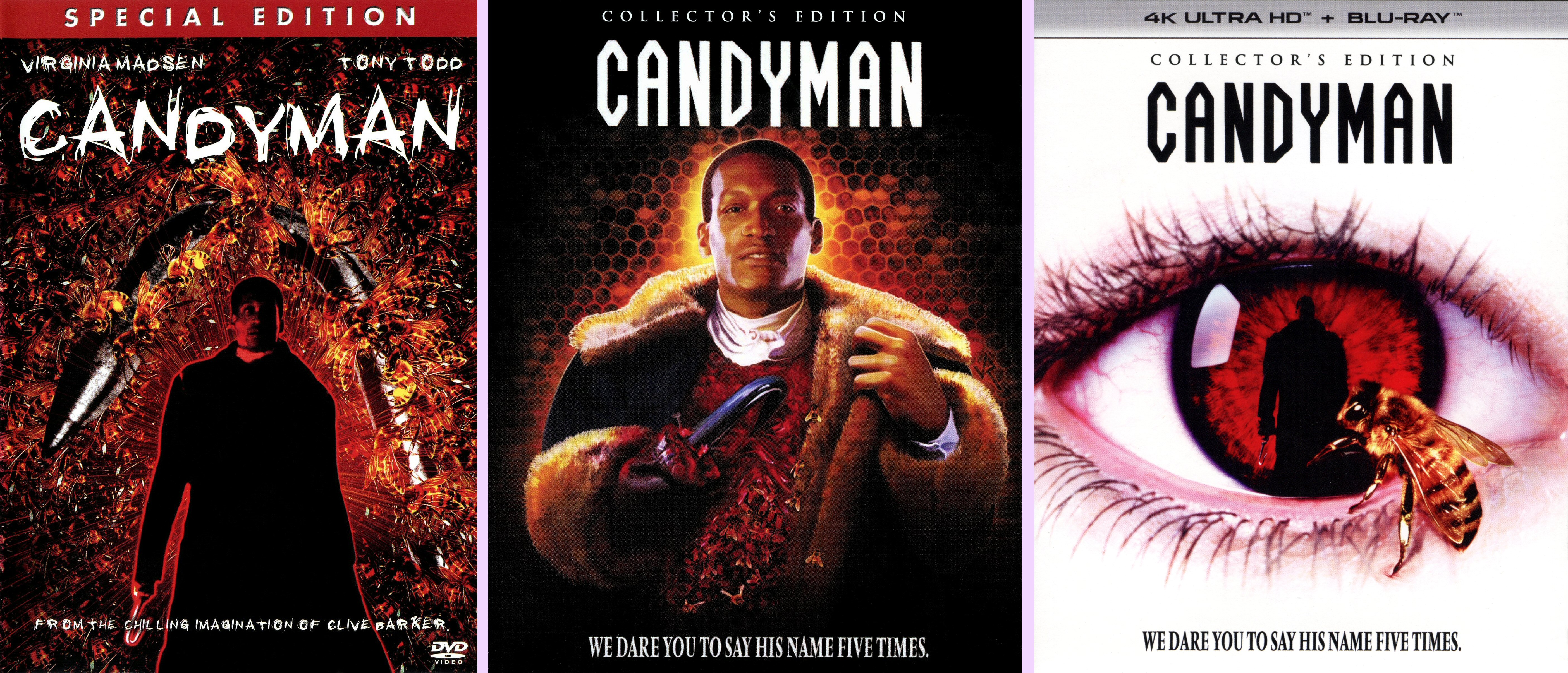
Candyman, Candyman, Candyman, Candyman... Now In *Real* 4k!

So, everyone's talking about Candyman this month, both because of its brand new 4k restoration, which I'm about to tackle below, or because of the recent buzz of Jordan Peele being in talks to produce, and possibly script/ direct, a remake.  Now, you guys already know I'm a pretty big fan of Get Out, but still, even assume Peele takes a strong creative lead, I'm not sure I'm too jazzed on the idea.  Admittedly, like how this latest Halloween film was bound to be an upswing in its franchise given how the messy the last bunch of Halloween flicks were, I'm sure Peele would be guaranteed to improve upon where we left off with Candyman 3: Day Of the Dead.  But the original Candyman is just one of those films where all of the elements came together in just such a perfect alchemical way, that I just don't see any way for additional attempts but down.

Update 11/19/18 - 5/26/22: When Scream and Arrow released their new 4k scan on 1080p blu, some people, people clearly shrewder than myself, held off on purchasing it, saying it was surely only a matter of time until said scan was released on a proper 4k Ultra HD disc in full resolution and HDR. Of course they were right, and here we are, and I've just triple-dipped.  ...But at least I was right about Candyman 4.  😜
Because Candyman is a serious contender for the absolute best horror film of the 90s.  And it's got to be one of the very few films of any genre to actually improve upon and top its literary source material.  It's based, of course, on Clive Barker's short story from his stellar Books of Blood series.  But by transporting the story to America - specifically Chicago's Cabrini Green - and adding the very fertile topic of race to the already thematically rich tale, it manages to hit you so much deeper.  On the one hand, it really works as a classic ghost story, like those BBC ones based on classic literature (another post for another day), but then it's as contemporary and vivid as any modern film.  Tony Todd and his gruesome hook convey a surprising combination of earnest pathos and enough mean-spirited gore to satisfy any jaded horror fan.  In fact, it's first class performances all around, even when a lot of dramatic weight is placed on the shoulders of a young child actor.  You've got cutting edge photographic techniques, knock-out special effects that hold up to this day (Todd had real live bees in his mouth! You know they'd just animate that with CGI now) and Phillip Glass's elegant score.  Really, what's a reboot going to deliver that this film hasn't already provided?
So Candyman originally came out on DVD via Columbia Tri-Star in 2000, as a barebones flipper disc with a fullscreen version on the other side.  They upgraded that in 2004 with a proper special edition, which is the DVD I've got for us today.  Now, there was a blu-ray version before the current pair of 4k restorations.  It came out in the UK in 2009 from Paramount, but it's not highly regarded: barebones (yes, they dropped the DVD extras) with edge enhancement.  Still in HD and a genuine upgrade from the DVDs, but not pretty.  In 2018, though, it's getting released by Arrow in the UK and Scream Factory here in the US.  Apparently, they worked together on this, sharing most of the new extras (though there are key differences, which I'll address below) and the same "new 2k restoration from a new 4k scan of the original negative, supervised and approved by writer/ director Bernard Rose and director of photography Anthony B. Richmond."  I went with the Scream Factory edition; and when both labels released it again in UHD/ BD combo packs this week, I stuck with Scream.
1) 2004 Columbia Tri-Star DVD; 2) 2018 SF (theatrical cut) BD;
3) 2018 SF (unrated cut) BD; 4) 2022 SF theatrical BD;
5) 2022 SF uncut BD; 6) 2022 SF theatrical UHD; 7) 2022 SF uncut UHD.


To start off, the DVD would have you believe it's 1.85:1, but I've left the negative space around the first set of shots to show you that it's actually slightly windowboxed.  It's anamorphic, mind you, but still slightly boxed in, and those vertical bars actually crop the image to more of a 1.81:1.  The new blu has pretty much the exact same framing, but it's actually 1.85:1, because it lifts the bars to show the extra image that they're masking.  It also has a smidgen additional picture along the top and left.  But of course, the real story is the huge boost in clarity.  For one thing, the colors and contrast on the DVD are flat and dull compared to the blu, which really pops.  The DVD has a faded look, plus a bit of a red hue over the whole film.  Just look how completely different the color of the ground itself is in the first set of shots.  Grain is fine, if a bit light in areas on the blus, but only sort of hinted at on the DVD, which just looks sort of lumpy when you get in close.  The standard definition compression results in haloing that looks at first to be edge enhancement, but might just be the result of artifacting caused by too low bitrates.  Of course, the HD takes care of all of that, and the edges look crisp and unencumbered by any such digital noise.

The UHD is also 1.85:1, but film grain is so much more distinct and thoroughly captured than the blus; it's a strong distinction.  The increased color range doesn't necessarily "pop" out in a more dynamic way, but it gives the film a more natural look.  Just look at the garbage pile, for instance, where bright spots flared out to pure, blinding whiteness.  But on the UHD, you can see all the authentic shading and detail (and film grain) that was lost on the blu.  When I sat down to watch this one for the first time, it wasn't a "wow!" moment, but it's another step forward in picture quality.
theatrical cut top; unrated cut bottom.
At this point, I trust you've noticed two sets of shots for each SF disc.  That's because Scream (as well as Arrow on their release) have included both the widely released theatrical cut and the original unrated cut.  The difference comes down to only one scene, and about four seconds of footage.  Both cuts basically feature alternate shots of the same kill, so both cuts are the same length.  And the unrated cut is barely any bloodier.  But anyway, because the negatives contain the theatrical cut, they've had to insert "HD footage from a rare print."  I'll say this.  You definitely do notice the jump in quality in motion (visually and in the audio) on the BDs and UHD, particularly the thicker, unrulier grain; but the inserts look pretty darn good.

Anyway, the DVD gave us a nice, solid stereo mix with optional English subtitles, plus French and Portuguese dubs and subs.  Scream 2018 bumps the stereo mix up to DTS-HD, again with optional English subtitles, plus an even more boisterous 5.1 mix, also in DTS-HD.  And Scream 2020 keeps the same stereo track and subtitles, but replaces the 5.1 (on all three discs) with a Dolby Atmos track.
The special edition DVD was actually pretty sweet in terms of extras.  It's got a pretty ideal audio commentary by Bernard Rose, Tony Todd, Virginia Madsen, Kasi Lemmons, Clive Barker and producer Alan Poul.  Then they've got a fairly comprehensive little 'making of' doc that comes in at about 24 minutes and an additional, extended interview with Clive.  They also include an animation of some very colorful storyboards and a couple bonus trailers (though not the Candyman trailer itself).  All great stuff.

Now, before we get into where Scream and Arrow differ, let's get into what they have in common.  Both share a very cool collection of original special features.  First, there are two brand new audio commentaries: one with Bernard Rose and Tony Todd, which I'll talk more about in a moment, and an expert commentary by the always reliable Stephen Jones and Kim Newman.  Then, there are great (and rather tightly edited and paced) on-camera interviews with Tony Todd, Viriginia Madsen and production designer Jane Ann Stewart .  These are great, as is a featurette on the special effects featuring interviews with Bob Keen, Gary J. Tunnicliffe and Mark Coulier.  Then there are a couple more critical pieces, with Douglas E. Winter delving into Clive Barker's original short story, and a conversation about the racial aspects by writers and scholars Tananarive Due and Steven Barnes.  They actually talk about how the film might be done differently today... something we may wind up seeing for ourselves if that Peele project sees its way to completion.  Both blus also offer the trailer (finally) and a small image gallery.  All also great stuff.

But like I said, things differ.  First of all, Scream carries over all of that DVD stuff, right down to the storyboards.  Arrow does not.  And now I'll get into that Rose and Todd commentary, because they take it fairly lightly.  It's a very breezy, entertaining chat, that routinely drifts very far from Candyman.  They talk about other movies, like Avengers 3 and A Quiet Place (by the way, I agree with Rose on that one), current projects they're working on, Todd's childhood, Rose's greencard...  On the Scream Factory release, it's great, because you already have them doing a regular audio commentary, so you wouldn't want them repeating all the same anecdotes and observations.  But if you have the Arrow set, it's going to be a frustration that they barely say anything about Candyman.  So that's a big advantage for Scream.
The other Tony Todd on-camera interview.
Next, Scream has some really neat exclusive extras.  They have another, second on-camera interview with Tony Todd, and on camera interviews with Kasi Lemmons (who laughs a lot) and the guy who played the kid, DeJuan Guy. These are great, really fun interviews not on the Arrow set.  They also have another, fourth audio commentary with Rose and the guys from the Movie Crypt podcast.  This one's more light-hearted, too, but stays a lot more focused on the movie itself... in fact, it's probably the one where Rose gets the most in depth into many of the nuts and bolts.  So again, that makes the Rose/ Todd commentary a much better fit for Scream than Arrow.  They also have an additional TV spot.  So another advantage for Scream.

But it's not all so one-sided.  Arrow has a couple of exclusives, too.  Namely, they have three short films by Bernard Rose, made when he was a young man in the mid 70s.  They also have a brand new interview with Clive Barker.  From what I've been able to gather, it sounds like he covers a lot of the same ground he did on his old DVD interview, which Scream has; but it has to be noted that Arrow's is substantially longer.
And now, in 2022?  Basically, all the extras are the same as in 2018 (yes, it still has all four commentaries, despite some online listings to the contrary), except Scream has added one new interview.  It's with Vanessa Williams, probably the most conspicuously absent face from the 2018 collection of extras, so this is a very satisfying addition.  She's probably here in part because she was brought back for Candyman 4, which she discusses; but most of her talk is dedicated to the original.

In terms of packaging, the 2018 Scream has reversible cover art with the original bee on the eyeball poster image and a cool slip cover.  Also, the first 2000 copies ordered directly from their website include a second slipcover and two rolled (not folded) 18" x 24" posters. For 2020, the artwork is not reversible, but it has new slip with the eyeball cover and if you ordered it directly from their site, it came with another rolled poster.
So okay, all you smarty-pantsers who saw the exciting new blu of the long-neglected original Candyman in 2018 and still had the fortitude to wait.  Now is your moment, the real UHD sets are here, and as expected, are the definitive way to go.  Arrow has a fancy new box with more swag, but Scream has the new interview, which clinched it for me.  Either way you go, though, it's a banner year for Candyman.

Let's Talk About Twilight Zone: The Movie

I've talked plenty about controversial blu-rays, but today's post is about a film that's controversial itself, Twilight Zone: the Movie, the 1985 anthology film based, of course, on Rod Serling's classic television series.  In fact, it follows some specific episodes quite closely, which I'll detail below.  But it opens with a great, completely original Prologue by John Landis that's surprisingly dark, despite starring Dan Aykroyd and Albert Brooks, and sets the mood perfectly.  If anything, it sets the bar so high, everything that follows struggles to live up to it.
Segment I, also by Landis, is sometimes described as being an original story, and sometimes as being based on the season 3 episode, A Quality of Mercy starring Dean Stockwell.  Having watched both, I'll say it's pretty far removed, though they share a very basic core.  Both depict war where one man learns an important when he has to see things from the opposing point of view.  But that's really it.  In Quality, Stockwell is a WWII army lieutenant who joins a new platoon and orders them on an excessively dangerous and blood thirsty mission to destroy a cave filled with Japanese stories... until he suddenly finds himself general of the Japanese unit, being fired upon by his own men.

In the movie, Vic Morrow (R.I.P.) is a civilian in contemporary America, who makes racist comments about black, Asian and Jewish people before finding himself being put violently in their place: starting out being chased by the KKK, then finding himself being shot at by American troops in the Vietnam war and finally pursued by Nazi Germans during WWII.  So, basically, both spend at least a little time in WWII, and more critically have a leading person who finds himself in somebody else's place to learn a lesson, but otherwise they're very different.  They don't even learn the same lessons.  One is about respecting human life over the glory of war, and the other is about recognizing the dignity in all races.  So unlike the latter segments, this has a lot to offer in terms of original ideas.
Segment II is based on the season 3 episode Kick the Can, and it's absolutely the sappiest and eye-rollingly nostalgic.  Of course Steven Speilberg did this one.  It's also the most boring, although to be fair; there are plenty of worse episodes he could've chosen.  People forget, between the unforgettable classics, Twilight Zone had some real duds in its day.  Both versions are set in a retirement home where most of the residents have pretty much given up on life and are passing their final moments waiting to die until someone suggests they play kick the can, like they did when they were kids.  When they eventually concede, they become young again - literally.  But in the original series, this character was one of the residents who was naturally pushing back against his fellows' despondence.  Here, Scatman Crothers is well cast put poorly written as a mysterious, magical figure who travels from retirement home to retirement home, restoring everyone's love of life.  As a consequence, I found the original episode more poignant, and the film segment cornier, the one dud in the line-up.
You can take it as a given that the movie has higher production values than the old television episodes, but nowhere is it more apparent than in Joe Dante's Segment III.  In the season 3 episode, It's a Good Life, "the monster" creates a 3-headed gopher and then kills it with his mind... entirely off camera.  But Dante brings to wind life his inhuman creations with ambitious animatronic effects and big, bold colors.  The premises are the same in both: a group of adults live in constant terror of a young boy with unlimited mental powers.  If they displease him in any way, even just in their thoughts that he can read, he can wish them out of existence, or infinitely worse.  Interestingly, the movie narrows the scope to a single family in the boy's house, whereas it's an entire town that lives under his thumb.  Dante also focuses the story with a clear protagonist: a young nanny who gets roped into taking care of the monster and learns along with the audience just what a nightmare she's walking into.  And he gives it a resolution - the show basically explores the scenario and then quietly steps out.  Dante also envisions a delectably madcap, Looney Tunes-inspired world as only he could.  So overall, I'd say this segment is a real upgrade over the original.
I'm not sure I can say the same about the final Segment, based on the season 5 episode, Nightmare At 20,000 Feet, despite it being the big crowd-pleasing show-stopper of the film.  It's by Mad Max's George Miller, so that's to be expected.  But it adheres surprisingly closely to the original, with John Lithgow taking the place of William Shatner as a man with a debilitating fear of flying trying to get through a commercial flight, even as he sees a monster destroying the engines on the wing of their plane.  I suppose the special effects are better - the original monster looked like a man in a fuzzy monkey Halloween costume - and Lithgow is probably a better actor; although Shatner was actually quite effective the first go around.  This is an episode so expertly crafted it didn't need a remake, but it got one anyway.  Therefore this is the least essential segment, but still generally the most entertaining.

But we can't talk about this film without addressing the controversy.  In fact, some potential viewers may feel they still can't view or support this film to this day, because Vic Morrow and two young children died during the filming of the first segment.  Worse, their deaths were not just a tragic accident (though it certainly was that), but the result of negligence, where the actors were working under illegal conditions.  There's been a whole written about the case if you really want to get into it all, and it does have to be said that Landis and the other filmmakers involved were ultimately acquitted of manslaughter charges.  But it's certainly always going to be an awful stain on this film's legacy.
2007 WB DVD top; 2007 WB BD bottom.
And that's probably why it took so long for Warners Bros to to release this on DVD.  But they eventually put it out concurrently with an early (and now quite out of print) blu-ray and HD-DVD all in 2007.  Both the DVD and BD present the film in 1.78:1, though the DVD is slightly stretched vertically, which the blu fixes, revealing extra slivers along the top and bottom.  Over all, this is a decent but slightly dated presentation.  The HD is free of any unwanted glitches or tweaking, but the image is soft and film grain is only lightly hinted at.  It's certainly sharper than the DVD, though.  For a 2007 blu, this is quite good, but it's easy to imagine how much nicer a 1.85 4k scan would be today.  However that's probably going to have to stay in our imaginations.

The DVD includes the original stereo track, a 5.1 remix, plus French and Spanish dubs, as well as optional English, Chinese and Portuguese subs.  The blu bumps the 5.1 remix up to LPCM, but the stereo track stays lossy, which is a disappointment.  It keeps all the foreign language dubs and subtitle options (including, to be clear, the English), and even adds French and Spanish subs.
The only extra found on either edition is the theatrical trailer.  Horror's Hallowed Grounds recently made a video visiting the locations of this film, including yes, the infamous crash site.  But I can't imagine that'll find it's way onto a Collector's Edition anytime soon.  And there was a brief Shudder documentary series called Cursed Films that did an episode about Twilight Zone that sounded promising.  But it turns the series proposes that the films they cover were literally cursed and wind up talking to clairvoyants and all types of silly nonsense rather than just taking credible looks into the unfortunate stories behind these troubled films.  So feel free to skip that.  But given the "cursed" nature of this film, I wouldn't expect a new edition of this film anytime soon, so if you come across one of these blu-rays for an affordable price, jump on it, because they've gotten rather scarce.  Even if you can't bring yourself to watch it, the resale value will be worth it.

Liv Ullmann Directs Ingmar Bergman's Faithless

Faithless is a script Ingmar Bergman wrote late in life, a very introspective, even autobiographical one. And yet he chose not to direct it. Instead he gave it to his longtime lover and star Liv Ullmann, who by that time had already made several films of her own. It was first issued on DVD in the UK by Tartan, and then in the USA by First Look. It's long been stated that while the film is rather long, roughly two and a half hours, that the import DVD features an even longer "international cut" (for example, they list it on the film's dvdcompare page) That's the version I always had, but I recently picked up a copy of the US DVD to see what's so different about the two versions, since I can't find any site anywhere that specifies. And I was rather surprised by what I found.

Update 11/22/15 - 4/27/22:
Throw those DVDs in the garbage!  A far superior new blu-ray has just been released by the BFI.  Bam!
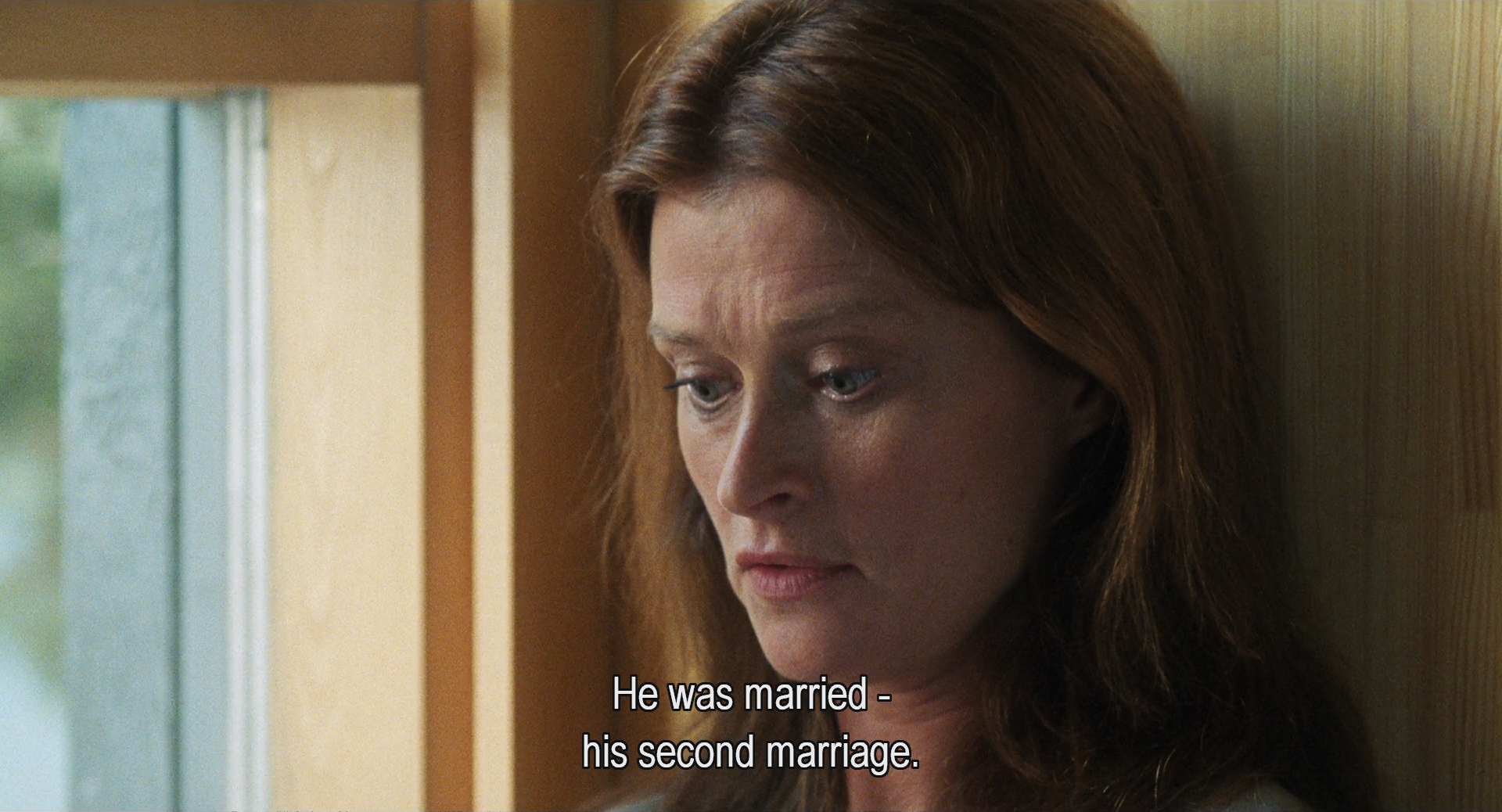
Ullmann cast one of Bergman's best staple actors, Erland Josephson (Scenes From a Marriage, Face To Face, etc) to play the lead, and wow does that pay off. This is a very grounded film of long, steady close-ups and realistic human emotion, and Josephson can bring the power to that like very few actors in film history. He plays Bergman, an isolated film director who lives alone on an island writing scripts about the loves and infidelities of his past, and conjures up his former lover (played by Lena Endre) to retell their entire story from her point of view (though there's a surprising and moving shift in perspective in the third act). What makes it work is that it's very strong emotional subject matter handled very honestly and subtly. It's not melodrama, in fact the first half or so is very slow moving; but by the end: "oof!"
You could certainly accuse Ullmann of imitating Bergman's style here, but that's hardly a bad thing considering how well it works; and it's especially appropriate given that this is not only his writing, but a story seen through the eyes of himself as a filmmaker. Although I also noticed touches that I'm sure Ullmann put in there that Bergman never would have.  In fact, the fact that this story focuses more on the children of the destroyed relationship, something Bergman has often glossed over, lends considerably more dramatic power.  It might be a bold admission, but I consider Faithless, a film not directed by Bergman, to be one of the very top Bergman films.
One of Bergman's many crossed paths with A Dream Play.
Okay, now here's the story with the "international cut:" there's no such thing, at least not on Tartan's DVD. I watched both country's DVDs side by side and there isn't a single deviation or extra scene, shot or trimming. It's 100% the same movie. There are a few factors about the running time that probably added some confusion to the mix. First, naturally, there's the whole PAL/ NTSC business. Also, the US DVD has a couple trailers on it, and they're on the disc as one long video file with the main feature, so the running time on your player is actually adding the time of the movie and the trailers together for one larger sum. There's also different company logos in front of the opening credits and all. So, actually just looking at the movies themselves, the UK disc runs about 148 minutes, and the US is about 154... not 142 like it says on the back of the case. I believe that misprint is entirely at fault for the idea of there being more than one version of the film. Account for PAL speed-up, and they're the same length.
1) 2003 US First Look DVD; 2) 2001 UK Tartan DVD; 3) 2022 UK BFI BD.


And as you can see, the two DVDs have very different looks, as indeed does the new blu. The UK DVD has a very high-contrast (crushed, even) look suggesting it was taken from a film print, whereas the US DVD has a much more natural look, seemingly taken from the negative. That's great for the US disc, but unfortunately, it's full-screen, and not even open matte. It's an old school "chop the sides off" job. The UK disc is slightly pillar-boxed to about 1.74:1, and it's anamorphic, which is a relief. But both discs are a heavy compromise. If only we could've gotten the best of both worlds, we'd have had a pretty nice looking release.

Well, now we have even better than the best of both previous worlds.  We have a properly widescreen 1.85:1 transfer.  And the fresh 2k scan is of the original 35mm negative (and according to the booklet, a bit taken from the 35mm duplicating positive).  There is just so much more detail and clarity, as well as more photo realistic coloring, the screenshots really speak for themselves even if you don't bother to click through to the full resolution versions.  Just look.

All three discs feature the original Swedish stereo mix, but the new lossless version on the BFI blu sounds more robust and authentic.  They've also added a DTS-HD 5.1 mix.  Oh, and also the English subtitles are removable, which is more than can be said for the burnt in ones on the Tartan disc.
The US disc only has a couple of trailers for extras, though at least one of those is the actual Faithless trailer. The UK disc has the trailer and a bunch of bonus ones, too, but it also has the very substantial bonus feature of an on-camera interview with Liv Ullmann. It's pretty in-depth, lasting over 31 minutes.

BFI now, has really turned it into a special edition.  First of all, yes, they have kept the Tartan interview and they still have the trailer, so no ground lost.  They've also added a new, expert audio commentary by critic Adrian Martin, and it's excellent.  No dead space and a lot of information and insight, including some readings from Bergman's autobiography that sync up surprisingly specifically with this film.  Then, there are two more interviews with Ullmann, both are on-stage and last over an hour each.  There is some unfortunate redundancy, and it would have been nice if somebody could've edited these so we wouldn't be hearing the same 5-6 minute anecdotes repeated practically verbatim.  That's downright punishing to sit through.  But you'll be rewarded, because each interview also has a lot of unique content, with fun anecdotes about her career and insight into Faithless.  There are also two stills galleries and a hefty, full-color, 34-page booklet including two essays, a director's statement and an interview with Ullmann.
So the international cut seems to be a myth. I mean, okay, maybe there's another version out there somewhere that runs longer; however beyond early assemblies or workprints, I'd be surprised if that's the case.  Despite there only being one cut of the film, though, the home video releases are quite different. But there's no question which is the winner now.  BFI's new blu is a beaut that puts the old editions to shame.  Faithless is a masterpiece, and this is a must-own.

Now where's Private Confessions?

Black Roses, Better Than No Blu

There was a cheesy little subgenre of horror in the 80s, presumably based on America's brief period of "Satanic Panic," of heavy metal themed horror films, like Hard Rock Zombies, Trick Or Treat, Rocktober Blood... 1988's Black Roses isn't my favorite of them (that would be Rock 'N' Roll Nightmare!), but it's a fun runner up.  And it's available in HD, but only if you're up for importing.
2007 US Synapse DVD top; 2014 DE NSM BD bottom.
The Black Roses are a hot new band who want to practice performing in a small town for a few nights (that "one night only" tag line is just flat out wrong-o) before embarking on their big tour, especially since everybody in the audience at the last place they played turned into monsters and went on a rampage.  Yes, the uptight school marms seem to be right to suspect this rock and roll band of having a devilish influence on their youth, and it's up to a hip(?) high school teacher to to get to the bottom of why his students behavior is becoming increasingly criminal before it's too late for the whole world.
2007 US Synapse DVD top; 2014 DE NSM BD bottom.
Black Roses is a low budget bit of Canuxploitation with a lot of ambition.  It's full of cheap but thoroughly entertaining set pieces, from dramatic scenes of patricide to seductress ghosts appearing in the night.  Records bubble on the turntable, monsters leap out of your speakers and all the nice girls start teasing up their hair.  It's super cornball melodrama that's at least fifty percent self aware but knows to keep throwing stuff at the screen to keep us entertained.  It helps that the music is really catchy and surprisingly good.  The effects are all over the place, very low budget and rubbery, but often well designed and creative.  Think Rawhead Rex, where he looks great until you realize the expression is fixed and it's essentially a thick rubber mask that barely moves.  And for some reason The Sopranos' Vincent Pastore turns up for a small role with a very out of place Brooklyn accent.
2007 US Synapse DVD top; 2014 DE NSM BD bottom.
So Synapse originally released this on DVD in 2007 as a nice little special edition.  Unfortunately, that's where they left it, never upgrading it to blu-ray.  But in 2014, a little label called NSM Records was there to pick up the slack.  "There" being Germany, where they released the film under the misfitting title Freakshow.  It didn't hang onto all the extras, but it's in HD for the first and still the only time.
2007 US Synapse DVD top; 2014 DE NSM BD bottom.
Both discs are just slightly off of 1.78:1 - Synapse is 1.77 and NSM is 1.79, and their framing is slightly altered, though it's hard to say which is better.  NSM's blu's colors are better separated and its image is brighter/ less saturated, the latter of which, again, may or may not be an improvement, though it still keeps its blacks black.  NSM's blu is unquestionably a sharper, HD image, though.  It's not exactly a cutting edge scan, and the grain sometimes looks like over-sharpened digital noise, but it beats the smoothed out SD image.

Another advantage is that NSM bumps up the original stereo mix to lossless DTS-HD.  Neither disc offers subtitles, so what's usually a small loss with imports like these is just a side-grade, and NSM does add a German dub (also stereo DTS-HD), if anyone's interested in that.
2007 US Synapse DVD top; 2014 DE NSM BD bottom.
Now, Synapse's special edition isn't too packed, but it's star feature is a pretty impressive commentary track with the director, writer and several of its cast members.  It's not perfect - the director keeps putting his kid daughter on the mic, which is equal parts annoying as cute.  Still, it's great to finally hear the story behind this film, and fans should be delighted to get it.  There's also some fun audition footage[right] that shows some other directions they could've gone with their lead villain character, plus there are some extended promos (Essentially two five minute trailers).

Sadly, NSM didn't carry over the commentary or the auditions, leaving it as a fairly barebones release.  They did manage to hang onto the promos, however, and unlike Synapse, they found the actual theatrical trailer.  They also added a gallery of high def stills and a bunch of bonus trailers.  It has reversible artwork with the far more impressive poster art, and the big red ratings logo is a sticker you can peel off the plastic.
2007 US Synapse DVD top; 2014 DE NSM BD bottom.
So, no, it's not a massive upgrade, and even if you do spring for it, you'll want to keep your DVD for the extras.  But it's something, which is more than we've got in the USA.  Maybe it's worth just holding out hope that Synapse will get around to revisiting this title someday, along with Rock 'N' Roll Nightmare, which as another of their DVD-only titles; but in the meantime this is what we've got.