Showing posts with label DennisPotter. Show all posts

Brimstone & Treacle & Brimstone & Treacle

Here's a release I've been alternatively excited for and nonplussed by leading up to its release.  I'm referring specifically to Vinegar Syndrome's new UHD of the 1982 film Brimstone & Treacle, although I'll be covering both films here today.  Just for a start, this is a brand new 4k restoration and special edition of a film I never thought would get one.  I mean, an audio commentary by Sting?  Holy cow!  And I'd forgotten, until I went back to my old MGM DVD for this review, that the previous release was non-anamorphic, so it was especially in need of an upgrade.  On the other hand, it's a remake of a another, better film from just five years earlier, which would seem to render the whole endeavor utterly pointless?
The original Brimstone & Treacle is Dennis Potter's 1976 Play for Today that was banned and went unseen until 1987 (ironically making the remake the version people got to see first).  Michael Kitchen (Dracula AD, Mrs. Dalloway) plays a grifter who cons his way into the household of Denholm Elliot (Raiders Of the Lost Ark, Blade On the Feather), where he and his wife care for their invalid daughter.  Little do they suspect that the man they've invited in is the literal devil and their daughter being completely cognitively impaired doesn't deter his designs on her.  Yeah, the material's pretty edgy and you can see why the BBC would've taken issue with it.  But it's also some of Potter's sharpest writing and wonderfully acted.
Ultimately, I would say the remake is not pointless, but it should be primarily of interest to those who already have the original.  It's definitely interesting to see the what sporadic, sometimes seemingly arbitrary, changes they decided to make while otherwise sticking line for line, beat for beat to the original.  Some of those changes may've been landed upon casually during the filming, but others required some definite intent in the planning stages.  And all the little "whys?" can be a fascinating puzzle.  For the most part, they weaken the story being told.  One or two changes really undercut the story's inherent power.  Unfortunately, it would be a spoiler to lay into the biggest ones, but a couple smaller, but still weakening alterations include taking out the entire political subtext re: The National Front, and swapping it for some silly business about working for a religious greeting card company, or changing the nature of the father's tryst, which makes it more PC but far less dark and shameful, to the point where you'd wonder why anybody but his wife would be traumatized by it.
But then, since most of it is so similar - right down to the recasting of Elliot in the same role - anyone familiar enough with the first version can easily take all that as written and just enjoy what they get right the second time around, appreciating what the original would've looked like had it been shot on 35mm.  There's one additional line of dialogue I quite like.  But I'd hate to think of people approaching Brimstone & Treacle story from the 1982 end.  It would've been a shame even beforehand, but it's especially so since the ban on the original was lifted in 1987, and it was released on DVD by 2 Entertain in 2004.
2004 2 Entertain DVD.
This DVD sports an interlaced, fullscreen (1.29:1) transfer, which is to be expected, since this is a television broadcast presumably shot on videotape, though I imagine it could look at least a tiny bit better if restored for HD today, especially if the exteriors were shot on film, which was frequently the case with the BBC.  The AR should probably be tweaked to 1.32:1 or so, a modern scan might clean up a little noise and the higher resolution should at least clean up a little compression smudginess along the edges.  But basically, you can see why this has been left as a DVD-only title so far, and I wouldn't hold off purchasing it waiting for the unlikely upgrade.

The audio is the original mono track in Dolby Digital, and happily they have included optional English subtitles.
And more good news: it's not barebones!  It's basically got one extra: a vintage half-hour made-for-BBC program called Did You See? that aired when BBC lifted their ban and aired Brimstone in the 80s. At first, it looks a bit doofy: a panel discussion with three finger waggers about whether the show should be seen.  But they actually have a reasonably and surprisingly smart discussion on the matter, and far better still, the program also includes separate interviews with key players including Potter himself, the producer, a journalist from The Guardian and the head of BBC programming, and those - -especially Potter - are invaluable.

And that takes us to the remake, which was released on DVD in the UK by Prism in 1999 and here in the US by MGM in 2003.  Both are barebones and, as I mentioned at the top, non-anamorphic.  So this new special edition 4k restoration on a BD/ UHD combo-pack from Vinegar Syndrome is pretty essential, at least for anyone who considers this film to be essential at all (although it should be noted a 2009 anamorphic DVD was released in the UK in the interim). 
2003 MGM DVD top; 3035 VS BD mid; 2025 VS UHD bottom.

Despite being non-anamorphic, the MGM DVD has almost the same, proper aspect ratio: 1.63:1, compared to Vinegar Syndrome's 1.67:1, which just very tiny slivers of extra picture along the sides, and barely adjusted vertical framing.  The old DVD has some gentle color bleeding and edge enhancement, but for an old non-anamorphic DVD, it holds up to the VS release better than you'd expect.  Still, Vinegar Syndrome has a clearer image with corrected colors and proper film grain, especially on the 4k.  The new restoration makes the picture quality look especially impressive, which is important, since that's one of the few things the 1982 version has going for it.  It's basically a lesser-written piece with fancier photography, so thankfully that fanciness shines.

MGM gives us the original Dolby stereo track, with its fancy Police soundtrack, and optional English, French and Spanish subtitles.  VS bumps that up to DTS-HD and keeps the English subs, while dropping the foreign language options.
And they did not skimp on the extras either!  First and foremost is a partial audio commentary by Sting and director Richard Loncraine (Richard III, The Haunting of Julia).  It sounds like they recorded a traditional commentary, but they left a lot of dead air, so VS just trimmed it down to a tight, involved talk that runs about half as long.  It was absolutely the right decision; it's a don't miss track.  Then there's an additional on-camera interview with Loncraine (a bit redundant), a good one with the production designer, and a featurette with two experts who are okay, but repeat a lot of information from the Did You See? program nearly word for word, and generally just feel like a couple of guys with a passing interest in Potter who looked some stuff up online before recording.  In other words, it's a decent explainer for newcomers, but fans won't learn much.  Both this and the MGM disc also have the trailer.  But only VS's edition includes a 16-page booklet with notes by Alexandra Heller-Nicholas.  It also has reversible cover art, and if you ordered the limited edition, an exclusive slipcover.
Conclusion: Vinegar Syndrome has given the remake a brilliant edition I'm not at all sure it warrants, but it makes me happy.  Again, how could I pass up that commentary track?  But for anybody reading this who's not already in the paint for this movie, I cannot stress enough how much more I recommend the 2 Entertain of the original Brimstone & Treacle instead.

Is No One Going To Do Anything About the State of Mesmer?!

Well, I'm not tagging Mesmer M.I.A. because it is available on DVD from Image.  In fact, it has been since 2000, and it's certainly far from rare, although in recent years it's been inching its way up in price as a long OOP title.  There are also foreign releases, in the UK and Australia, among others.  But they're all barebones discs using the same, crap fullscreen transfer.  And damn it, Mesmer deserves more than this!

I've read enough online reviews to know that many unprepared Alan Rickman fans seem to have stumbled upon this looking for some kind of Snape spin-off movie, or some torrid romance novel breathed to life.  And to a large degree, Mesmer delivers on the latter.  But most of them probably weren't ready for all the incest and sexual abuse.  Because the critical thing to know about this film is that it's written by Dennis Potter, so it's not going to shy away from the dark sides of its story.
And I know, often with Potter films, the disappointment is that they're watered down versions of his superior British television originals.  Like, I see a lot of people talking about how pleasantly surprised they were to discover Steve Martin's musical Pennies From Heaven is actually rather good.  And sure, it is, but the shame is that almost none of these people have seen the fuller and far superior original starring Bob Hoskins.  Once you've had that experience, the only reason to return to Martin's is for some flashier production numbers and maybe nostalgia.  Then you've also got the dueling Brimstone and Treacles, Track 29 vs. Schmoedipus, and god save you if you're only familiar with Robert Downey Jr's interpretation of The Singing Detective.  Or to a lesser degree, Alice and Dreamchild.  But Mesmer is a true 1994 original, the definitive and only version.
On its face, Mesmer tells the true story of Franz Anton Mesmer, the radical 19th century doctor who believed our mental and emotional states directly affected our physical health.  He introduced a lot of ideas, like psychosomaticism, that we still used today, but also some pretty far-out new age shenanigans (yes, he's where we get the word "mesmerize" from).  Indeed, this film is book-ended with Mesmer being brought up in front of a medical board on the charge of being a total fraud.  Chief among his critics is David Hemblen, who you'll recognize from all of Atom Egoyan's best, early films.
But Potter isn't really interested in teaching us history; this just qualifies as a biopic by technicality.  It's a fanciful, bleak, humorous and sly exploration of, you know, whatever was going on inside Potter at the time.  Anton rockets through class, working his magic for everyone from street peddlers to royalty.  He's at once a new age charlatan with some truly crazy treatment plans, and a bit of a medical savior, ahead of his time in a field of struggling experts whose answer to most things was still bleeding their patients and torturing them with leeches.  For some reason, it seems to help when his patients are beautiful young women.  Hmm...
Mesmer embraces the art house, so be ready for mobs of French revolutionaries to behave as a theatrical device rather than realistic rioters, or even for Rickman's face to be super-imposed on the moon.  I wouldn't blame you for being skeptical if you looked up the director.  Roger Spottiswoode has some rather spotty credits (sorry; I couldn't help myself) on his resume... his previous movie was Stop! Or My Mom Will Shoot.  And I'll admit, a finer director might've wrung some more nuance and subtlety out of this material.  But Rickman's is downright transcendent here, and the string's in this score are doing God's work.  I'm starting to run long, so if you still need to be properly sold on this film, I'll direct you to these vintage reviews from Variety and The Atlantic that really seem to get it.
2000 Image DVD.
So, like I said, Mesmer is presented fullscreen here (1.33:1), though this was of course a widescreen theatrical release.  I'm not even confident that this is open matte, as there doesn't seem like a lot of excessive head room, and the framing looks pretty tight.  Most damning, it's just so dark and soft.  The colors are drab, contrast is low so it feels like someone turned off the lights even when characters are out in the sun, and I bet a lot of detail has been crushed in those blacks.  It looks like what it surely is: an old video master made for tube televisions in the early 90s.  At least there aren't any rolling bars, and surprisingly, it isn't interlaced.  But otherwise, things are pretty sad.

Audio is just your basic 2.0 Dolby track, which is fine.  There are no subtitles, and the only extra is a(n also fullscreen) trailer.  That and an insert listing chapter breaks is all we get.
Mesmer is one of those films I've been waiting decades for an upgrade for.  Anytime a studio like Twilight Time or Kino would announce their monthly releases, I'd check to see if Mesmer was amongst them.  I wasn't expecting a loaded special edition, but you'd think someone would at least get it to us in its proper widescreen.  I gave up really hoping years ago, though.  For some reason, this exotic film just feels doomed to neglect.  Meanwhile, Nail Gun Massacre is getting its fifth remaster, this time on UHD.  And if anybody gets that decision, I do.  But come on, studios, publishers... is really no one going to step up to the plate for this?  Stop! Or My Mom Will Shoot is on blu-ray, with a 'making of'!  Surely this can get a no frills 2k clean-up?

Dennis Potter's Two Dark Visions of Wonderland: Alice and Dreamchild

Dennis Potter has written so many great, rare and unreleased television plays for the BBC over the years. A disappointingly substantial number of them have yet to be made available in any form, while others are out only on some pretty obscure discs. One of his earliest, and long unreleased, is Alice, a "Wednesday Play" from 1965: a more realistic and tragic take on the relationship between Lewis Carroll and the real Alice Liddell who he crafted his stories for.

Update 9/10/15 - 11/11/22: Kino has given Dreamchild a much needed upgrade to blu.  'nuff said!
Here we see Carroll, excellently played by George Baker, as a reclusive, stuttering professor with an undying devotion to the very under-aged daughter of his dean (Upstairs Downstairs' David Langton). Nothing overtly sexual or immoral happens, but Alice's mother slowly catches on that there's something inappropriate in this man's attentions to her the girl, spending all of his time with her, buying her gifts, inviting her over to be photographed. But at the same time, something genuinely beautiful and innocent is developing out of his true feelings for her: these wonderful stories he creates to win her affections.
Throughout the film, we see moments and characters that inspire some of the most famous scenes from Alice In Wonderland, and occasionally we enter into the storybook world itself. It's an honest look at human relations seldom examined, and a psychological character study too honest to simply present us with anyone to demonize or romanticize. When Carroll ultimately takes his first book of Wonderland stories to an appreciative publisher, they're all too eager to have their illustrator visit the real Alice for their pages, but there's the awkward moment when Carroll must explain to them that the family now objects to the entire affair.
In 1985, Potter wrote the screenplay for a film called Dreamchild, which is often referred to as a remake of Alice. That would certainly make sense... a small but highly praised BBC teleplay getting turned into a feature film happens often enough, even specifically with Potter's works; and certainly this film has many of the same themes and a rough premise in common with Alice. In fact, it has a few scenes replayed word for word. But I really don't think it's fair to call this a remake; it's actually quite a different film, that just happens to stem from the same root idea.
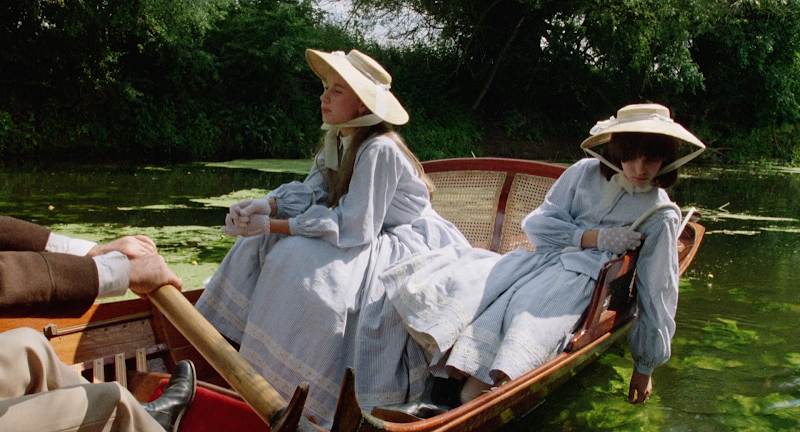
Certainly, it's another story of "the real Alice" and an implied darker, even abusive, relationship between her and Carroll. But it's quite a different story. Despite its title, Alice was about Carroll; Alice was just the catalyst. Dreamchild, on the other hand, is about Alice. This film is set in the 1930s, when Alice is now 80, visiting America for the very first time because she's receiving an honorary degree from an ivy league university as part of a celebration for Carroll's centenary. She's surprised to learn just what a cultural icon the book has become, as she's instantly beset by reporters who don't understand how haunted she is by the story's characters (angry monsters brilliantly brought to life by Jim Henson). In Alice, Carroll seemed to simply want more than there could be with Alice, but in Dreamchild, we're left to infer that something immoral did indeed happen, and she's a survivor forced by the book's lasting popularity to confront her demons to her very last days.
There is so much story that isn't even hinted at in Alice. Peter Gallagher is a major character playing a reporter who Alice rejects but eventually warms to after he shows her how much money there is to be made in exploiting her newfound American fame. There's a whole subplot, then, about her young assistant who she brought over from England and tries to keep under her thumb (a sort of mirror, where she tries to keep Lucy infantilized just like Carroll wished of her). The scenes this has in common with Alice are all flashbacks from her youth with Carroll, this time played by Ian Holme. Again, those scenes are the same down to the precise word; but they only make up maybe 15% of this movie, which has an entirely different tone and very different things to say. Certainly production values are much higher here - compare the gryphon and the mock turtle in the screenshots from each production above. But I have to say, key scenes - like the one where Liddell's family asks Carroll to recite a silly poem from his book and Alice and her sisters laugh and get distracted by their boyfriends, because they've outgrown his childrens' stories - are more heartbreaking in Alice. Truly, though, they're two very different and excellent original works by Potter; and you'd be doing yourself a disservice to only see one or the other.
Both of these films were unavailable for ages. However, if you'll pardon a brief detour (it'll tie in eventually), what was released, was a rather smart 1966 BBC adaptation of Alice In Wonderland by Jonathan Miller, who also directed the terrific Whisper and I'll Come To You. This is a faithful adaptation of the story by someone who greatly disliked the Disney cartoon, and it features a brilliant cast including John Gielguld, Peter Sellers, Michael Redgrave and Peter Cook. It's a more mature version, with a strong score by Ravi Shankar and all the characters (the white rabbit, etc) portrayed simply as humans, and the entire adventure as a dream.
I used to have the BFI DVD of it, which had some excellent features, including an audio commentary by Miller, a vintage featurette on Shankar's scoring process, and an old silent film version of Alice In Wonderland from 1908 with commentary by a BFI expert. But I upgraded that old edition for this US DVD when it came out in 2010, as it carried over all of those extras but also included the DVD debut of Potter's Alice! I kind of wish I'd hung onto that BFI disc (also released in the US by Home Vision), because look at the ghosting in that screenshot above. I'm pretty sure that's a PAL to NTSC conversion issue the original UK disc didn't have. But I'd have bought it anyway, just for Alice. I would've bought Alice on DVD just by itself, because it's terrific. I don't care if they've tucked it away as an extra; it's an amazing package.
And Dreamchild? That finally came out as just an MOD DV-R from MGM in 2011. It's in its original widescreen OAR, and it was fantastic to finally have this movie. But DV-R is pretty disappointing and looks really compressed. It did actually get a proper, pressed DVD release in the UK from 101 Films in 2015. But apparently it's the same transfer and no extras or anything. Besides, now in 2022 we've got a proper blu-ray from Kino, and it's even a bit of a special edition. Everything else is now ancient history.
2011 MGM DVDR top; 2022 Kino BD bottom.

It's nice to see this isn't just the same master slapped onto an HD disc, although honestly, I would've been happy with that.  Especially since we're coming from a wonky, interlaced DV-R, not even a proper DVD.  But this is even better!  Obviously the compression is vastly improved, the image is sharper being in HD and the interlacing is corrected.  But beyond that, we have fresh, corrected colors so everything doesn't look so orange anymore, and the aspect ratio has been corrected from 1.82:1 to 1.85:1, slightly adjusting the framing of the entire picture.  Did I mention they made it less orange?  Because that really makes a big difference.

The original mono audio has been bumped up to DTS-HD, and optional English subtitles have been added to the blu.
And we finally get some extras.  We start out with an audio commentary by expert Lee Gambin, which is okay.  His expertise is clearly more on Henson than Potter, and he goes on a long 20+ minute jag of just reading every puppeteer's IMDB credits one by one.  But there's some good stuff in there, too, if you've got the patience.  The other main extra might take a little patience, too.  It's an audio-only interview by Gambin with director Peter Medak.  To be clear, Medak is a director, but not Dreamchild's.  He's here to share memories of star Coral Browne, who he worked with on another picture.  Unfortunately, he doesn't remember much more than the fact that she was sexy.  He's asked, for instance, if he ever saw Dreamchild, which Browne was immensely proud of; and Medak says he's pretty sure he did but doesn't remember it at all.  Like the commentary though, there are some interesting moments if you've got the time.  It's an unedited and slow phone call, including a long bit at the end where Gambin struggles to end the conversation... I can only imagine the reason they left all that in is because nobody listened to it before sticking it on the disc.  But it's still a nice, little bonus.  Kino also includes the theatrical trailer and a couple bonus trailers.  So this is easily a must-have for anyone's collection.
Now, maybe we can hope for an HD upgrade of Alice?  There are still a substantial number of excellent Potter teleplays left to be released on DVD, let alone blu, so maybe the BBC could give us a box boxed set.  Fingers crossed, but I'm not holding my breath.  So I strongly recommend the Kino blu and the 2 Entertain DVD, because more people should really see both... and Miller's adaptation too, for that matter.  But only viewers who are prepared for something a little heavier than a Disney musical.

Dennis Potter's Defective Secret Friends... Saved by Indicator/ Powerhouse!

A lot of Dennis Potter's work has been issued on DVD, especially if you're prepared to import from the UK (or just happen to live there, of course). But a lot isn't. And some of it is, but only on rare, long out of print, obscure releases, MODs and the odd foreign disc. And I do mean odd. What we have here is one of Potter's lesser known later works, Secret Friends, available on DVD from the Spanish company Cameo. And it would appear that their entire run is defective.

1991's Secret Friends is the film Dennis Potter not only wrote, but directed, loosely based on his novel, Ticket To Ride. Dennis Potter was, deservedly, a critical darling in the UK for a very long time, but had just experienced his biggest failure, Blackeyes, which was his directorial debut for the BBC. This was to be his follow-up (not that the stories are connected at all), but after Blackeyes had been so thoroughly rejected by audiences and critics, the BBC went cold on the project, and Potter wound up making this as a small theatrical film instead. It didn't do very well and is consequently pretty obscure - Potter never directed again - but it's actually not a bad little film.

Update 7/2/15 - 2/22/20: I didn't see this one coming, but I'm sure glad it came. Indicator/ Powerhouse has given us the first, fully functional release of Secret Friends. What's more, it's a sweet, restored edition.  Oh, and P.s.: I also added the DVD edition to the Christmas Horror Story page.
It feels a bit like The Singing Detective on a train. Almost all of Potter's recurring themes check in here: a story fragmented in time, 1930s music, miserable childhoods and very dark themes unafraid to thoroughly explore sex and death. Alan Bates, who previously starred in Potter's excellent adaptation of Thomas Hardy's Mayor of Casterbridge, is our lead here, an artist who's having some sort of severe identity crisis in a dining car, sitting across from two very unhelpful fellow passengers. We journey through his memories and fantasies, from a painfully strict religious upbringing, to rendezvous with his wife at a hotel where she pretends to be a prostitute. It's a sort of murder mystery explored through one man's interior mind. It can feel a bit redundant if you're familiar with Potter's past works, but parts of it, at least, are still quite effective. It's lesser Potter certainly, maybe a bit lazy; but as his fans know, even bad Potter is a strangely riveting viewing experience, if only because his subjects are so personal and directly attacked.
I spotted this disc online years ago when I was searching for any more of Potter's work I hadn't yet seen, because I'd just devoured all of the available releases in the US and UK. I immediately ordered a brand new, shrink-wrapped copy and it didn't want to play. I put it in one player, and it wouldn't load. In another, it started to play, but then froze... after a while it would play a bit, but then freeze again, getting increasingly unplayable as the film progressed. So I returned it for another brand new copy, and it behaved the same way. I saw one user reviewed it on Amazon expressing the same issues with his copy. So I guess there's just something wrong with all of them?

BUT I did manage to get it to play all the way through. And thankfully, I was smart enough to be recording during that one time, because it's never been able to play to the end again. So I have a DVD-R of it, but unfortunately the picture is a little softer and duller than the actual on-disc image of the official copy. The real disc absolutely will not boot up or be ripped on PC, though (I've tried many times with many programs, on more than one computer), so I've had to take my screenshots from my home-made DVD-R. So bear in mind, while these screenshots essentially tell the story of the framing and image on Cameo's disc, the actual DVD looks a little better. ...If you can get it to play at all, that is.
2009 Spanish Cameo DVD top; 2020 UK Indicator BD bottom.
The back of the DVD case says that it's 1.85:1 and 16x9 anamorphic. Fortunately, the 16x9 bit is true, but the image is actually slightly pillar-boxed at 1.67:1. Indicator's new blu retains that same ratio, but includes more picture information on the right, and a little along the top.  That's because, as you can plainly see in direct comparison, the DVD is stretched horizontally, which the BD corrects. Their booklet doesn't tell us much about the transfer, just that "FilmFour's HD remaster was the source of this Indicator edition."  So safe to say this isn't a spanking new 4k scan, or they would've told us here and in the marketing.  But it's certainly a massive improvement to what we had before... I mean, even putting aside the it-doesn't-play thing.  Colors are cooler and a lot more natural, and detail is enhanced beyond the minimum you'd just get from putting the same transfer on an HD disc.  Grain actually looks pretty thorough and natural, rather like a modern 2k scan, in fact. Information that was crushed in the DVD's blacks are brought back to life.
Cameo's DVD has the original English stereo track with forced Spanish subtitles. The subs appear player generated, though, so you might be able to remove them depending on your player.  Indicator also has the stereo track, which we're told was also remastered by FilmFour, in lossless LPCM with optional English subtitles.

There are no extras except for a four bonus trailers for other Cameo releases, including Factory Girl and Il Divo.  But Indicator's blu's extras, while brief, are very satisfying.  We start out with an on-camera interview with actor Ian McNiece, which is only about five minutes long, but still shares some interesting behind-the-scenes memories and opinions.  Other labels may've been tempted to pad it out with clips from the film, opening and closing credits and leaving every non-sequitor he utters in the edit, but here, it's just a clean and engaging little interview.  The only other video extra we get, then, is by Graham Fuller, editor of Potter On Potter, who gives both a critical review of the film and explains a lot of the film's themes and history.  Anyone who walked out of this movie feeling baffled by the film's idiosyncratic storytelling structure will certainly appreciate this.  There's also the a stills gallery and the trailer, plus a very good 36-page booklet, with an essay by film historian Jeff Billington, two vintage interviews with Potter, a couple of vintage critical reactions from 1992.  The blu also offers a reversible cover with the same artwork but minus the rating and logos.
I would've been quite happy with Cameo's DVD if only it had worked. But in 2020, it was time for an HD upgrade anyway, even if there hadn't been anything wrong with the old edition. And Indicator/ Powerhouse gave it everything it deserves: an HD remaster, lossless audio, and compelling new special features.  It's even region free.  And color me optimistic, but with this release coming close on the heels of their Track 29 blu, I hope this is a portent of many more Potter releases to come from Indicator.

When Nicolas Roeg Met Dennis Potter: Track 29

1988's Track 29 is a late entry of Nicolas Roeg (R.I.P.)'s and Dennis Potter's that fans tend to let slip off the ends of both of their oeuvres.  For Potter, it comes right at the peak of his Blackeyes period, where his work was getting increasingly overwrought, and even long-term admirers were beginning to turn on him.  And for Roeg, well, from all the commemorations I've been reading of him over the past two days, he seems to be essentially remembered as simply the director of Don't Look Now and maybe two other films quietly preserved in the Criterion Collection.  Well, here's another very noteworthy creation they haven't gotten to yet; it hasn't even been released in HD anywhere in the world.  Yes, it's DVD only I'm afraid, but I think you'll find it's definitely worth getting your hands a little dirty and reaching back into the world of standard definition video for it.

Update 11/26/18 - 6/15/19: It looks like somebody had the same idea I had when we lost Roeg - it was time to revisit this film.  New this month from Indicator/ Power House is an impressive special edition blu-ray of Track 29, no longer DVD-only.
Track 29 is a remake of Potter's original 1974 BBC teleplay, Schmoedipus, with Gary Oldman in the lead role, originally played by Tim Curry.  So yes, it's another in a line of big screen cinematic Potter remakes like Pennies From Heaven or The Singing Detective.  But unlike those, which struggled to condense robust miniseries into a single feature's running time, this one actually expands what was just over an hour long to 90+ minutes.  So happily, this one isn't a "Reader's Digest" triviality, instead managing to retain pretty much everything that worked in the original.  The bulk of Track 29's dialogue, at least between the two main characters, is almost word-for-word as it was written in Scmoedipus.
But if Potter was already getting overwrought, he found an enabler in his partnership with Roeg.  To some degree, this is great.  We get to open up the action which previously took place 75% in a single London apartment to a wealth of North Carolinian locations, and you can just tell that creative photography of the underwater swimming pool shots or the bumper cars' electric stalks sparking in Theresa Russell's bedroom are very welcome additions brought to the table by having a visionary, A-list director.  But the absolute insanity of Christopher Lloyd's political rally of model train enthusiasts which expands what was the husband's completely realistic and grounded hobby in the original version just gets downright bizarre.
But it's not just Roeg's influence that takes this film into over-the-top territory.  As much as the bulk of the original has been faithfully transcribed here, Potter has also made some sensationalized changes.  Where the original tracked the husband character's frustrations with his daily life with him failing to connect to his coworkers or getting chewed out by his manager, Bob Hoskins (here replaced by by the equally terrific Seymour Cassel), he's now indulging in a humorously kinky affair with his nurse, played by none other than Sandra Bernhard.  The original had a simple, natural exchange where the husband points out a beautiful girl on the street and his coworker claims not to notice and then calmly chastises him.  Here, Sandra puts on red rubber gloves and a conductor's hat to spank him to a specially prepared cassette tape.  The same basic themes are presented, but it's a hugely different tone.  And I won't get into any spoilers, but the ending has completely changed.
But don't take this as one long gripe.  It's not all change for the worse.  I would say I slightly prefer the original, thanks in part to Curry's frightening performance, and the fact that the extra half hour does more to dilute the original's power than enhance it.  But this fresh take is often quite rewarding.  It's certainly a lot more artful and entertaining to look at.  And the new ending, while far less subtle, might actually work a bit better, at least in some ways.  You do get the impression that Potter has had the chance to ruminate on this material and make some new observations.  Plus, the new cast is terrific.  And at least taken on its own terms, as opposed to in direct comparison to the original, it's certainly a dark, fascinating little film that has the power to raise eyebrows just like Potter did in '74.
I used to own the original 2007 Anchor Bay DVD, but I sold it off when I replaced it for the 2012 Image DVD long before I thought of creating this site.  But I can tell you that it was barebones and fullscreen, looking more or less like a video tape transposed to disc.  Image's DVD, then, is an anamorphic widescreen disc.  But I'm happy to leave them both in the past now that Indicator has released the film on BD this summer.
2012 US Image DVD top; 2019 UK Indicator BD bottom.
The DVD is certainly soft and standard def... I'm surprised they came out with a widescreen update of a catalog title as late as 2012 and released it as DVD only.  Still, it was a welcome improvement over the Anchor Bay disc, looking naturally framed (at 1.78:1) and again, anamorphic.  The only major drawback, as you can plainly see in a couple of the shots above, is that it has interlacing issues.  Those are of course gone, now, on Indicator's new blu-ray.  It's a bit brighter, clearer, and matted a little tighter at 1.85:1.  Still, it's not the greatest HD restoration I've ever seen.  Grain is soft when it's there at all, and there's plenty of pixelation and digital noise when you look closely.  The booklet simply says, "HandMade's HD remaster was the source of this Indicator edition," suggesting this is an old HD master - the same one used for the Image DVD, by the looks of it.  It certainly trumps the DVD, and is perfectly adequate as a BD transfer; but if you're looking for a Roeg-worthy restoration or anything cutting edge, this'll be a bit of a let-down.

Image's audio is just your basic Dolby stereo mix, which is perfectly fine, and lacks subtitle accompaniment.  Indicator did just alright in terms of PQ, but they really come through in every other department.  The stereo mix is bumped up to LPCM and English-language subtitles have been added, plus they've gone the extra mile and included an isolated music and effects track.
And they do even better in the special features department, turning this into a proper special edition.  Image gave us nothing, not even the trailer.  Well, the trailer's here now, and so is so much more.  We get an excellent audio commentary by film historian Jim Hemphill, who has a ton if insight and behind-the-scenes info to share (though he sprinkles in a little misinformation about Potter's work).  Even if you typically skip commentaries that aren't by the filmmakers, I'd give this one a listen.  Speaking of commentaries by the filmmaker... we sort of kinda get one.  There's an audio interview with Roeg from 1994, followed by an audience Q&A, that they play over the film.  Unfortunately, he's mostly talking about his then-latest film Heart of Darkness and other general topics, rather than Track 29; so it's more of a general-interest track only for serious Roeg fans.  But hey, I'll take it!  And if you want more on Track 29, we get it in the form of some smart on-camera interviews with the editor, sound designer, costumer (this one's brief) and Colleen Camp.  There's also a photo gallery and a substantial, 36-page booklet, which includes notes by Danny Leigh, plus interviews with Potter and Russell, and excerpts from critical reviews of the day.  Indicator's release also features a reversible cover with alternate artwork.
Schmoedipus, meanwhile, remains painfully unreleased, like so many of Potter's excellent teleplays.  I'm only able to include a screenshot of it because low quality rips, with that ugly time-code running over the whole thing, have been passed along on the internet for years; and I've made myself a DVD-R.  Potter's plays have been dribbling out slowly, mainly thanks to the BFI and Network these days, so one remains hopeful.  But there's so much great BBC drama in the vault, and the releases so sporadic, that it's hard to maintain optimism for any particular title, let alone Potter's entire body of work.

But then again, I wasn't terribly optimistic about getting Track 29 on blu, and yet here we are, with a sweet special edition.  So I guess, as Potter's shown us here, you never know who'll come knocking on your unsuspecting door next.