It's time to go beyond all the doors! The
Beyond the Door movies are three unrelated Italian horror films that just so happen to be sequels to each other. One's a pretty well made
Exorcist knock-off, one's an atmospheric ghost story, and one's about a coven of Yugoslavian witches on a train. They're all a good time, though; and they do share some coincidental themes. Thankfully, they also have pretty decent DVD releases.
Update 9/4/15 - 8/23/19: And one of them even has a blu-ray release. Amazingly, the sequels still don't, but in 2017 Code Red upgraded their DVD to BD. It's been requested a couple of times, so I just had to include it before I closed out Update Week. Otherwise, could we really say we went beyond
all the doors? 😜
Update 10/27/19: Boy, I never thought
Mario Bava's
Shock would be the last film in the trilogy to get a high def release, but here we are! Vinegar Syndrome has just released a fancy Limited Edition blu-ray of
Beyond the Door 3, a.k.a.
Amok Train!
Update 4/20/20: Surprisingly, Arrow's already giving us another edition of the original
Beyond the Door, and they're clearly aiming to make it the definitive, ultimate edition. And it makes Bava's film even more conspicuous in its HD absence. But rather than dwelling on what we're missing, let's open our presents!
Update 1/28/22: Another year, another update... but this is the one we've been waiting for!
Beyond the Door 2, a.k.a.
Shock, has gotten the special edition it's always deserved, and we've finally got quality HD editions of the whole trilogy.
The original
Beyond the Door, released in 1974, is the directorial debut of
Ovidio G. Assonitis, who also directed a couple other films we've looked at here on
DVD Exotica:
Super Stooges vs the Wonder Women and
The Visitor. Like I said, it's a pretty blatant
Exorcist rip-off - it's got the head spin gag and everything - but it also goes in some pretty original directions. Where
Exorcist was about a mother whose little girl becomes demonically possessed, here the mother is possessed by Satan himself, who actually opens the film by directly addressing the audience. While the bulk of the film focuses on the possession and following in the
Exorcist's footsteps, the plot goes off in some different directions towards the end, which I won't spoil, but definitely doesn't march in line with
Friedkin's
film. I also don't remember him having any scenes with an aggressive nose flutist.
Beyond the Door's pretty well made. It's got high production values, is stylishly shot, and stars two very credible British actors:
Juliet Mills and
Richard Johnson. It's got some effective sequences, only about half of which are derivative, and it easily out-classes most of the
Exorcist clones that popped up around its time. It might strike viewers as boring, as it can get a bit dry in the middle considering so much is entirely "seen it before" stuff; but it's held aloft by the novelty value of some two badly dubbed children who curse like sailors.
Beyond the Door debuted on DVD in Japan, from JVD, which was a pretty nice import. It was widescreen and featured an international cut about ten minutes longer than what had been released on VHS in the US. Unfortunately, it wasn't anamorphic, and the only extra was a trailer. But Code Red took care of that, releasing a loaded special edition in 2008. I used to own the JVD disc, and I think it had the same core transfer, but Code Red made it anamorphic, and like I said, had a bunch of extras. But that's not all. Code Red made a 2-Disc Collector's Edition exclusive
for Best Buy with some bonus goodies. And that was all until 2017, when Code Red reissued the film on blu with a "Brand New 2016 HD Master," bringing us into the HD era. And now, in 2020, Arrow's come for the crown with their new, 2-disc limited edition BD set.
 |
| 1) 2008 Code Red DVD; 2) 2017 Code Red BD; 3) 2020 Arrow BD. |
So Code Red's BD starts off correcting the slightly off 1.83:1 of the DVD to a proper 1.85:1, though the newer framing is actually a bit tighter around all four sides. Film grain on the blu is still a bit light, but generally present and film-like, and it clears away the unfortunate compression artifacts and combing that was present on the DVD. You can read much more of the lettering on the book behind the kids now in this clearer HD presentation. The colors have also been re-timed, and overall it's a nice improvement, but at some points, like that first set of shots with
Gabriel Lavia crossing the street, I prefer the color timing of the DVD. But there's no way anyone in their right mind is going to look at that close-up and say, "no thanks, I prefer the standard def version."
Still, Arrow's blu is another healthy stride forward. Still slightly matted to 1.85:1, this time the framing reveals more around the edges than ever before. And the grain from this fresh 2k scan from the original negative is no longer light but explicitly captured and rendered. Fine detail like the kids' hair is similarly restored. And the colors have been re-timed a third time, this time capturing the best of Code Red's previous worlds. Whether it's worth double-dipping for is up to you, but this is a distinct and obvious upgrade in PQ. It's also not the only upgrade Arrow has in store for us here.
All editions use the original English mono audio, but the blu-rays do bump their tracks up to uncompressed DTS-HD (Code Red) and LPCM (Arrow). Arrow, however, is the first to add optional English subtitles to their release.
 |
| 1) 2008 Code Red bonus DVD; 2) 2020 Arrow bonus BD. |
Before we get into the extras proper, one of the goodies the Best Buy 2-disc set features is the shorter, US theatrical cut, taken from a
funky looking, fullscreen (1.32:1) source. There's nothing really exclusive to the US
cut, it's basically only missing stuff (including the Satanic nose flute attack!), so this version doesn't have much to offer besides disappointment and very mild curiosity
value. I think it was only included to show off how much better Code Red's main transfer looked.
 |
| 1) 2020 Arrow uncut BD; 2) 2020 Arrow US edit BD. |
Still, for whatever reason (perhaps to justify spreading their release across two discs, though I appreciate the dedication to being completist regardless), Arrow has also thrown the US edit into their set. And this time, they've used their new 2k remaster, so it looks just as good as the full, uncut version. Except for in a few minor instances, like this shot above, where they had to use a theatrical print to fill in the gaps (because the uncut version plays the credits over the following scene, which the US edit cuts, so that version plays the credits over this opening). You can see it looking slightly grungier, greener and a bit more tightly cropped compared to the rest of the film, but it's still 1.85:1 and miles beyond the old Code Red bonus transfer. And yes, it also has lossless audio and optional subtitles.
Now as far the regular extras, there are two audio commentaries, one with Juliet Mills and a really
good one by Ovidio himself. Both have multiple moderators to help things
along. There's also a terrific
35 Years Later featurette, which
includes interviews with just about everybody and is very engaging.
There's also a fun, on camera interview with Richard Johnson, plus the
trailer, a TV spot, stills gallery and some bonus trailers. And the
first 2500 copies pressed featured a cool looking slip cover, pictured
above. The Best Buy edition never came in the slip, but did feature an on-camera interview with Juliet Mills (who was seen on disc 1 in the
35 Years Later featurette), where the focus is on the rest of her career rather than
Beyond the Door.
And their blu? That's got everything from the single-disc DVD, but not the Best Buy exclusive stuff. The fullscreen, edited version of the film is no loss, but it's a shame they didn't squeeze on Juliet Mills' interview, if only so we don't feel like we're moving backwards when we upgrade. But if I had to lose one of the old DVD's extras, that would be it. And for our one step backwards, we get to take two forward, because we also get something new and better: an on-camera interview with co-star Gabriel Lavia, in Italian with dense English subtitles. He's funny and has some unique anecdotes we haven't heard in the previous extras. Code Red's blu-ray also includes reversible artwork and a cheesy, illustrated slipcover.

With Arrow's fancy, new release, I was happy to see they included everything from Code Red. Even the brief intro, the Lavia interview they added to the blu-ray and the extra Mills interview from the Best Buy bonus disc. So this edition really has everything... including a bunch of new stuff. First of all, they include a feature-length documentary on Italian
Exorcist rip-offs. The fan boy in me's first thought was that I hope they talk about
The Eerie Midnight Horror Show, and yes, they do, though not as in-depth as most of the others. It's essentially a composite of interviews with some veterans of these films, including of course Assonitis,
Roberto D’Ettorre Piazzoli,
Alberto De Martino (1974's
The Antichrist), Elena Fusco (1975's
Return Of the Exorcist),
Giulio Petroni (1978's
Obscene Desire),
Giuliano Sorgini (
Return's composer),
Silvia Petroni (script supervisor for
Return and Giulio's daughter) and
Stella Carnacina (
Eerie Midnight). Also on board are a few Italian filmmakers who didn't make
Exorcist rip-offs, but are there to rhapsodize more about the collapse of Italian genre cinema in general, specifically
Marcello Avallone,
Pupi Avati,
Sergio Martino and
Luigi Cozzi. There are a handful of critics to bridge the gaps, but it still feels rather patchwork, elaborating on - or glossing over - films based just on who they could get interviews from. I also realized after watching this that there actually weren't so many Italian
Exorcist rip-offs as one might've guessed, making it a bit of a shallow field to ho. It's dry, and the whole things gets stuck in a sand trap for a while of just chronicling the professional history of Giulio Petroni. But for anyone who's a fan of these films, it's still an engaging watch that talks to some interesting filmmakers about some funky films that don't get talked often enough about.
Anyway, you'll probably be more interested in the new features that actually directly pertain to the film at hand (though, to be fair,
Beyond the Door was one of the prominent examples discussed in
Italy Possessed). To that end, Arrow has conducted their own interview with Lavia, which has easier to read subtitles than Code Reds, but is audio-only. So bit of a trade-off there. And they conduct new, on-camera interviews with Assonitis, cinematographer/ co-writer Piazzoli, composer
Franco Micalizzi and camera operator
Maurizio Maggi. So these, combined with the older Code Red extras, give us a pretty thorough examination of
Beyond the Door. They also throw in three more trailers (in addition to the ones Code Red had) and alternate credits sequences with the film's varying titles, plus a radio spot and an extensive stills gallery. Swag-wise, there's a 60-page full color booklet, a double-sided fold-out poster, six lobby cards, reversible artwork, an Arrow card (mine's for
White Fire) and a solid slipbox just like Arrow's other recent limited editions.
Ovidio had nothing to do with 1977's
Beyond the Door 2, released on DVD in the US under the title
Shock, and has said in interviews that he doesn't approve of the title borrowing. This
Beyond the Door is actually the final film by Mario Bava, and it's based on an original script by
Dardano Sacchetti and Mario's son,
Lamberto Bava, who also got his start directing by shooting a few scenes in this movie. It's the story of a small family who move into a new house, which turns out to be sort of haunted. Everything seems great at first, of course, but we soon learn the father isn't the real father, he's just "mom's new boyfriend," because the real father killed himself years before, in this very house. And somehow that's causing their young son to behave pretty horribly towards his mother, who's having enough problems dealing with flying furniture and visions of the dead.
Unsurprisingly for Bava fans,
Beyond 2 is a very well crafted film. It's expertly shot and full of the kind of ingenious camera tricks he's known for. It also has a bold score and stars
Dario Argento's former wife and collaborator,
Daria Nicolodi and
Ivan Rassimov, who was unforgettable as the devil in
The Eerie Midnight Horror Show. And by sheer coincidence, the possessed child in this film is the young actor who played Juliet Mills' son in the first
Beyond the Door. He never acted in anything else before or since, just these two movies, and he's definitely not playing the same character. But once again he's badly dubbed and behaving diabolically. In fact, that's this film's greatest weakness or appeal, depending on your attitude. The child is basically this film's
Freddy Krueger, but he's so badly dubbed, running around cursing and things, that he's downright comical. Only a really die-hard Bava fan will be able to see past it and take this film seriously as the atmospheric horror it's meant to be. But on the other hand, he's a real hoot (like he was in the first film) if you take it all as camp.
There had been a couple underwhelming international DVDs of this title out there for years (i.e. barebones, non-anamorphic), but the first worthwhile release came from Anchor Bay in 2000. This featured a high-end 1.85:1 anamorphic transfer and an interview with Lamberto Bava, as well as a couple trailers. Blue Underground re-issued it in 2007 when the rights went to them; but it's the same disc. It also featured English, Italian and French audio tracks, which was great except for one problem: no subtitles! So, unless you're fluent in the other languages, you were still stuck with the English audio. Anyway, all of that is finally in the past, thanks to Arrow's brand new special edition blu-ray, with a remastered transfer, a heap of extras, and the English & Italian tracks... with English subtitles!
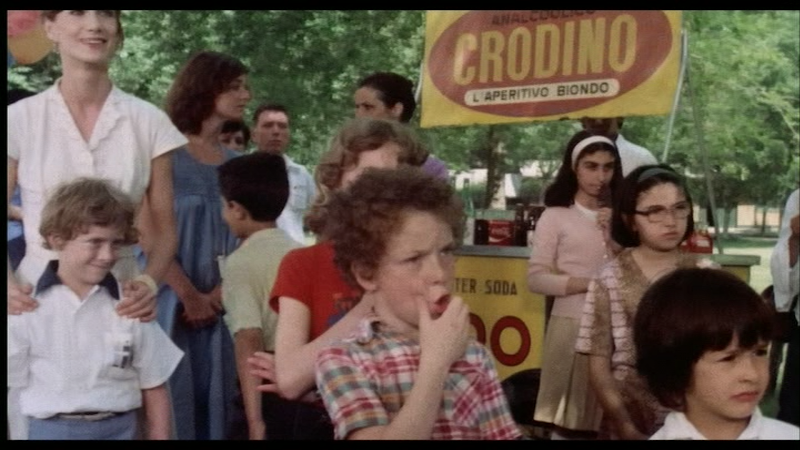 |
1) 2000 Anchor Bay DVD; 2) 2022 Arrow BD.
|


I left the negative space around the first set of shots do show how the DVD is curiously three quarters windowboxed, which the BD corrects. Both discs are actually 1.85:1, but we can see now AB only accomplished this by matting tighter and actually cropping out chunks along all four edges. Often on this site, it's a matter of thin slivers gained or lost across newer editions, but here we've gained a considerable amount of picture. And the resolution - wow! Arrow's transfer utilizes a brand new 2k scan of the original negative (except on the English language version, which seamlessly branches to English credits and inserts taken from an interpositive) with a beautiful encode that looks finely detailed and naturally filmic. Compare it to the DVD, which was anamorphic and free of interlacing, but still looks smeary and murky, almost like its taken from a tape master. I usually find it pretty corny, if not downright dubious, when film reviewers talk about what a different, new experience watching a film on blu-ray is. Sure, it's better, but it's not like you couldn't make everything out almost as well on the previous edition. But here, the new picture really helped me appreciate this film as the effective psychodrama Bava was going for, and not just a silly ghost story with some neat trick shots.
Of course, a LOT of that is being able to finally watch this film in the original Italian, too. The whole cast, and the kid in
particular, is dubbed much better. In the US
version, he's voiced by an adult attempting to sound like a little boy,
and it comes off as really cheesy. And the translations are different, too; so it's not just hearing the lines read differently; the lines themselves are different. For example, in the US version, the kid keeps yelling, "pigs, pigs!" But according to the new Italian subtitles, he's saying, "filthy," which is at least slightly more grounded. But if you still prefer it the other way, Arrow does also provide the dubtitle track, so you can read it either way. Plus, of course, both audio tracks are remastered with lossless DTS-HD tracks.
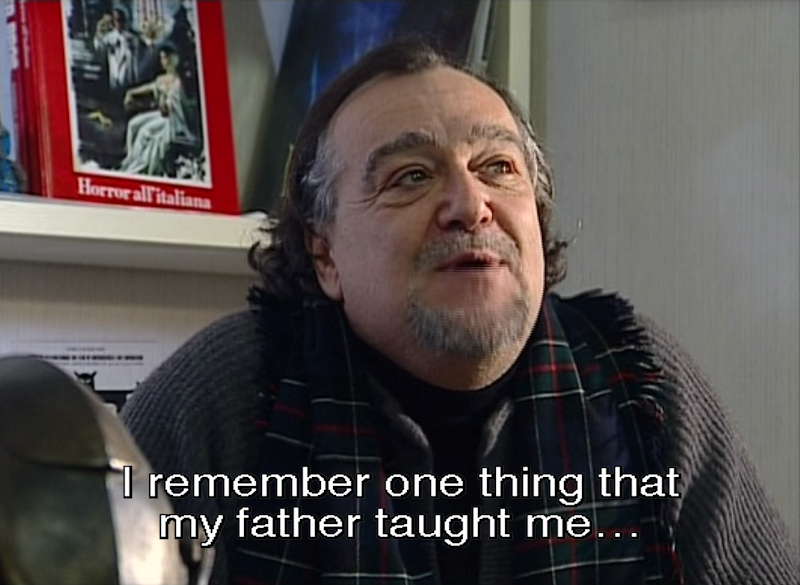 |
Anchor Bay's original interview.
|
Previously, I wrote, "Interview Daria, get a
Tim Lucas
commentary...
how isn't this a thing already? It's a no-brainer!" Well, sadly Daria
has passed, but the Tim Lucas commentary is here and it's great. He sounds more natural than he did on his OG Bava commentaries for VCI, but still with no dead air and plenty of great info. You can tell the difference when you have a general "cult films" expert doing a commentary versus Lucas here, who's dedicated decades to studying Bava in particular. Still, this commentary is just the beginning.
Now, as I already mentioned, AB did have a nice little interview with Lamberto Bava, which Arrow has not carried over. Instead they've conducted a new one, which looks a lot better in HD, and covers even more ground, running almost four times as long. They've also got a substantial new interview with Sacchetti, who I've really been learning to appreciate more and more as the consistent voice behind nearly all of my favorite I horror films by all the most famous directors. And if you want more critical analysis, there's an excellent video essay by
Alexandra Heller-Nicholas on the themes of hands and puppetry in the film, and a more general overview by
Stephen Thrower that runs almost a full hour. Both are full of great insight, but I wish Thrower's had been edited down a bit... there are sections where he covers ground already well-trodden in the other special features, and this featurette could've benefited in the pacing department. For instance, he, Bava and Sacchetti all explain how Bava accomplished the famous "hair" shot, using the same clips from the film, storyboards, etc. It's completely redundant, starts to get tedious and it's not the only instance.
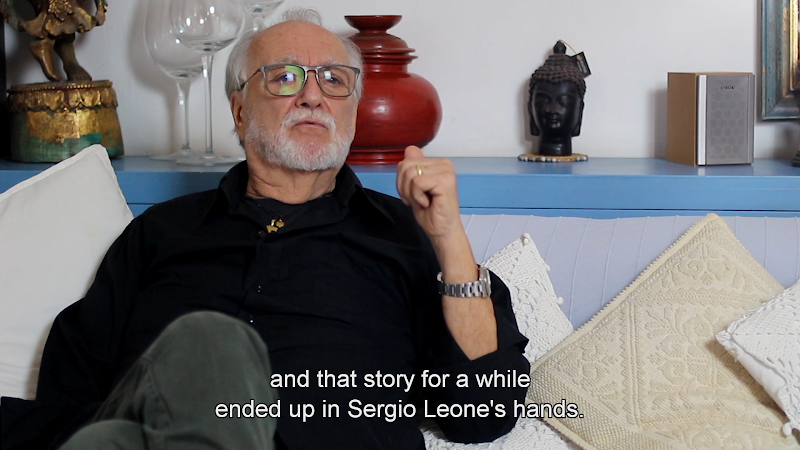 |
Arrow's new interview.
|
Still, at least they erred on the side of too much rather than too
little. You can't complain too much when an easy solution is to just
fast forward here and there, but I just wish the people commissioning
the extras for these discs would start taking a more holistic overview
of what they're doing. It's a common problem. If a filmmaker tells an
anecdote in the commentary, we don't want the exact same anecdote
repeated in their on-camera interview. And it's not like any of this
Shock stuff
are legacy extras that fell into Arrow's laps as-is. Anyway, moving
on: both discs also have a bunch of trailers and TV spots, with Arrow
adding some new stills galleries, too. And they've got a fun little
curiosity piece where journalist
Alberto Farina shows us a cute caricature from the film that Nicolodi gave him. Anchor Bay threw in a cool insert with
Beyond the Door 2 poster art, but Arrow gives us a 24-page booklet with notes by
Troy Howarth. It also comes with reversible cover artwork and a
Shock slipcover. Or, if you order it from Arrow directly, it comes in an alternate
Beyond the Door 2 slipcover.
Now, after
Shock, it took another twelve years to get the next unconnected sequel. Except the series returned to Ovidio Assonitis. This
time he's just the producer, but based on interviews, he seemed to be
the driving force behind this project. But his original title for the
film was
Train, and he says it was the distributors' idea to use the
Beyond the Door title, an idea he was against. Because, once again, it has nothing to do with the other movies.
Bo Svenson stars
in this one, a story of a bunch of American college kids who travel to
Yugoslavia and run afoul of a coven of witches who want to sacrifice
them all. The bulk of the film takes place on a runaway train, hence
the film's original title. This movie's from a whole different
generation than the first two and feels very different. It's very 80s,
less serious but gorier, and much less interested in psychology than
kills. It's got a good look to it, though, and at least someone gets
possessed in this, so there's a thematic connection to the other
Doors.
It's kind of a dumb movie. It has dialogue like:
"What is it you love about me?"
"I don't know. Your hair?"
...But it provides ample quantities of everything you'd look for from a
film like this. There's plenty of special effects, exotic locations,
action, production values (they got extensive use of that train), and a
whole bunch of crazy, entertaining stuff happening at all times. The
cinematography's back to workman-like after the Bava entry, but it's
glossy with plenty of interesting stuff in front of the camera, so it
still looks pretty impressive.
Now, there had been a cheap Dragon DVD first, but Shriek Show came along
and knocked it out of the box in 2008. A somewhat special edition with
a nice, anamorphic 2.35:1 transfer... although, to be honest, the
framing looks pretty tight. I wonder if the filmmakers didn't also have
1.85 in mind? That's how Dragon framed it. Anyway, their DVD wasn't even
anamorphic, so Shriek Show was easily the one to own regardless.
"Was," that is, because now Vinegar Syndrome's gone and restored this
film in HD with a fresh 4k scan of the original negative for a brand
new, Limited Edition blu-ray arriving just in time for Halloween.
 |
1) 2008 Shriek Show DVD; 2) 2019 Vinegar Syndrome DVD;
3) 2019 Vinegar Syndrome BD. |


Vinegar Syndrome's limited edition is actually a DVD/ BD combo pack,
which is why we've got three sets of shots instead of two. All three
discs are presented in 2.35, but Vinegar Syndrome's discs do pull out to
reveal a tiny bit more around the edges. The colors have been
corrected, looking both more genuine and vibrant, and detail is
clarified so nicely. I mean, we're jumping right from a DVD to a brand
new 4k scan of a negative in HD, so it's a big leap forward even with
Shriek Show's DVD looking as good as it did (one of their rare
non-interlaced ones haha). I suppose I should point out a weird little
detail where the edge of the frame sometimes comes in on the left,
effectively giving us a slight black pillarbox on the left-hand side,
re-adjusting the AR to about 2.33:1. That's on the Shriek Show disc,
too, though, and is clearly tied to certain shots (in one scene you can
watch it appear and disappear as the camera shot/ reverse shots between
two characters), so it's how the film was shot. One could argue that
maybe the proper framing would be to crop that edge tight enough, then,
that you never see it? But it's really no big deal; you won't see it
unless you have your eye glued to the left edge of the frame the whole
time watching for it. ...Although, now that I've told you guys, maybe
you will - sorry!
Both editions feature the stereo mix, which is in lossless DTS-HD on the
blu-ray. The Dragon DVD also offered a German dub, if anyone cares.
And both releases have optional English subtitles for the parts of the
film spoken in... Croation? I think? But Vinegar Syndrome has taken
the extra step of adding an additional option that subtitles the entire
film, English and all. So, to be clear, you can choose between either
sub track or none.
Now, one thing Shriek Show's DVD had going for it that still holds
weight is its special features. It wasn't quite a fully loaded special
edition, but it had some good stuff. There's a lengthy and fascinating
interview with Assonitis, and another interview with the
cinematographer,
Adolfo Bartoli. There's also the theatrical trailer, a couple bonus trailers, and an easter egg of an alternate title sequence with the title
Amok Train, which is also what's on the case (the on-screen title for both Shriek Show and Vinegar Syndrome is
Beyond the Door III).
Disappointingly, VS doesn't carry any of that over, but they have
created all new special features. They have their own interview with
Bartoli, plus on-camera interviews with the director (40 minutes long!)
and Bo Svenson, who's quite a character. There's some spicy
behind-the-scenes drama for this film (for example, Assonitis apparently
fired the director, but then changed his mind), so the new extras are
great, but it's a shame to lose that Assonitis interview as a
counter-point. And it's a small thing, but I'm surprised VS neglected
the trailer. They do give you some cool, reversible cover art, though,
letting you choose between
Amok Train and
Beyond the Door 3.
Plus the limited edition (2000 units) comes in a very stylish slipcover
that uses the same crazy art as the old laserdisc. So get the VS for
sure, but hang onto your old SS discs, too.
Well, they've done it! We now have kick-ass, fully loaded HD
editions of the entire trilogy. It's been a heck of a journey, but all
three films are perfectly represented on home video. So, well, I guess
it's time for Assonitis to hit us with that fourth
Beyond the Door sequel/ reboot he's been teasing all these years. Apparently,
it's coming out this year?!


