Is There Hope for Lars von Trier's Medea?

Before we get accused of becoming too caught up in the latest, high-end Ultra HD new releases and forgetting our exotic DVD origins, let's take a look at the dual releases of Lars von Trier's 1988 made-for-television classical drama, Medea.  Just two rare DVDs of a funky art film hardly anybody talks about anymore.  Could there be a future for it?
With Medea, Trier is directing an unproduced script by Carl-Theodor Dreyer, a fellow Dane who started directing in the silent era and is probably best known for Vampyr and The Passion of Joan Of Arc.  At the onset, that might not sound too promising.  I don't mean that as a knock on Dreyer, but Trier's artistic voice is probably most compelling as a screenwriter.  Sure, he's known for all sorts of directorial flourishes and technical innovations (uncharitably, one might say "gimmicks"), but it's really his writing that sets his greatest works above his peers.  So where does that dynamism go when he's dusting off an old script adapting an even older play?  Assuming I can trust wikipedia, Euripides first produced Medea in 431 BC, and that of course was based on an even older myth.
And admittedly, things here are slower-paced and free of the dark, sardonic wit we can otherwise expect from Trier.  But Medea is a powerful story - there's a reason it's been preserved and retold for centuries - and it's expertly told.  Trier stays pretty faithful to Dreyer's script, but he chucks the traditional Greek chorus that Dreyer had intended to retain, re-stages the story to a location that doesn't even try to be ancient Greece (there's a line where the king says he won't relent until the gates close behind Medea, when they're standing in a muddy of a tiny island that clearly has no gates in any direction) and utilizes some creative rear-projection that reminds us we're watching Trier, not Dreyer.  But then again, you'll probably be surprised how understated Udo Kier is here as Jason of the Argonauts.
Facets Video first released Medea on DVD in 2003, here in the US.DVDcompare says the Facets' "picture is VHS-sourced," but the back of the case claims it's "direct from the original video master."  The film doesn't have that classic shot on video look, but it probably was made on the cheap and at least edited on some kind of tape format.  Either way, as you'll see, it ain't pretty.  There are some shots where it's hard to even make out which character is on screen, though it's debatable how much of that is deliberate stylization.  It's even been suggested the image was intentionally downgraded to obscure the unnatural separations between the fore- and back-ground imagery in the rear projection shots.  I have to be honest, crushing the total image quality does help to mask the seams.  But is that the best this film can look?  Everyone talks about the Facets DVD and how ugly it is, but what about the later Raro DVD that came out in Italy in 2005 (and repressed in 2012, which is the edition I have)?  They seemed to turn it into more of a special edition, so I double-dipped to find out if things could be any better. 
2003 US Facets DVD top; 2012 IT Raro DVD below.
Well for starters, Raro is a shade darker than Facets.  Both discs are roughly 1.30:1, but that's rough because the edges of the frame actually shift slightly, even within a single shot.  I left the negative space around them so you can see how messy the edges are.  Raro's is a couple pixels wider, and in some shots reveals a bit more image (compare the bottoms of the second set of shots), but other times doesn't.  Either way, both discs clearly share the same grungy, murky, ugly master.   For the most part, the screenshots speak for themselves.  One detail you'll need me to tell you, though, is that on the Facets, every sixth frame is un-interlaced, while every frame is interlaced on the Raro, which I guess technically is a point in Facet's favor.  But it mostly just raises questions.  According to the back covers, the Facets is NTSC and Raro is PAL, just like you'd expect.  And test both video files in MediaInfo, that bears out.  But both editions seem to actually play at the same speed for 76 minutes, so something weird.  I guess one has been conformed to the other timing.  Considering how funky this disc looks anyway, what's one more little quirk?

Both discs present the film in its original Danish mono 2.0.  One point for Raro: the English subtitles are burnt in on the Facets, but both English and Italian subs are optional on the Italian disc.
Facets has no extras at all, not even a trailer or insert.  But Raro has a couple noteworthy goodies, starting especially with their interview with Massimo Fusillo, a literature professor.  This is actually a pretty great interview, especially for a second-hand expert (as opposed to one of the filmmakers with first-hand knowledge of working on the footage).  It's a tight fifteen minutes with no waffling or film clips.  He starts out telling us about the original play and earlier literary adaptations, including different that have been added to and removed from the story over the years.  Then he gets into the film, with good insight into its history and comparing it to Passolini's Medea from 1969.  Technically it's low-fi, with jump-cut editing, interlacing, the sound of air conditioning buzzing and framing/ lighting that seems more interested in Massimo's fax machine than the man himself.  But content-wise, it's just what we want from an expert, and other special edition producers would do well to take notes.

The only other on-disc extra is a silly thing where quotes from the original screenplay can be read on the menu screen, followed by two unsubtitled clips from the film, ostensibly so we can compare how Dreyer wrote it with how Trier shot it.  But without the subtitles, it's less enlightening than just watching the film itself, utterly pointless, and just feels like an attempt to flesh out the special features to make this feel more like a loaded special edition that it is.  On the other hand, though, Raro has provided an excellent booklet, in both English and Italian, with an essay by Gabrielle Lucantonio as well as reprints of various reviews, articles and Trier quotes on the film.  So that's worth having.
The fact that some frames aren't interlaced on the Facets disc suggests some, if not all, of the present interlacing this film suffers on disc isn't inherent to the original film elements.  Who knows what else is a flaw in the DVD presentation as opposed to the master?  Everything you read about this film suggests it must always look as terrible as it does, but this makes me wonder what kind of restoration is possible?  Even if it couldn't look like Lawrence of Arabia in 4k, it seems likely it could look better than it does presently.  I'd love to find out some day.  But in the meantime, the Raro's the way to go, if only for that interview.

Werner Herzog Documentaries and Shorts

Okay, I've been covering all the Werner Herzog collections with the best editions of his films throughout the run of this site.  And in the course of that, this box, Werner Herzog: Documentaries and Shorts, has been pulled into the comparisons over and over again.  It's the 24 film, 6 DVD boxed set that Herzog started selling exclusively through his own website in 2006.  And it's still relevant because, even after all these fancy special editions and restorations released all around the world, four films can still only be found in this set.  Specifically, they are: Jag Mandir, Wings of Hope, Bells From the Deep and I Am My Films.  That's two feature-length documentaries and one short documentary by Herzog, plus a full-length film documentary about Herzog, respectively.  Everything else has been released elsewhere, largely for the better.  So first, here's a direct link to the 21 films I've already covered previously on this site:


...All of these films are presented better in other sets, mostly on blu-ray.  Even in the case of The Flying Doctors, which has yet to be released in HD anywhere, is still better on another edition (as an extra on Revolver's Encounters At the End of the World disc), because it isn't interlaced.  Everything in this boxed set is badly interlaced, which really hurts its viability.  Really, all that makes this set viable, are the remaining exclusive films.  But that is a critical exception.
Wings of Hope is a 1999 documentary I'm always surprised has never been more commercially available.  It feels like it would have more easy, mainstream appeal like Grizzly Man than any of his more eclectic, eccentric stuff like The Wild Blue Yonder or Precaution Against Fanatics.  It's the story of a seventeen year-old girl who was the sole survivor of a plane crash, who then had to survive for weeks, lost deep in the Peruvian jungle.  Herzog interviews her, then takes her on a journey to retrace her steps, even finding the wreckage still strewn about in the jungle decades later.  Yes, it's very much akin to Little Dieter Needs To Fly, a documentary so successful that Herzog later made a feature film about it for MGM starring Christian Bale.  But it's also very much its own distinct story, and Juliane Koepcke is a fascinating character in her own right.  It's really a wonder there wasn't even an Anchor Bay or New Yorker DVD of it in its time.
2006 .com DVD.
The box lists this as 1.33:1, but it's really more like 1.31:1, and like everything in this set, suffering serious interlacing problems.  Otherwise, though, the colors are strong and distinct, details are about as clear as you can ask for in standard def, and overall this looks pretty damn good for a 16mm documentary on DVD.  There's just the one English language stereo track with no subtitle options (instances of foreign languages spoken are over-dubbed by Herzog or an uncredited actress who speaks for Koepcke).
I have to admit, I can understand a bit more why 1991's Jag Mandir has never been commercially released outside of this set.  After a brief introduction by the man who staged the show and some explanatory narration by Herzog, this is a largely a single, filmed performance of the private theater of Maharajah of Udaipur.  The camera cuts and moves around, but the closest analog to this film in Herzog's film is still probably that AmEx presentation of The Killers' concert he filmed for Youtube.  After the opening, there's really very little of Herzog in this film, and your interest will be held or lost entirely by how interested you are in the central performance being captured.
For my money, this is a lot more fascinating than The Killers' show, and the final film feels more in keeping with Herzog's body of work just because this theater seems more in line with the sort of material he seems interested in pursuing.  But still, after the first couple of minutes, this could be the work of any random videographer who happened to be there that day.  And like that Killers film, Herzog fans who aren't interested in the particular cultural artifact might be satisfied to just watch the first ten or so minutes, and then switch it off when Herzog eases off and the "plain" show starts.  But it's certainly a much more colorful, varied performance than just watching some 2000's pop rock dudes standing around on stage, with a constantly rotating cast in a variety of exotic costumes performing a much broader variety of music and dance.
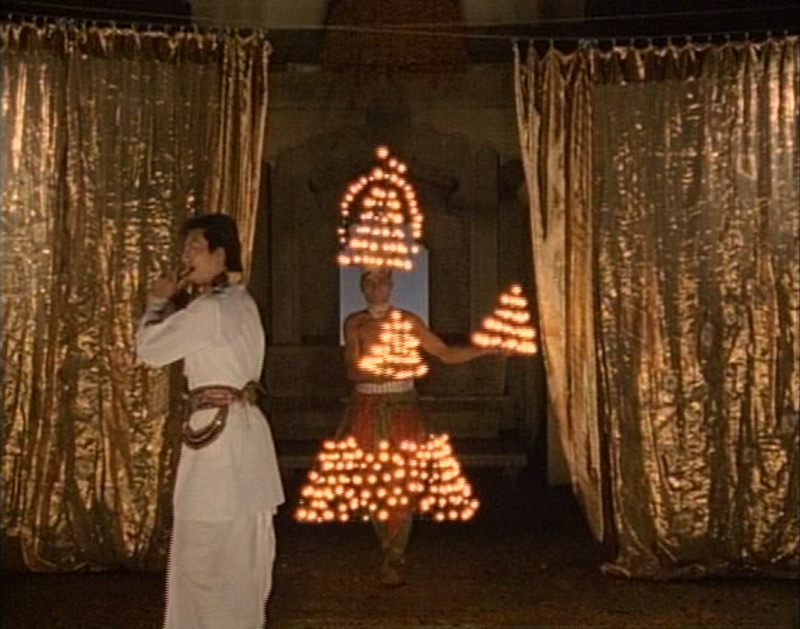
2006 .com DVD.
Again listed as 1.33:1, this presentation's even narrower at 1.27:1.  Otherwise, the story is just like Wings of Hope.  It's another 16mm film that mostly looks quite clean and distinct as far as standard def goes, but the interlacing is strong and harmful.  Casual viewers might think, hey, my player automatically deinterlaces everything it plays, so what's the problem?  But that's really just softening the image and making weird ghosting frames that creates a nasty judder whenever the camera pans.  You can't really fix interlacing after the fact, except in the cases of very specific pull-down issues and specialized software.  Otherwise, it's akin to using Motion Smoothing to "fix" a grainy image or other tinkering that really does more to damage the image than improve it.

Anyway, this film just features the one mono track, which is mostly clear apart from some natural room tone.  It has a few burnt in German subtitles, and removable English subs for the entire film.  Not that there's much talking at all in this movie.
Finally, I Am My Films is a 1978 feature-length documentary about Herzog, by Erwin Keusch and Christian Weisenborn.  It's largely based on a long, sit down interview with Herzog, though it's supported by many clips from the films he'd made by that point.  The clips play long and would have been a lot more exciting, I'm assuming, back when his films would have been very hard to see outside of a special theatrical screening.  But now that his fans have them all on disc or screening options at their fingertips, it's a bit of a tedious drag on the film's pacing.  It's not just quick inserts to illustrate what he's referring to; it's long stretches of scenes from his films being played uninterrupted.  So you might be tempted to fast forward through those.  But apart from that, it's a satisfying doc and early precursor to films like Noah Baumbach's celebrated DePalma.  There's also some nice behind the scenes footage from the filming of Stroszek, and it ends with Herzog playing a reel to reel recording of Klaus Kinski flipping out.
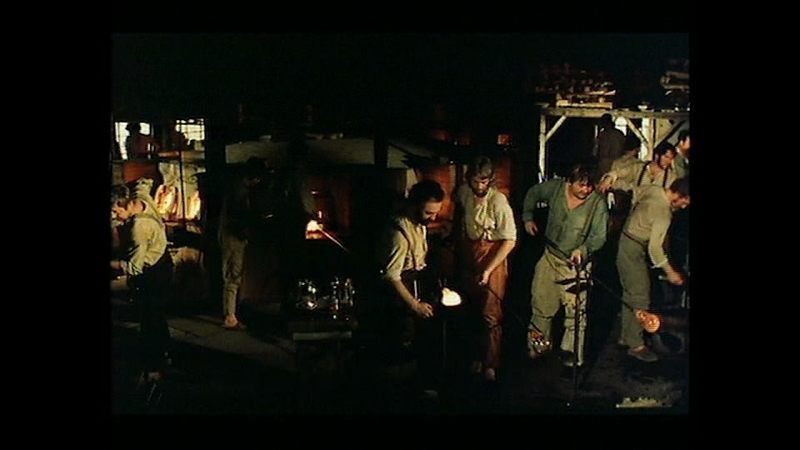
2006 .com DVD.
Credited as 1.33:1, this is more like 1.29:1, with the exception of a few, non-anamorphic widescreen clips of a couple of Herzog's features, like that first shot above, from The Enigma of Kasper Hauser.  The picture's a bit soft with yellowed colors, but that's quite possibly down to the original film.  The interlacing isn't, though, of course.  Some color correction might work wonders, but for an honest transfer of the original film to disc, this is just fine, apart from that interlacing.

The film is presented in its original German mono with optional English and Italian subtitles.
Documentaries and Shorts contains no extras for any of its films - except, I suppose, in so much as the films about Herzog, such as Portrait: Werner Herzog, can be considered extras themselves - not even trailers.  The DVDs are packaged in six standard amary cases housed in a thin slipbox.

I should also mention the Shock version of this box, which I wrote about more in depth here.  It's essentially an Australian copy, but with a couple additional films and discs, and minus some language options (mostly Italian subs).  Those additional films are all available elsewhere, and the Shock set is long out of print and very hard to find, but still possibly a preferable option, if you ever find yourself in the unlikely event of choosing between the two options.  The prospect of paying through the nose for either set isn't a pleasant one, but it is still our only option for the remaining hold-out exclusives.  Hopefully, Shout, BFI or another label will come through and restore these onto blu-ray, too.  But that's a big if and when.

Uncle Sam Wants You In 4k Ultra HD

Anybody with just a little bit of insight into these things could tell that it was only a matter of time until Blue Underground released 1996's Independence Day-themed slasher, Uncle Sam, on 4k.  In fact, I held out for years, refusing to upgrade my DVD, because I knew it was bound to happen sooner or later.  Until I broke down last December and bought the blu-ray as a little Christmas present for myself.  Then the UHD was announced in January.  You're all welcome.
Uncle Sam is the fourth and final collaboration of Larry Cohen and William Lustig, following their Maniac Cop trilogy.  It's not as great as their first two entries, but it might be as good as the third.  It's certainly more coherently resolved.  And it's a thematically appropriate follow-up: from a cop who rises from the dead to exact revenge on those he feels wronged him, but must be stopped when he winds up hurting innocent people to a soldier who rises from the dead to exact revenge on those he feels wronged him, but must be stopped when he winds up hurting innocent people.  There are a lot of obvious similarities, too, with one of the better Masters of Horror episodes, Joe Dante's Homecoming, about fallen American soldiers returning from the Middle East as zombies looking to exert some payback.  But those soldiers were essentially good guys come back to get the bad people who sent them to die.  "Uncle" Sam Harper is at heart a terrible guy - again, more akin to Matt Cordell - who wants to kill not only his fellow Americans who fail to live up to his fanatic levels of blind patriotism, but to keep abusing his family, as he did in life before he shipped off to war.
You can count on Larry Cohen to have a lot of clever, interweaving themes in his scripts, with characters and plot turns that elevate the writing above his peers'.  And you can count on Lustig to shoot an attractive, dramatically effective picture with impressive set pieces that suggest something greater than its actual, limited budget.  The night sequences look great and the fire stunts are envelope-pushing.  Both Lustig and Cohen have an fine appreciation for great character actors, too, and this film is packed with them, adding much-needed jolts of nuance and credibility to what might be otherwise typical B-movie fare.  Isaac Hayes (pre-South Park) is obvious, but there's also Bo Hopkins, PJ Soles, William Smith, Timothy Bottoms and most entertainingly, Robert Forster as a local politician who's only in town to deliver a Fourth of July campaign speech to the local "hicks."  Admittedly, this film has a tendency to lay a little flat, but thanks to all the talent involved, there's more going on here than your average slasher.
Elite Entertainment originally released this film back in 1998, essentially carrying over their laserdisc special edition to the latest format.  But in 2004, Lustig was able to bring his baby back home to Blue Underground, with a new, specialer edition DVD.  By the way, I don't have that Elite disc, but it was non-anamorphic, so it was always time to replace that sucker.  Anyway, that improved DVD was updated to blu-ray in 2010 and now, just in time for July 4th, they've upgraded it again to 4k Ultra HD.
2004 BD DVD top; 2010 BU BD mid; 2022 BU UHD bottom.
ltr: 2004 BD DVD; 2010 BU BD; 2022 BU UHD.
To start with, the framing shifts slightly, from 2.36:1 to 2.35:1 and finally to 2.39:1, with the UHD showing a smidgen more on the sides, but also achieving its wider AR but cropping slightly tighter along the top than previous editions.  Though, by splitting the difference horizontally and vertically, it makes the distinction really tough to notice outside of a direct screenshot comparison like this.  The real difference is in the resolution; I mean, just look at that close-up.  Okay, it's shot from far away that you can never quite read that label of... mustard?  But so blurriness and digital noise has been replaced with photo realism and, for the first time, clearly rendered film grain.  Another nice improvement is the edge enhancement, that was probably useful on the DVD but made the BD a bit crass and unattractive.  It's happily gone on the UHD.  And its not like any of BU's previous editions were low quality in the brightness or contrast departments, but the UHD renders the highlights more natural and occasionally finds more picture information in them.  Seeing Uncle Sam look this good for the first time might help raise the whole film in the eyes of horror fans who've sometimes been a little too hasty writing it off.

This film started by giving us a choice between a stereo and 5.1 mix (on both the Elite and BU DVDs, neither of which had subtitles).  On blu, the stereo mix was dropped, the 5.1 was boosted to DTS-HD, a new 7.1 mix (also DTS-HD) was added, and so were optional English, French and Spanish subs.  Now, the UHD keeps the lossless 7.1 but replaces the 5.1 with a Dolby Atmos track and keeps all three subtitles.
Now, Uncle Sam has always had extras, going back to the laserdisc.  It had the trailer, and a fun commentary by Lustig and Hayes.  It's mostly Lustig giving an expert, informative commentary track, with Hayes chiming in with a few memories of his own.  When BU got their hands on it, they added a second commentary by Lustig, Cohen and producer George G Braunstein.  Unfortunately, Lustig repeats a lot of the same anecdotes, practically verbatim, but there's a bunch of new stuff to be found in here as well.  They also added a fun featurette on their explosive finale, a stills gallery, a brief gag reel (funnier if you listen to Lustig explain it in the audio commentary first) and two takes of a brief deleted scene.

The same extras were carried over to the blu-ray and UHD.  I was disappointed they didn't take add anything extra for the UHD... Perhaps Lustig feels he's said everything he has to say already, but it would've been nice if they could've sat somebody down on camera for a new interview... maybe one of the leading ladies, or Mark Governor to talk about the music?  Oh well.  The latest release at least comes in a very cool holographic slipcover that recreates the famous VHS box, as well as reversible cover art inside.
Uncle Sam isn't exactly Lustig's greatest achievement, but it is a fun, off-beat 90's horror flick.  And thanks to the fact that it's the baby of the head of Blue Underground, it's gotten restored to a degree it probably doesn't deserve.  I mean, The Exorcist and A Nightmare On Elm St wish they had home video transfers like this.  But who am I to look a gift horse in the mouth?  This is a great, summertime treat.

Herzog: The Collection, Volume 2 and Echoes From a Somber Empire

Eight years after Shout Factory released their impressive Herzog: The Collection boxed set, we're back with Volume 2!  This time around, we get five discs and eleven films (seven shorts and four features), six of which are debuting here in HD: Dark Glow of the Mountains, Wild Blue Yonder, La Soufrière (technically, this was released on blu by Revolver as a bonus for their release of White Diamond, but it was just a standard def extra), Echoes From a Somber Empire, Signs Of Life, Herdsmen Of the Sun.  And one more, Wheel of Time, has been released on blu before, but this is the first with English language options.  The other four are at least Region 1 BD debuts.  So even if you already have The BFI's Werner Herzog Collection and every other English-friendly Herzog release from around the world, you're getting seven upgrades here.  We'll be taking a look at Echoes From a Somber Empire below.  Every other film in this set has already been covered on this site, so I've updated their corresponding pages with fresh comparisons from this set:


A quick summation to save you the trouble of clicking through all those links: All of the blu-ray debuts are obviously superior to their previous DVD-only releases, but this set has no extras, including any pf what was on past DVDs, like the Signs of Life commentary or the Wheel Of Time interview.  So while these are upgrades, you'll still want to hold onto any old discs you have with extras.  And for the four shorts that were already included on the BFI set, there are slight differences, in terms of brightness or contrast, but they're fairly equivalent even when they're not strictly identical.  But they have one advantage: Shout has added optional English subtitles for the English language audio, where BFI didn't bother.
And that brings us to Echoes From a Sombre (here spelled Somber) Empire, the 1990 feature-length documentary making its blu-ray debut here, and previously only available on DVD in the Werner Herzog Documentaries and Shorts boxed set (primarily sold exclusively on Herzog's own website starting in 2006, though there was a variant, Australian version available from Shock in 2009).  This is a heavy one.  In fact, the film opens with a worried Herzog reading a letter from journalist Michael Goldsmith, who he's been unable to reach after they were arrested and expelled from Africa.   ...We don't learn it in the film, but I looked it up, and Goldsmith passed away the same year as Echoes' release, in a hospital in Southern France after suffering a stroke, which explains Herzog's inability to contact him.
Anyway, we then enter the body of the film, where Herzog follows Goldsmith as they research the life and trials of Bokassa I, former president and emperor of Central Africa.  Goldsmith interviews his former wives, lawyers and others, while also revisiting key locations of his reign, during which time Bokassa was accused of a myriad of horrible crimes, from cannibalism to massacring school children.  Goldsmith had actually been imprisoned by Bokassa himself, so he has a real connection, and Herzog himself remains a mostly silent witness throughout the film.  A good third of this film is also made up of vintage press footage, and at one point, to illustrate a dream Goldsmith had, we see the crabs later depicted in Invincible.  In fact, having revisited this film for this review, I've realized some of it is actually the exact same footage.
2006 .com DVD top; 2022 Shout Factory BD bottom.
This is a huge jump in quality.  Where to start?  Well, the AR has been corrected from 1.29:1 to 1.33:1, but even beyond that, the image has been pulled back to reveal more picture around all four sides.  Like everything in the .com set, this DVD is also interlaced, which of course the BD fixes.  The colors have been strongly corrected, looking way more natural and attractive.  The SD softness has been cleared away in the jump to HD and detail is much clearer now.  Look at the pattern on Goldsmith's jacket which has been smoothed away on the DVD.  Further information that was crushed in the DVD's shadows are back in view now, too.  Grain is soft to invisible, which suggests an old scan, poor encode and/ or possibly even DNR.  But regardless, it's a revelation.
Both films include the original mono audio (which is mixed, but mostly French), in DTS-HD on the blu and optional English subtitles.  The DVD also throws in optional German subtitles.

And again, there are no extras, so that's easy.  Not even a trailer.  Neither set has any extras for any of its films.  So hang onto your old DVDs of Wild Blue Yonder and Signs Of Life.  Shout's set at least comes in a slipcover.  Their Volume 1 was a big, fancy mediabook with large, full-color pages.  Volume 2 you're buying for just the movies.  But when it's a collection of important works from one of the world's greatest filmmakers, that can easily be enough.
Now, here's my wishlist for Volume 3, all of which are still lacking blu-ray releases: Jag Mandir, Wings of Hope, Scream Of Stone, Christ and Demons In New Spain, Les Gaulois, No One Will Play With Me, Pilgrimage, Bells From the Deep, The Transformation Of the World Into Music, Ten Thousand Years Old, Herakles, and Game In the Sand if Herzog ever relents (he said he'd never release it because some of the footage was too disturbing).  Plus, a bunch of his newer releases are still absent on blu, including Family Romance LLC, Meeting Gorbachev, both seasons of Death Row, Fireball and Into the Inferno.  I don't want to sound greedy; we've just gained some great ground today, but there's still a lot of work left to do, so bring it on!

No Chance. No Help. No Escape. Without Warning

I could've told you guys this review was coming, but then it wouldn't have been... Without Warning!  Thank you, that's all I got.

Nah, okay.  Without Warning is an early 80s (filmed in the late 70s) sci-fi horror that's graduated from a long guilty pleasure of mine to a straight up, actually great little flick.  Director Greydon Clark doesn't exactly have the most critically renowned track-record, ranging from titles like Satan's Cheerleaders to The Forbidden Dance, with a whopping six features appearing on Mystery Science Theater 3000 and Rifftrax.  But this - and it might sound like a backhanded compliment given what I've just said, but this is his masterpiece.
First of all, Without Warning is a tight, well-paced script with a premise, not for nothing, introduced the Predator concept years before Predator.  Yes, an alien comes to Earth to hunt humans for sport.  And, as in Predator, out protagonists get caught in the middle of a violent three-way conflict with not just the aliens, but armed humans who prove to be just as dangerous.  It sure doesn't hurt that said dangerous humans are Jack Palance and Martin Landau.  In fact, the cast is chock full of great character actors, including Neville Brand, Cameron Mitchell, F Troop's Larry Storch in a genuinely funny comic relief role and a young David Caruso.  The alien has a great design created by none other than Rick Baker, and his weapons are awesome.  The great Dean Cundy (Halloween, Jurassic Park, etc) shot the  film, it's got fantastic lighting and a genuinely moody atmosphere that gives the material an elevated level of credibility the film's limited budget and far-out concepts otherwise probably couldn't have sustained.
For years, Without Warning was only available via cheap, often cut, foreign DVDs.  I used to own the Scandivian DVD from Another World, which was the first anamorphic widescreen option, but had a few scenes patched in with subtitles and no audio.  Nobody had done this movie right until Scream Factory released it as a DVD/ BD combo pack in 2014.  Uncut, widescreen, HD and they even gave it the proper special edition treatment with a bunch of great extras.  It was easily the definitive choice for years, but its since gone out of print.  Fortunately, Kino has seen fit to not only bring it back into print, but to give it a new, 2k scan.
1) 2014 SF DVD; 2) 2014 SF BD; 3) 2022 Kino BD.
Scream Factory and Kino both properly matte this film to 1.85:1, though Kino pulls back to reveal a tiny pit more picture along all four sides.  Scream Factory's blu still holds up fairly well, except it's soft.  It almost looks like standard def until you compare it to the DVD, which is really soft.  But there's still very little sign of actual film grain until you look at the new transfer from Kino, which is much sharper and more refined.  And it's not just the grain, but actual detail in the film is clearer and easier to make out.  It's definitely a superior scan... but the colors are a little more debatable.  Overall, Kino's are more stark and contrasty, where Scream's are warmer.  Just look at the skin tones in that second set of shots.  Kino also has deeper, darker blue night scenes.  Honestly, I can't decide which set of colors I prefer; it varies shot to shot.  But Kino's PQ wins in the other departments, which easily tips the scales in their favor.

All three discs offer the original mono track, in DTS-HD on the blus.  Scream Factory and Kino both include optional English subtitles as well.
Scream's extras really add a lot of value, starting with a pretty great commentary by Greydon Clark.  He has a lot of memories and behind-the-scenes info.  He runs out of things to say by the last half hour or so, though, so you can turn it off early and not miss much.  Red Shirt then provides some first class interviews, the best of which is probably a joint featurette with the two young leads, Christopher Nelson and Tarah Nutter.  We also got ones with producer Daniel Grodnick, Dean Cundy and effects artist Greg Cannom.  There's also a stills gallery, a trailer and reversible artwork.

And Kino has kept all of that.  And they've even added a little more.  They've thrown in the Trailers From Hell (in addition to the basic trailer) with Mike Mendez.  That's fun, though he's a little dismissive of this film as anything more than a cheesy lark.  And in addition to reversible artwork, Kino's disc also comes in a slipcover.
So yeah, this new Kino is a nice upgrade, though there is a subjective aspect re: the colors.  Still, if you already own the Scream blu, that might make this a lower priority upgrade.  If you don't have it, though, I'd sure rather pick up the slightly superior Kino disc for a reasonable price than shell out the crazy, inflated prices people were EBaying the 2014 blu for.  So it's all good news.