Who Can Kill a Child? Huzzah!

Oh yes, I have been waiting for this one!  Today we have Mondo Macabro's new blu-ray release of Who Can Kill a Child?, pretty much the greatest killer children film of all time.  And this blu marks the film's near debut in HD (more on that later) and the first proper special edition of this 1976 Spanish horror classic.  The Dark Sky DVD did have a couple decent extras, too, which we'll also look at.  But really, this is a long awaited blu-ray that fills a big deficit.  I'm excited.  😁
I have a pet theory about this movie, that Stephen King basically lifted it for his much more famous Children Of the Corn.  Now, please don't make too much of this - I don't claim to have any great inside angle or deep-seated conviction - but it feels right to me.  This movie came out in 1976, and was, you know, about as popular as a small foreign horror flick is going to get in the USA, meaning still pretty obscure.  But I did read where King spoke positively about this film back then.  And then, at least according to Wikipedia, he published his short story in Penthouse in 1977.  And certainly, there are completely original elements to King's story, i.e. the whole thing about a monsterish creature in the cornrows that the kids worship as a god.  And you know, neither story invented the killer kids subgenre... obviously there are some major precedents like The Bad Seed, Village Of the Damned and sort of The Omen (it also came out in '76).  But everything about the young, idealistic couple on a trip wandering around a small, seemingly abandoned village only to find out that the children are lurking, and ultimately murderous... as well as key elements like the pregnancy, stumbling on the kids in the church and the ultimate resolution (no spoilers, I'll leave it at that) all feel like the same story being told twice.  And we know King likes to import awesome foreign horror ideas into the US, like his Kingdom Hospital of Lars von Trier's original masterpiece.  So... that's my pet theory.
This movie's better than Children Of the Corn, though.  That movie's fun, though it gives Who a strong advantage by softening up King's original story, with the couple adopting two of the kids from the corn, and there's still the issue of that film's missing footage.  But any way you cut it, this is a better made, more dramatic film.  The performances are better - including a neat appearance by the Demon Witch Child herself! - the moral questions raised are more thoughtful and compelling, and the horror is more genuinely disturbing.  We're not let off the hook by a big plot point where a dude just has to drive a tractor into a monster to save the day.  Here, there are no pat explanations or plot devices; we don't even learn why the kids have gone homicidal apart from some brief philosophical suggestions of why they might be in some ways justified.  Apparently the book (yes, Who was also based on a book) actually did go into some pseudo-scientific clarifications, but the film wisely steers clear.
And wasn't this film remade?  Yes, in fact the special features on Mondo's new release even talk about it a bit.  From 2012, it's called Come Out and Play, and it isn't just a remake; it's practically shot-for-shot. It's such a faithful copy that there's really no reason for it. It doesn't add or alter anything. Well, it does one thing. It cuts about 30 minutes out of it, mostly from the beginning. And it doesn't duplicate every single camera angle, like Gus Van Sant's Psycho remake. However, like that remake, it just feels like a completely pointless exercise because, really, every moment plays out the same. And, frankly, the scenes were played a little better in the original (for instance, when the guy tries to open the kid's tackle box and gets a surprising response - it's more effective in the original). On the other hand, because it's such a faithful remake, they manage to not screw things up completely like so many remakes do. There's no arbitrary changes that unwittingly detract from the drama, ruin characters carefully constructed motives or make plot points illogical. It's just... the same things over again. And most of the performances are fairly comparable - only the wife stands out as having been much better acted in the original. Everybody else at least comes close enough. As such, if you just jump into this movie blind (i.e. having not read the book or seen the original), you'll probably think it's a fine, surprisingly derided horror movie with a compelling storyline. And it is out there on DVD and blu, too.  But you're doing yourself a real favor if you watch the original instead. And once you have seen the original, all the value of Come Out and Play is lost.
So, Who's history on disc is a little complicated.  Here in the US, Dark Sky gave us a nice little DVD in 2007, and in the subsequent couple years, different companies put it out across the various countries in Europe with a new transfer and sometimes an additional featurette.  But naturally Spain got to this film first, putting out a basic edition way back in 2001.  That version was non-anamorphic, though, and completely barebones.  And I called Mondo's release nearly Who's debut in HD, because there was a Spanish blu-ray put out first in 2016.  But that edition was disappointingly barebones, reportedly DNR'd and more critically, not English friendly.  So yeah, unless you're fluent in Spanish, this is your first real HD option.
2007 US Dark Sky DVD on top; 2018 US Mondo Macabro blu-ray bottom.
Mondo's new blu boasts a "Brand new 4k transfer from the film negative" and looks terrific.  And Dark Sky's DVD only serves to make it look better by comparison.  The DVD is ostensibly 1.85:1, but as you can see, there's a bit of dead air in the overscans, particularly on the left, so it's really closer to 1.83:1.  Still, getting an anamorphic widescreen transfer of this film with the correct language options (more on that in a minute) was pretty exciting in 2007.  But after seeing Mondo's transfer, you can just throw your old discs out.  Framed at 1.85:1, it doesn't really reveal any more picture - it might even lose a sliver, shifting slightly from shot to shot - but it is so much cleaner in HD.  I mean, where to even start?  Going 4k rather than 2k really helps sure that the grain is very naturally captured, and detail is definitely stronger here.  It doesn't help the DVD's case that it has a waxy look, like they tried to to wipe away grain compression.  Obviously, a DVD is never going to be able to resolve grain like a blu, but they over-compensated on the Dark Sky.  Also, the DVD colors have a heavy green push to them, like there's a tint laid over the whole film.  Look at the black and white comparisons a little further down the page.  Mondo has fully color corrected the film, making it look very attractive and authentic, also restoring some information in the shadows that the DVD had crushed into solid black.
2007 US Dark Sky DVD on top; 2018 US Mondo Macabro blu-ray bottom.
I mentioned correct language options with this film, and that's important.  This is a multi-lingual film, with tourist characters speaking to each other in different languages.  So ideally, the way to view this film is with the mixed audio track and subtitles for all the non-English parts.  Fortunately, both Dark Sky and Mondo included those audio tracks: the original mono, in 2.0, upgraded to lossless DTS-HD on the blu.  They also included fully Spanish tracks, which dub over all the other languages to Spanish, and the blu adds a third track, dubbing everything into English.  But the mixed track is the most authentic one, demonstrating the language barrier between characters.

Mondo's disc also boasts "newly created English subtitles," where they've fine-tuned the translations.  So, for example, in the scene shown above, the news report starts out by saying, "[i]n spite of their suicidal sacrifice, the demonstrators' protests have been futile" on the DVD.  But the blu-ray now writes, "[t]he sacrifice of the priests as a protest against the war... have been in vain," which I assume is more accurate.  Mondo also gives you more subtitle options, so you can have it translate all the dialogue, or just the parts that aren't already spoken in English.
2007 US Dark Sky DVD on top; 2018 US Mondo Macabro blu-ray bottom.
And speaking of Mondo laying on the options, the blu-ray also makes the extended, documentary-style intro optional.  If you're not familiar, the film starts with an eight-minute documentary prologue, setting the tone for the film that's about to take place.  This intro is often cut from various international cuts of the film, which is honestly understandable.  It only connects to the story in a subtextual/ thematic way, and features some very graphic, 100% real imagery from the holocaust and other tragedies.  So you can imagine marketers trying to sell you a little light, scary entertainment would be keen to just lop it off.  Now, the DVD did include the intro, as does this new Mondo blu-ray (I'd be pretty bummed if they didn't).  But Mondo's blu makes it optional, so you can watch the film with or without it.  They call it the Island of Death version, because it also features that alternate title card and alternate opening credits that play over the first scene of the movie.
Finally delving into special features, the DVD featured two key interviews: a nine one with director Narciso Ibanez Serrador and a sixteen minute one with the DP, Jose Luis Alcaine.  Both feature forced English subtitles and are pretty good, but could've definitely stood to go a little further in depth.  But apart from a stills gallery, that was all the DVD gave us.

Happily, the blu-ray goes further.  And to start with, yes it includes those two interviews from the DVD.  We hear a lot more from them now, however, with the inclusion of a roughly 45-minute Spanish television documentary on the film, that pairs the two of them up with a genre expert and their host to reminisce on the film.  One really cool aspect is that, we know the director spent a lot of his time doing Spanish television, but this actually explores that work, showing clips, etc.  Then there's a fun interview with British critic Kim Newman, who talks about the film and even its place in the killer kids subgenre.  He also compares it to Children Of the Corn, but if he shares my pet theory, he doesn't mention it.  😉
But that ain't all.  There's also a brand new audio commentary by Kat Ellinger and Samm Deighan, who do a podcast called Daughters of Darkness.  I've never listened to it, but I'm going to check it out now, because they do a great, informative job here, filling us in on differences between the book and film, etc.  There's also a fun trailer for a double bill with Lucifer's Curse, where they mix the footage up so it looks like some of the film from that movie was in Who Can Kill a Child.  Then there's some radio spots and a montage of clips from other Mondo Macabro releases. 

And the edition I'm reviewing is the limited edition that was only available direct from Mondo's site.  It's limited to 1,000 numbered copies (mine's #771), and is essentially out of print, though I think I read somewhere that Mondo held onto a few copies for an upcoming holiday sale.  So if you really want it, you should still have a shot.  But a regular, non-limited edition should be coming out sometime in July.  That version comes in a blue case instead of a red one, has different artwork, and is missing the following exclusives, pictured above: eight cardstock lobby cards, reversible Island Of the Damned artwork and a twelve-page booklet with notes by Lee Gambin.  My understanding is that the actual on-disc content, including all the special features, will be identical.
So this is a pretty terrific release of the film, whichever edition you get.  And it's a really under-appreciated horror flick.  I'll put this at the very top of the killer kids list, but even as just one of the all-time great horror films of the 70s, period.  I'm honestly giddy.

Werner Herzog's Incredible Saga of Little Dieter (DVD/ Blu-ray Comparisons)

Guys, if your familiarity with Werner Herzog as a documentarian begins with Grizzly Man, go back and check out 1997's Little Dieter Needs To Fly right away.  That's a bit of a weird period for Herzog... not among his classic 70s stuff with Kinski, Bruno S., etc, but far from his newer projects that've been reaching millennial audiences.  His films from around this may have less of a reputation, but he had some really heavy hitters then, too, like this wild documentary project Herzog seemingly became fascinated with.
The majority of this doc is based on direct interviews with the titular Dieter.  He starts be telling us a dream-like story of being a young boy in a small German village during WWII, playing upstairs in his room, when bomber plans flew through and destroyed the whole place.  He says he looked out his window, made direct eye contact with one of the pilots, and that's when he decided he had to become an American pilot himself.  So he came to America, joined the navy, and wound up on an air craft carrier during the Vietnam war.  He flew a bomber over Vietnam and got shot down, and spent years as an MIA, living in the jungle and spending most of that time as a POW in a prison camp where he was tortured and starved, until he was eventually able to lead a violent uprising and escape.
It's an incredible story of survival, but what's almost as unbelievable is the way Herzog has Dieter tell his story.  Herzog starts innocently enough, suiting him up in his old uniform and getting him back in his old plane, and back to his old German village.  But soon he's taking him back into the jungles of Vietnam to essentially relive his traumas.  Dieter calls back very detailed recollections and personal anecdotes of his experiences, and Herzog reconstructs the scenes around him.  As soon as Dieter tells us how he was forced to run through the jungle, arms tied behind his back, with armed Vietnamese soldiers pushing him along, Herzog has armed Vietnamese locals run him through the jungle with his arms behind his back!  Still, Dieter is charming and fascinating as he leads us along the same journey he'd undergone decades earlier.  It's a unique combination of first-person reportage and recreation in the same scenes, making for a very vivid telling of an extreme human experience.
Little Dieter Needs to Fly debuted on American DVD from Anchor Bay in 2001.  They reissued it a few times over the years, but I still have the original.  Also, as we've already seen in past entries, I've since got my hands on Shout Factory's massive, Herzog: The Collection blu-ray box set from 2014.  There, it shares a disc with Lessons of Darkness, which you can see in the link I've already covered.
2001 US Anchor Bay DVD top; 2017 US Shout Factory blu bottom.
So, wow.  You don't need me to point out the most glaring difference here.  The DVD looks overly washed in reddish brown, giving it a not unnatural, but murky look.  But it also seems like the pendulum may've swung too far in the opposite direction on the blu.  I mean, the film is full of mud, bamboo, wood and dirt.  The film's supposed to be fairly heavy on the brown, and just watching the DVD on its own (i.e. outside of a direct comparison), nothing really looks wrong about the colors except that the whites are pushed a little into the reds as well.  It just looks a little too brown, like the colors got flattened a bit.  Now the blu is really playing up the greens and blus of the film.  And sure, this film does also contain a lot of natural greenery of the jungle and blu skies.  Just watching the blu on its own, the colors aren't too distractingly off either.  The other shots earlier in this post are also from the blu-ray, so you can see the film doesn't look like it's under an invasive blue hue, per se.  But boy, seeing the two transfers side by side, it sure is an extreme change, and I wonder if the ideal color timing isn't somewhere in the middle; and closer to the DVD side of that middle.
2001 US Anchor Bay DVD left; 2017 US Shout Factory blu right.
Colors aside, it's a distinct boost in quality.  The DVD looks very compressed, with a lot of artifacting and softness when you get in close.  And all of that is happily cleared up in the HD transfer.  Even considering the color timing, I wouldn't recommend going back to the DVD.  The blu-ray also changes the aspect ratio a bit, from 1.84 to 1.78, unveiling more vertical information, and shifting a bit horizontally.  The blu is much more distinct than the DVD, but the unclear grain and a general lightness of detail betrays the fact that this is an older master, taken from a blow-up (the booklet tells us the negative was incomplete), and even without better source materials could probably look a bit better with a fresh 2 or 4k scan.  There's also some unevenness simply because this film seems to have been constructed with differing film stock (so why not a composited remaster using the negative elements that were available?), not to mention your typical documentarian inclusions of archival footage, meaning that the quality would be shifting somewhat even with an absolutely perfect transfer.  This is the only HD release of this film to date, however, and as I said, a big jump forward from the DVD.  Just not cutting edge.
This film's always just had a mono track, and that's all either disc gives us.  The blu-ray's is an uncompressed DTS-HD presentation, though, and adds English subtitles, which the DVD was lacking.  As for special features, neither disc has anything, not even a trailer.  This is disappointing, because this was released right around the time Herzog was giving Anchor Bay audio commentaries for everything, and Shout's Collection preserves them all.  But for some reason, he gave it a miss on this film, which is a shame.
The reason why I suggested Herzog was fascinated by Dieter's tale earlier is because, almost twenty years after completing and releasing the doc, he wasn't done with the story.  In 2006, Herzog released one of his most mainstream films, Rescue Dawn, starring Christian Bale.  And it's an out and out dramatization of Little Dieter Needs To Fly.  Bale is Dieter.

Co-starring Jeremy Davies and Steve Zahn, Rescue Dawn may appear on its face to be a more typical, Hollywood film.  In fact, even as a serious Herzog fan, it still took me a year or two to finally getting around to watching this film, because I sort of figured I'd already seen the superior telling.  I thought I didn't need to see this anymore than I needed to see the American remakes of The Vanishing or Wings of Desire (remember that one?).  But I should've had more faith in Herzog, because when I finally got around to it, it was pretty damn good.
I won't rehash the plot, because it's incredibly faithful to Dieter's real journey, as explored in the documentary.  But it's terrifically photographed and acted, with Herzog's penchant for traveling to ideal, exotic locales to set his films in.  And because it's so true to the actual events, it shakes loose of the typical Hollywood structures (though it has a bit of cheesy conclusion tacked on at the end).  If you're not familiar with the documentary, you'll never predict where or when it's going to take its next step.  And if you do remember the original film, I think it's actually an even more rewarding experience as Dieter's words are brought to vivid life on screen with impressive production values.
Being a new American studio film in 2006, it naturally hit both DVD and blu-ray formats (and even HD-DVD) in 2007 from MGM.  I actually have the Canadian blu-ray, also from MGM, just because I was able to find it dirt cheap.  Apart from the additional French on its packaging (apparently this film is a.k.a. Secours a L'Aube), however, it appears to be exactly the same as its US counterpart.  And I've borrowed a copy of the US DVD to compare it to.
2007 US MGM DVD on top; 2007 Canadian MGM blu-ray bottom.
Being concurrent editions of a new release film, there's no surprise that the root transfers are nearly identical.  Both are framed at about 1.84-1.85:1 (depending whether you count some single pixel width fraying on either side of the image), with identical coloring, etc.  The only difference, of course, is the natural glasses on/ glasses off distinction between the standard definition DVD and HD blu-ray.  It really is a nice boost on the blu, though.  In that second set of shots, for instance, you can really see the details pop to life as you click between the two screenshots.

Both editions feature English, French and Spanish mixes in 5.1 and English and Spanish subtitles.  But of course, only the blu-ray has the audio in lossless DTS-HD.
And unlike Little Dieter, Rescue Dawn is packed with extras.  This time we do get the traditional Herzog commentary, with regular moderator Norman Hill.  They're always great, and this is no exception; and yes, they definitely talk about Dieter and all the connections between the two films.  There's also a nearly hour-long documentary, which is great to see the locations they traveled to, how they built the prisoner camp from the ground up, etc.  And perhaps most importantly of all are the deleted scenes.  fans of Little Dieter surely noticed a couple of short but major details from Dieter's story that didn't appear in Dawn (particularly the bit about the wedding ring).  Well, it turns out that stuff was shot, and I suppose cut for pacing or other pragmatic reasoning; but it's very satisfying to see it envisioned as additional content.  Unfortunately, these deleted scenes are in interlaced non-anamorphic SD.  But on the plus side, they also feature optional audio commentary by Herzog and Hill.  You really get everything you could want included here.

In fact, it borders on going overboard.  There's a featurette where they interview real Vietnam vets about their experiences, which isn't uninteresting, but barely connects to the movie.  It reminds me of those jewelers on The Pink Panther disc, or the "real world" ghost hunters on the Poltergeist blu.  And there's a weird interactive war memorial feature, which lets you browse around the Vietnam War Memorial.  They're definitely stretching at this point.  Plus there's the trailer, a big photo gallery, bonus trailers and a trivia subtitle track.  They didn't really need to pad it out, because there's so much high quality legit stuff.
So I definitely recommend both films, in particular Little Dieter Needs To Fly.  And if you've seen Rescue Dawn before, go back and revisit it after Little Dieter, and I think you'll find an even richer appreciation for it.  Unfortunately, Little Dieter is only available on blu in Shout's massive (and expensive) 16 film Collection.  Of course, the whole set's pretty great (and yes, I do eventually plan to offer comparisons for every single one of those films on this site), but it's not the kind of thing all of us can just casually spring for.  So it's too bad there aren't any single disc release options.  You might just want to pick up a cheap DVD copy instead.  If it makes you feel any better, you can tell yourself you didn't want the the blu, anyway, because it's too blue.  I mean, surely that sketch should've looked more like this, right?
2001 US Anchor Bay DVD.

Indulge In Some Decadent, Adult Fairy Tales Nostalgia

Producer Charles Band's Adult Fairy Tales comes from a rare strain of films that I don't think could even work in today's internet age, but is certainly fascinating to go back and look at as a curiosity.  The most obvious issue you'll notice when watching this today is simply: who's the audience for this?  It's a dirty, silly 70s comedy with a sense of juvenile humor that kids in schoolyards all around the world would get a kick out of.  But it's packed to the brim with full frontal nudity and off-color material totally inappropriate for children.  And of course, that's what I loved about it as a kid.  If it only had safe, kid-friendly material, it would've been intolerably lame, with its cheap sets and hammy performances.  It's funny because it's so outrageously "x-rated" (in quotes, because this is really an R-rated sex comedy, not a hardcore flick).
It's the kind of movie where a topless woman in a bonnet talks about impotence in a baby voice.  It was the kind of film you could tell your friends about and they wouldn't even believe you.  "Oh man, on TV last night there was this movie where the frog prince is waiting for a princess to free him from his curse, right?  But he looks totally normal and you're like what's going on, but then his hard-on ribbets!"  But I don't think it could work today where everyone can find far weirder and worse online in an instant.  And because a big part of what makes a novelty a novelty is the barrier to entry.  It was hardly an original or creative idea in this movie to have Snow White having group sex with the seven dwarves.  Every little brother around the world's come up with that.  But when movies had to be shot on real film with expensive cameras, etc, the part that was so hard to believe was that somebody would film it with enough production values to get it distributed.
You might scoff when I say "production values" looking at that big, paper mache shoe, but still, that took a crew far more time and dedication to build than your basic fairy tale-themed porno would ever bother with.  There's a big cast and even musical numbers, because yes, this is a musical, too.  For the most part, this film just works on that one thin, nostalgic line I was talking about in my Deathrow Gameshow post, where children of the 80s who'll be nostalgic for the wild memories generated by this film will get a kick out of revisiting it, but there's no way you could pass it off to your spouse or anyone who didn't grow up with it as a legitimately good movie they should watch with you.  You've really got to be in the club for this release.
But that's not to say this film has absolutely nothing to offer the uninitiated film lover; it has its interesting moments.  Martha Reeves (of Martha and the Vandellas fame... even if you don't recognize the name, you'll surely recognize their monster Motown hits like "Dancing In the Streets" "Jimmy Mack" and "Heatwave") was somehow talked into providing a great song and on-camera performance, reminiscent of Tina Turner's stand-out number in Tommy.  That's the only legitimate good song, but there's also an amusing parody of The Andrews' Sisters "Beat Me Daddy, Eight To the Bar" as - you guessed it - an S&M theme.  If you remember Band's previous venture of this ilk, Cinderella, you'll probably recognize the highlight of that film, the fairy godmother, is back in another scene-stealing role as Sirus the pimp.  And this film is noteworthy for featuring the first appearance of Linnea Quigley.  I know there's a lot of info out there claiming Psycho From Texas to be her first film, but I tracked down this interview with Quigley that dispels that notion.
So those are all fun to look out for, but unfortunately, apart from that, it's just starts to get boring.  The film languishes in a handful of locations, and most of the jokes and songs just fall flat.  It's like those terrible Bob Hope specials he kept making into the 90s, except with nudity.  And even when they work - like, like that frog prince gag genuinely made me chuckle - they run them into the ground.  Who's still laughing by the fifth time they pan down to the prince's crotch for another ribbet?  And that issue's compounded by what should be a really good thing about this new release.  When Fairy Tales was restored for blu-ray, several minutes of lost footage was discovered and reinstated.  Awesome!  But what's the footage?  Well, there's this bit where Peeping Tom is watching an orgy through a keyhole.  And this footage is like five extra minutes of bland orgy footage.  Just like those scenes in the extended cut of Caligula.  And they keep cutting back to it, somewhat randomly, throughout the second half of the film.  It doesn't even look like it was shot for this movie.  So it's great that lost footage (presumably removed so the film could get distributed as an R) was recovered, but an argument could be made that it hurts as much as it helps.
88 Films 2018 UK blu.
So, 88 Films was good enough to send me a review copy of their brand blu, which features a "[b]rand new HD restoration from the original camera negative."  Of course, it's a restoration by Full Moon, created for their 2016 blu over here in the states (under it's shorter, US title Fairy Tales, and which 88 already released on DVD last year), so it raises a few small questions.  As you can see above, grain seems a bit light, suggestive of an older HD scan, and the case lists a 2.35:1 aspect ratio, but the film's actually presented in an even wider 2.55:1 AR.  But it's still a solid HD image.  A little light flickering definitely gives the look of authentic film, and seeing the movie restored like this obviously blows away the broadcast television images we grew up with.  And that really makes the film better, if only in that it ups the audacity factor that they actually made a "real movie" of this ridiculous material.
Also, I don't have the previous Full Moon release of this film, but I did read that it had some issues with vertical squeezing (possibly related to that unusual AR?) and lossy audio.  Happily, 88 continues their long-standing tradition of quietly improving on their UK imports of FM's releases.  Whether they're adding extra commentaries to Subspecies and Puppet Master, including The Evil Clergyman with Castle Freak or correcting the AR of The Pit and the Pendulum, 88's been on the ball and going that extra mile consistently enough that anytime Full Moon comes out with something promising, I hold off to see what 88 will do with it.  And if you waited for (Adult) Fairy Tales, it just paid off again, because there doesn't appear to be any vertical stretching, and the audio is the original mono in lossless LPCM 2.0, with optional English subtitles.
Both blus, though, offer a pretty entertaining audio commentary by Band and co-writer (and co-star!) Frank Ray Perilli.  It's not perfect - neither remember the film all that well, and Band keeps stopping the discussion to listen to the movie.  But it's still a fun mix of informative anecdotes and sharing a laugh at the wacked out movie they created.  If you're hoping the commentary will be so much fun that it's worth buying a movie you otherwise wouldn't care to own, I'm not sure it quite reaches those heights; but it's a very strong inclusion.  88's blu also includes the original theatrical trailer, reversible cover art, and a limited edition (1500) slip cover with the first pressing.  I think Adult Fairy Tales is aiming at a very narrow demographic, but if that's you, 88 has come up with the best edition of it to date.

The More Cat In the Brains, The Merrier!

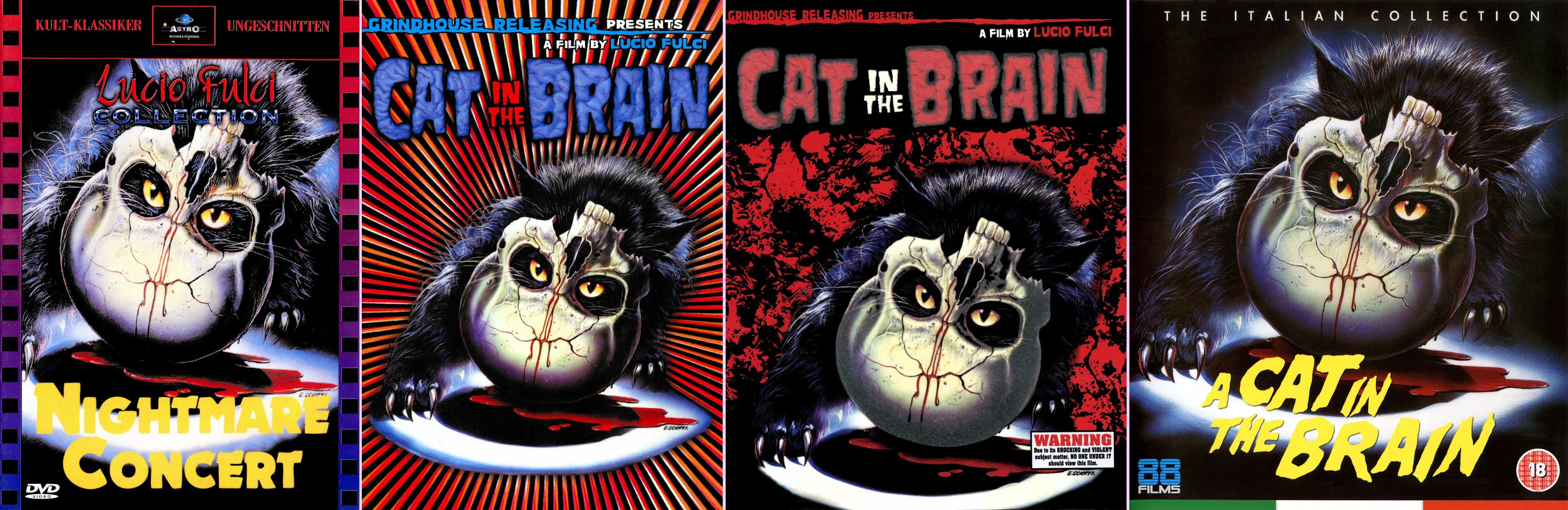
Admit it, whenever you first heard the title of Lucio Fulci's Cat In the Brain, you never would've expected this film to actually deliver you the image of a cat in a brain. Whatever criticism you may have of this film, you gotta admit, Fulci delivered. Today's film is a high concept but low shelf entry in the Fulci catalog. It's fun, got of lot of cheesy gore, plus you could say Wes Craven ganked the basic idea for his New Nightmare film years later. And it's been issued a number of times on DVD around the world. But that was capped pretty thoroughly when Grindhouse released a fairly definitive 2-disc set in 2009. But I still hang onto my old, banned Astro-Film DVD, which goes under the title Nightmare Concert. And we're going to find out why as we look back at Cat In the Brain...

Update 3/28/15 - 7/20/16 - 5/29/18: More cats in more brains!  First the Grindhouse blu-ray upgrade, and now 88 Films has just released a brand new edition of this crazy Fulci oddity over in the UK.
So one of the appeals of this film is that Fulci himself stars in it. He's often given himself little cameo roles in his film, as a cop or a coroner with a line or two of dialogue. But here he stars, as essentially himself: a horror movie director played by gruesome nightmares inspired by the scenes of his own films. And what's worse - the murders he's dreaming may actually be happening around him? Is he going insane? Or is some mysterious murderer out there somewhere, copying his films? Find out as Fulci reuses a whole bunch of old movies and stitches them together into one, semi-coherent narrative. That's right, instead of filming new murder scenes for his movie like most people do, he just uses clips of other movies' murders and cuts them into the movie. How cheap! Fortunately, Fulci is charming, and he does put in some genuine effort to match his newly shot footage of himself with the scenes from the old films. So while you'd never rank this anywhere near his best films, it does make for a bemusing watch.
From the opening credits of Bloody Psycho
Specifically, the films cut into Cat In the Brain include two directed by Fulci himself: The Ghosts of Sodom and Touch of Death, and an Andrea Bianchi film he produced called Massacre. But the other four are films he was less officially responsible for: The Broken Mirror, Hansel & Gretel a.k.a. Never Hurt Children - the only film directed by one of Cat's co-writers, Giovanni Simonelli, Escape From Death and Bloody Psycho, both of which were also written by Simonelli.  All four of those latter films were released under the heading "Lucio Fulci Presents," and in two of them, he's listed in the credits as "Supervised by."  So it's hard to say exactly how much of those films he was or wasn't responsible for behind the scenes, but I guess enough that he felt comfortable re-purposing them here.

Oh, and did I say the Astro-Film disc was "banned?" Yes, a bunch of the films they released were banned in their home country of Germany, and the head of the company was even arrested and imprisoned. That's pretty terrible, since they were just releasing old 80s horror movies - bloodier than some, but not exactly shocking snuff films or anything.
1) 2001 German Astro-Film DVD 2) 2009 US Grindhouse DVD
3) 2016 US Grindhouse blu 4) 2018 UK 88 Films blu
Okay, first the DVDs. Both discs claim to present the film in the correct aspect ratio of 1.66:1, but the Astro-disc is really closer to 1.47:1, so you can see the framing is noticeably different in the second set of shots. Almost as importantly, if not more so, the Grindhouse disc is anamorphic and pillarboxed, while Astro's disc is a smaller, non-anamorphic image floating in a windowbox. The image quality shifts around a bit as the film jumps between film clips spliced from other movies; but the Grindhouse's HD restoration is always substantially superior to the Astro disc. I mean, those comparisons speak for themselves. The colors, the lighting, everything. Even the flecks and scratches (like the white mark on the guy's cheek in the top shot) have been cleaned up on Grindhouse's disc.
Grindhouse DVD vs. Grindhouse blu
But now, seven years later, Grindhouse has upgraded their DVD to a new HD blu. It's sharper. Though the grain looks a little blocky and uneven.  And considering this isn't one of Grindhouse's new 4k or even 2k scans, yeah, I see what people have been kvetching about. Still, this is a blu-ray, and doesn't have the muddying compression of SD. So it is a definite upgrade over the DVD (it also squeezes in a pinch more vertical information), just not as big of one as we might've hoped for from Grindhouse. But given that this film is a hodgepodge of old, lesser quality filmstock, I can also understand why they might not've seen much value in paying for a high-end scan. Even with a new 4k pass, I doubt we'd be seeing much new detail or anything. It's not like there's a button you could push to make this film look like Lawrence Of Arabia that they're neglecting to push.

And 88's blu?  Clearly they're using the same master, but that doesn't mean the transfers are strictly identical.  They're both presented in 1.65:1 and the quality of detail and all is the same, but even without clicking through to see the screenshots full-sized, the difference in color-timing should be clear.  Grindhouse leans more greenish/ yellow, whereas 88 goes to the more blue/ red end of the scale.  Actually, 88's color-timing is similar to Grindhouse's DVD rather than their blu.  And I think I might slightly prefer it.  A slim distinction to be sure, but Grindhouse's blu looks a little overly orange to me compared to 88's new edition.

At least the blus mean we've gotten an audio upgrade from Dolby 2.0, which both the Astro and Grindhouse DVD had, to the original mono in DTS-HD (Grindhouse) or LPCM (88) tracks. And both blus and the Grindhouse DVD give you the option of English or Italian audio (Astro only has English and a German dub), with English subs.
Now when Grindhouse came out with their DVD, they only stepped it up with the transfer, but they brought us a whole second disc worth of extras, mostly in the form of some very in-depth interviews. There are two 40+ minute interviews with Fulci (which are really one long interview split into two parts) and a 46 minute one with Brett Halsey, who wound up in this film only by way of his starring in Touch of Death. There are also three very brief interviews with Jeofrey Kennedy, Sacha Maria Darwin and Malisa Longo, all of which are taken from the Paura: Lucio Fulci Remembered Volume 1 DVD. Besides those and a collection of trailers (including Cat In the Brain's), there are a couple easter eggs with additional footage of Fulci at conventions and clips of Halsey commenting on some of his other films. It also comes with a substantial booklet and a very cool lenticular 3D cover.

But Astro-Film has a 35 minute unique extra of its own, which is why I hang onto it. Basically, it's a menu screen with links to a clips from the films that were cut into Cat, showing you a reminder of how it was seen in this movie and then showing you how the scenes played in their original context immediately after. Unfortunately, they only use the German audio, bu this is still a very cool feature, and I'm surprised Grindhouse didn't attempt something like this on their disc. Because the clips inserted into Cat weren't just dropped in as whole chunks that play exactly like they did in the old films. Fulci edits himself into these scenes (well, some more than others), so they're new and different. And even if Grindhouse couldn't actually show you the long portions of the other films like this disc does (understandable... something tells me Astro pulled it off only because they were operating outside copyright law), they could've at least done something to talk about which clips were edited into Cat and what those films were about. That just seems like a very essential issue for understanding and appreciating Cat In the Brain that really ought to be in a special edition.  And to be fair, Grindhouse does this in text in their booklet.  But obviously that's nowhere near the same as actually seeing all the footage.

Oh, and the Astro-Film disc has the trailer, too.
But while Grindhouse's new blu-ray may've been underwhelming in the transfer department, they did step things even further up in the special features department. First of all, everything from their DVD is back, including the Easter eggs, Paura clips, everything. It has an equivalent booklet (which does a nice job covering each of the film's Fulci inserted into Cat), but instead of a lenticular cover, in comes in a glow in the dark slipbox [right], and also includes the soundtrack CD and a bonus portrait of Lucio. But besides the superfluous, they've also added some substantial new content to the second disc of extras. Because this is such an unusually constructed film, the interview I was most looking forward to was with co-writer, Antonio Tentori, and he does not disappoint. He talks for 27 minutes, answer many of our long-held Cat In the Brain questions. Then there are all new interviews with cinematographer Sandro Grossi, Fabio Frizzi, They also uncovered another vintage Fulci interview, this time a 1987 radio one with Tentori. And there's a clip of Frizzi performing Cat's main theme live in Hollywood in 2015. And finally, there's the familiar round of Grindhouse bonus trailers. Interestingly, they again included Pigs, even though that wound up coming out from Vinegar Syndrome.

And what does 88 bring to the table?  Well, this is interesting, actually.  They don't have all of Grindhouse's stuff, but they do have an all-new, original 45-minute documentary.  It's primarily critic-driven instead of participant-driven, but you can hardly fault them there, considering some of the key players are no longer with us.  Like, getting Simonelli to talk about the merger of his own work into this new script he wrote would've been great, but sadly, he passed on in 2007.  And 88 does get the most important person they could've: Tentori.  Then the critics/ scholars on hand are Calum Waddell of course, Mikel J. Koven, the disgraced Allan Bryce and the ever endearing Kim Newman.
But what's also interesting about this doc is that it's not just about Cat, but Fulci's later-period films in general.  This means we get to hear some pretty interesting stuff, not covered in other pre-existing special editions.  We get serious discussion of films like Door To Silence and Sodoma's Ghost.  Unfortunately, no, they don't take the time to cover all the "Lucio Fulci Presents" films, which would've been perfect here since they're all featured in Cat In the Brain.  But it means we get to hear Tentori talk about his work on Demonia (for instance, he points out some interesting Lovecraft influences I'd never noticed), which again, is only covered here, since there are no Demonia discs with Tentori interviews on them.  There's some good Aenigma talk, too, which is a little odd that 88 didn't use that for their Aenigma disc; but we've got it now, so it's all good.  And yes, there's plenty of Cat In the Brain coverage, too.  This isn't one of those features like the Caroline Munro interview on 88's The Last Horror Film, where The Last Horror Film isn't even mentioned and they just slapped it on there because they happened to have it.  You'll learn plenty about Cat In the Brain here.  My only wish is it could've been longer to include Fulci's TV movies (I kept waiting for House of Clocks) and his "Presents" titles; and you know you've got something good when you're when your only complaint is that you want more.

Besides that, 88's release (#39 in their Italian Collection line, by the way) features the same video of Frizzi performing the Cat theme that was on the Grindhouse blu, plus the theatrical trailer.  It features reversible artwork, a booklet with notes by Calum Waddell, which quotes the doc and takes some serious jabs at giving a more intellectual understanding of the thinking behind this film.  Plus, the first 300 copies pressed come in a limited edition slipcover.
I think the difference in color timing is just going to come down to a judgement call of personal taste, so essentially either blu will present you with a definitive viewing of the film.  So it really comes down to the special features.  For me, Grindhouse's blu-ray extras made it more than worth double-dipping on the Grindhouse DVD for.  And 88's combines with Grindhouse's to make an even more satisfying, full special edition (since 88's doc covers so many of Fulci's other films, there's not a lot of repetition between each label's extras) if you're a big enough fan.  If you're just more casually interested in the film, either blu will probably do just as well, so you can just get whichever is more convenient in your region.  But I have to say, it's pretty damn having the ultimate Astro-Grindhouse-88 mega edition of this crazy flick.  😸