The Authentic Invisible Man

So I guess Universal wants to reboot their classic monster line-up again, whatever that's going to entail. Sure, fine, good luck to all that. But if you want to see a really great, effective revitalization of The Invisible Man, it already exists by way of this totally underrated BBC adaptation from 1984. It's actually a made for British television series in six episodes, and by far the most faithful adaptation of HG Wells' original novel. And there's a fine DVD of it over in the UK.

There's actually not that many versions of The Invisible Man out there. Yeah, there's plenty of films and TV shows about killer invisible people that are clearly flowing in the original's footsteps, like Hollow Man, The Amazing Transparent Man, The Invisible Maniac, etc. But ones that actually, sincerely tell the story from the original novel? There's the old 1933 James Whale film, and there's this. And this is a full BBC mini-series that really takes the opportunity to present the entire book, as opposed to the standard "hit the highlights" version most movies make out of books.
And it's really well made. The acting is great all around. It still hangs onto the humor in the novel and original film, but also keeps the darker subtext. One big thing the old film changed was in that, the invisibility formula turned the man insane, like Dr Jeckyl and Mr Hyde. But this version sticks with the original novel's approach, where it's a man who only makes himself invisible, and the only "evilness" comes out of real human foibles boosted by the power he's given over others while simultaneously being isolated from them. It's more of a dramatically compelling tale that becomes a valuable exploration of our own nature, as opposed to just a fun "what if?"

Yet it's actually not so much longer than the original film. Universal's was a tight 71 minutes, and this one, when you take out all the repeat opening and closing credits of each episode, is maybe two and a half hours? So it's less of a mini-series, in terms of length, than just a longer, more in depth movie. Of course, the Universal version added a bunch of extraneous nonsense which dumbed things down somewhat. The invisible man in this one has a doting fiance with nothing but hammy scenes; and her father and his friend are scientists who are figuring science things out and delivering exposition like crazy. So if you figure the movie added all of that, it had to leave out even more of Wells' stronger material.
I'm not saying the 1933 version is all junk, by the way. It's a lot more faithful than most invisible man films that only share the basic "a scientist turns himself invisible and kills somebody" premise. Both films have all the major set-pieces of the mysterious bandaged scientist who rents a room at a small inn and makes everyone suspicious, and both eventually have him meet his former colleague to plan an ambitious abuse of his powers. The tone of the original actually holds up surprisingly well, with a highly entertaining mania to the villain, plenty of fun invisibility gags that were of course innovative for their time but are also still appealing today, strong performances including a lot nice touches with minor characters, and a cool, bleak ending that diverts pretty far from the book, but worked well in the movie. It's just a different, simpler version of the story that turns it into a more digestible, Hollywood-ized light entertainment. It works great on its own terms; it's just not a serious adaptation of the novel like this BBC version.
And for being a television production, the effects are all pretty well done. They use a variety of techniques to put across the various invisibility issues, and they're actually pretty impressive. I remember John Carpenter's Memoirs of an Invisible Man getting a lot of attention for showing the food going into the man's mouth and down his throat as he ate... but they did it here first, and it works perfectly well. This production more dated by being a full-screen shot on video production than anything else. The costumes and locations (this is also the first telling of Wells' story that keeps it in the 1800s as opposed to modernizing it) are all great; there's lots of slick camera moves. And the final chase is actually quite thrilling for what seems so superficially modest.
So, the picture is 4:3 and looks like video because that's what it is. There's no HD transfer of a 35mm negative to be made here. But this is a stable, clear presentation that looks as good as this show surely ever has or could. There's no interlacing, video noise, softening, color bleeding or any of the other issues that often plague older television series on DVD. BBC has done a thoroughly professional job getting this series onto disc; and they've even added optional English HDH subtitles.

And it's not entirely barebones. Chiefly, it has one brief extra: a 6-7 minute excerpt from the BBC television show Did You See? where several guests discuss the latest episodes of The Invisible Man mid-season. It's not actually cast or crew from this series, but other personalities, and their observations are sometimes a little on the banal side, but I'm glad they included it. It's definitely a time capsule. And that's all that's on the disc, but there's also a rather thorough, 20-page booklet included, which talks in-depth about everything from past attempts to film The Invisible Man, how this show got its funding, details of the original script, descriptions of the production, and how it was eventually received by the public when it aired in the UK back in 1984. Someone really put a lot of time into it.
This isn't a new release; it's from 2005. But I don't think you're going to see any company take another pass at this. And that's fine, because you can't realistically ask for more than this. It's a good disc of a great show that fans of smart horror should really check out. There's no way Universal's going to cook up something this good with the character in the next couple years.

Gates of Vernon, Florida: Two HD Upgrades by Criterion

Errol Morris does great audio commentaries, and some of his earlier films especially benefit from a little explanation and knowledge of their back story (especially Vernon, Florida). So it was always a shame that his older films only had barebones DVD releases. That's why I was so excited when Criterion recently began reissuing his classic documentaries as special edition blu-rays. First they tackled A Brief History of Time, and then they simultaneously released all three films from MGM's Errol Morris DVD Collection. I've already taken a look at The Thin Blue Line, and today I'm going to wrap that up with Morris' first two films: Gates of Heaven and Vernon, Florida, packaged together on Criterion's Two Films By Errol Morris blu-ray.
Gates of Heaven is just one of those perfectly absorbing documentaries where everything great all just happens to come out on camera. It's alternately funny, sad, relatable and fascinating, peeking into the otherwise unexamined world of pet cemeteries. Dating all the way back to 1978, it's also a become a bit of a period piece; but of course what's so effective about the film is how the humanity never changes. There's the two brothers who run one of the cemeteries with their father: one a frustrated drop-out musician who takes his giant speakers out to echo his jam sessions throughout the valley, the other a motivated go-getter who conducts his interview surrounded by all his sports trophies. People come to talk about life, death and the loss of their little loved ones, we witness the struggles of a small "mom and pop" pet cemetery versus bigger business, and we even have an eye-opening chat with the head of a rendering plant. It's just one of those movies you wish would never end.
Vernon, Florida is an even stranger film. I didn't know it when I first saw it decades ago, but it's essentially what came out of a film that couldn't be filmed. Morris originally went down South to investigate one of the country's biggest cases of insurance fraud. But when no one would talk about it, we wound up instead with a portrait of an eccentric little dot on the map. There's barely any structure as we encounter one local, then another, then cut back to the first. We hear their hunting stories, meet their animals, and ultimately sink into their personal philosophies of death, nature and the journey to find meaning in their lives. Sure, it feels a bit culled together from loose ends, but that almost makes it even more engrossing: the strange, organic film that grew on the outer fringes of a more traditional movie.
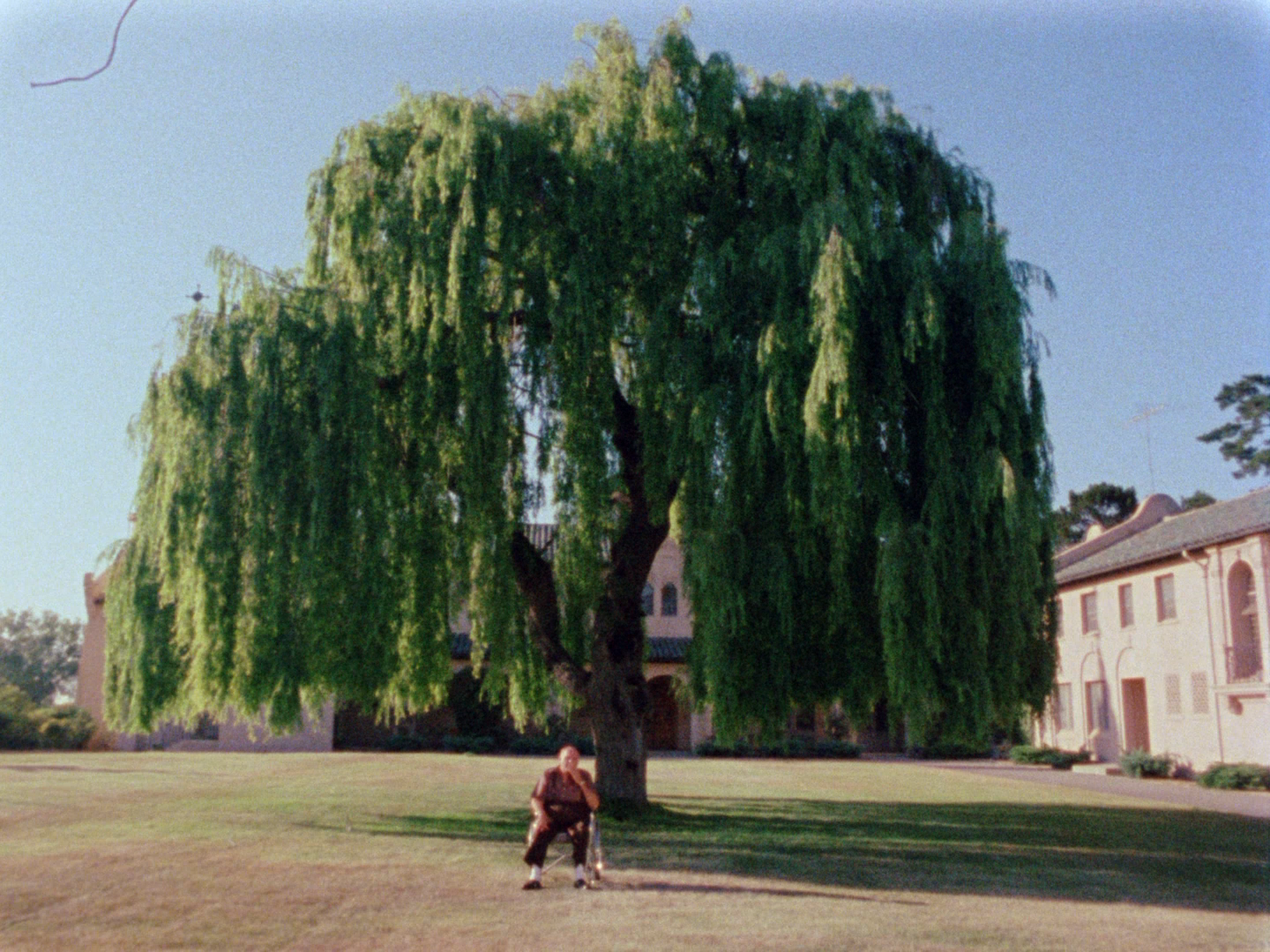
MGM 2005 DVD on top; Criterion 2015 blu-ray below.
MGM's 2005 DVD sort of said, "hey, what do you want for an old, low budget full frame documentary?" It was alright if you just wanted to see the film, no real flaws or issues. But Criterion, of course, gives it much better treatment with their 2015 blu. They've given it a new 2k scan, supervised by Errol Morris, from a 35mm color reversal internegative. It's still 1.33:1, because that's how the film was shot and meant to be shown; but they've given it back its natural, filmic look, compared to MGM's softer videotape-like image. Colors don't bleed like they do on the DVD, and the natural grain tells us we're seeing all the detail there is to be seen. The booklet with this blu talks about the "thousands of instances of dirt, debris, scratches, splices, warps, jitter and flicker" they manually removed, but as you can see in the second set of shots (top left corner), they missed a couple conspicuous ones that weren't even on the MGM disc. There's still some flickering in certain scenes, too. Some of the color timing decisions might be a bit questionable, too (what color is that guy's shirt in the first set of shots, really?). But these are minor instances within a rewarding restoration that happily replaces the old fuzzy transfer.
MGM 2005 DVD on top; Criterion 2015 blu-ray below.
Vernon, Florida shows an even bolder, more distinct improvement. Part of that is because MGM didn't even bother to encode the widescreen (1.66:1) film anamorphically - yuck! That's pretty bad in 2005. As you can see, it floats in a sea of negative space on the DVD, whereas Criterion preserves the 1.66 framing by pillar-boxing their image. You can also see they've adjust want's in the frame a bit, too; including more image on the bottom and both sides, but losing some a long the top. Again, Morris supervised these, so I'll just assume that's more correct.

So anyway, the other aspect of the improvement is that Vernon just seems to have been shot with a naturally stronger image (better camera?), resulting in a sharper, clearer picture when bumped up with another 2k scan. There just seems to be more detail to restore, making everything look even better. And like Gates of Heaven, the MGM DVD has a sort of VHS quality to its colors. Look at the American flag on the officer's shoulder or the bars on his back window in the second set of shots. There's all this green and purple discoloration popping up all over the place that thankfully has been eradicated in Criterion's much more naturalistic blu. Even at first glance, if you don't even bother to view these screenshots full size, the Criterion grabs just scream higher quality.

MGM's mono audio on both discs was always clear and fine, but Criterion has given both film's mono tracks a nice little HD boost. Both MGM's DVDs and Criterion has optional English SDH subtitles, with MGM also offering French and Spanish subs.
Criterion really comes through again in the extras. MGM had nothin'. Just some bonus trailers, not even the trailers for the films themselves. And while Criterion's blu isn't loaded with a ton of stuff, what it has is great and may be reason enough for people to double-dip, even if they're not the type to care much about video quality. Primarily, each film features a 15-20 minute on-camera interview with Morris, who tells you everything you wanted to know, and some fun anecdotes you didn't know you wanted to know, about each film. These are great and just what the old DVDs are lacking.

They've also included Les Blanc's short film, Werner Herzog Eats His Shoe. It's been included as an extra several Herzog films already, but it really belongs with Gates, since the story is that Herzog told Morris if he ever finished his first film (which was Gates), he'd eat his shoe. And this is him eating that shoe in honor of Gates of Heaven.

And finally, there's a very brief (like 1 minute long) clip of Herzog at a film festival saying a few words about Gates. Just a very minor, extra little thing, but hey, the more the merrier. Criterion's blu also has a nice, fold-out booklet with a very long essay by New York reporter Eric Hynes.
So this is a very welcome pair of upgrades, or just a great place to start for someone stepping into the world of Errol Morris. And frankly, at least in terms of extras, it's what MGM should've given us in the first place. Now, hopefully 2016 will give us Criterion editions of Mr. Death and Fast, Cheap and Out of Control and we can really feel caught up in the home video filmography of Errol Morris.

Discover Lady Stay Dead, Courtesy of Code Red

With cult labels releasing and re-releasing the same popular titles over and over again, I'm always happy to see something still making its debut on disc. Lady Stay Dead is a slasher/ thriller I hadn't even heard of before, and I grew up on these movies. But this turns out to be the final theatrical film by Australian writer/ director Terry Bourke, the man known for creating Inn of the Damned and possibly his country's first horror movie ever, Night Of Fear. And despite elements that might put some viewers off, I think it's his most satisfying, well-rounded work. So it's a little surprising that Code Red's relatively recent blu-ray is its debut on disc.
Our film opens with an introduction to Gordon (Chard Hayward), standing alone in his apartment wearing nothing but a tiny, unflattering black speedo. He feeds his fish, cleans his rifle, puts his favorite love song on the turntable and pulls a love doll out of his closet for a slow dance. This is not a man living the high life. He's a simple gardener who happens to work for almost his complete opposite: the rich, young and beautiful Marie (Aussy soap star Deborah Coulls), a singer/ model/ actress who couldn't possibly see Gordon as any less of a human being. But he doesn't seem to get that, truly believing he has a shot with her.

Well, things go about as badly as they conceivably could when Gordon winds up accidentally drowning her in a fish tank. But while her death wasn't intentional, we learn Gordon is far from the naive innocent he pretends to be. It turns out he's got a history of S&M and abuse, and now that he's crossed the line to murder, he's prepared to do anything to cover it up.
There's a weird mixture of tones at play that might initially put some viewers off. The film doesn't shy away from exposing Gordon's perverted side. Things get a little grim, in fact, as it asks you to follow along on the journey of a lustful and homicidal creep, not unlike William Lustig's Maniac. But about half an hour in, things take a real turn. We even switch protagonists. You see, Marie's death is just the beginning of a very bad day for Gordon, turning into The Money Pit of murder. Naturally, her neighbor sees too much and has to go. Soon everything's going wrong, a la Hitchcock's The Trouble With Harry. The body bursts out of the garbage bags he's wrapped it in, local teenagers show up to race their motorcycles in the drive-way. And how was Gordon to know today was the day Marie's long-lost sister was dropping by for a homecoming?

Now we're in a Wait Until Dark-like, cat and mouse psychodrama, as Gordon tries everything to convince sister Jenny (Louise Howitt) that all's well and there's nothing to be suspicious of. But this is not a bright man, and he's left clues everywhere. It's almost farcical until Gordon realizes his secret's out and he can't let Jenny escape alive.
Once things gets rolling, Lady is actually quite entertaining. There's a bumbling charm to our killer - at one point he puts on a suit and tie and shows up at the front door with a bag of groceries thinking he can convince Jenny to let him inside the house, even after they both already know full well that he's the killer! And the guy gets beat up more than the masked maniac in Scream. But other times he's quite real and menacing. There's a plausibility to his character that can get genuinely unnerving, compared to slasher super villains like Jason and Michael Myers. You won't forget Gordon.

In fact, it's a surprising collection of high production values and strong performances. I'm not going to spoil the third act - there's plenty of surprises - but things ramp up and the money is definitely on the screen. Released in 1981, this has the glossier look of an 80s movie rather than the more rugged, earthy feel of Bourke's earlier films. Although that last fact might come as a surprise to anybody who saw this film outside of this blu-ray or an original theatrical screening.
No comparisons today, because Lady Stay Dead has never been released on DVD (or blu, or laser... although apparently there were a bunch of VHS tapes back in the day) before Code Red's blu, which is thankfully pretty definitive. It's a strong, HD transfer clearly taken from a clean film print. This isn't one of their famous "grindhouse prints," and the grain looks very natural. The audio is just a simple but clear and strong mono track, and framed in full 16x9 1.78:1, Code Red has seems to have gotten it perfectly right straight out of the gate.

There are essentially no extras on this one, not even a trailer, but we do have one of Lady Katrina's infamous "Bucket List Theater" clips. It's an amusing, 4-minute intro with a little green screen comedy between her and "The Banana," and some of the her traditional IMDB reading. And she comes back at the end of the film for another minute (yes, one). Hey, it's better than nothing.
The exploration of Gordon's authentic but sleazy predilections will probably limit this film's audience considerably, which is a shame, since Lady Stay Dead is a really well-crafted film that's smarter and more engaging than many of its better-known contemporaries. The body count's low but it's an above average slasher film in all other aspects. And Code Red has presented us with an excellent introductory release for audiences to discover it. Not for mainstream audiences, but I'd recommend it to any 80s slasher fan.

Underrated Mysterious Skin (US/UK, DVD/ Blu-ray Comparison)

Mysterious Skin is a weird one, and I don't mean because of the subject matter. It stands well apart from Gregg Araki's other films, largely due to being based on another writer's work (a novel by Scott Heim) rather than his own original material. And to many of his critics, it stands apart as his only mature, or even worthwhile, work. Roger Ebert included Araki's Doom Generation in his short list of zero star films (although that list actually, bizarrely, includes some quite good films, like Rosencrantz & Guildenstern Are Dead). And it might be nice to put myself above those critics and crown myself someone who "gets it," but I can't say I've ever cared for any of Araki's other films either. But, hey, at least we can all agree on Mysterious Skin.
On paper, this doesn't sound like a very good film. The basic concept seems really heavy-handed, a mystery you solve just from watching the trailer. But the film works because it isn't trying to be clever. It doesn't fail to surprise you with its reveal because it doesn't really try to surprise you. Two young boys who play in the same small-town little league team grow up to be complete opposites: one a rebellious gay hustler, the other a nerd obsessed with the idea that he's a UFO abductee that can't otherwise account for the a period of "missing hours" from his life. What accounts for these missing hours and how are these boys unwittingly connected? You probably already figured it out from my two sentence description of the premise, right?
But it doesn't matter, because it's a gentle, touching look at the characters' lives and exploring real life subject matter most filmmakers don't delve into. It's got an amazing cast: Joseph Gordon-Levitt, Brady Corbet, a surprising turn from Mr. Show's Mary Lynn Rajskub, Bill Sage, Chris Mulkey, Brisco County Jr's villainous Billy Drago, the always dependable Richard Riehle and even an impressive performance by Elizabeth Shue. Every frame of this film is beautiful... Really, I was tempted to take a million screenshots for this post. Araki's usual flair for shooting actors with style really pays off here, mixing with the film's nostalgic period allure and the rather dark side of the story, but never pulling a punch.
Mysterious Skin hit theaters in 2004 and DVD in 2005. Strand released it in the US, but disc received some criticism, driving more serious viewers, including myself, to import Tartan's UK release instead. Last year, however, Strand returned to the title for an updated blu-ray release. I've got all three here, so let's see how they really stack up.
2005 US Strand DVD top; 2005 UK Tartan DVD mid; 2014 US Strand blu-ray bottom.
To be honest, looking at them now, I was expecting the US DVD to hold up worse compared to the flack it got. It's only real problem, as seen in the first set of shots, is that it's interlaced. Though, yeah that sucks, and it was certainly nice that the UK disc didn't have that problem. The other main difference is the slight variance in aspect ratio. The US DVD is 1.78:1 (despite saying 1.85:1 on the case), so purists were naturally drawn to the import's slightly letterboxed 1.85. But the trend now seems to be for blu-rays to be perfectly 16x9, meaning they ditch the letterboxing and go back to 1.78:1. And that's the case here alright. In fact, the blu seems to have even a sliver more picture information that the original DVD.
2005 US Strand DVD left; 2005 UK Tartan DVD mid; 2014 US Strand blu-ray right.
There's no question the new blu truly gets the benefits of the HD treatment. The image is so much cleaner and clearer. And again, this is a film where the attractiveness of the image is a distinct component of the film's chemistry, so this is a very welcome upgrade, even if you had the superior UK DVD.

Both DVDs had healthy audio options, with Dolby 5.1, DTS 5.1 and Dolby 2.0 stereo English tracks, plus optional English subtitles. The blu-ray brings it down to just two tracks, DTS-HD 5.1 and a 2.0, but it's nice and lossless, and also has the optional subs.
Extras are another big part of what sets each disc apart. The US DVD isn't exactly barebones, featuring a commentary with Araki and his two leads, a nearly hour long video of the two stars reading selections from the original novel, and the trailer. The UK disc kept the commentary and trailer, but ditched the book reading in favor of a series of in-depth interviews (around 20 minutes each) with Araki, Heim and the two leads together. Then there's also a Q&A with Heim and Araki at a London film festival. It also has some bonus trailers, and a nice insert with notes by journalist Sloan Freer. So the special features were another good reason to import.

And again, Strand's blu enters the ring with plans to exceed. It's got the commentary, trailer and brings back the novel reading video. But it also introduces some new extras to the scene: a collection of deleted scenes and audition footage, a new interview with Heim, a short video introduction by Araki, a photo gallery and a new film festival Q&A, this time with Brady and Gordon-Levitt. There's an isolated score audio track. Oh, and there's some Strand bonus trailers, including Araki's latest film, Kaboom. What the blu-ray doesn't have, however, are Tartan's exclusive extras (the three interviews and Araki/ Heim Q&A). So if you've got the UK disc, keep it.
So Strand's new blu-ray is a strong recommendation. Even if it doesn't sound like a film you'd enjoy based on its premise, I think this one could surprise you. And I say that even if you disliked Araki's previous films. And the disc itself is a strong bump up over its past DVDs, certainly more so than some other blus I could name, and also comes with some compelling new extras. And if you're really taken with the film, consider looking for a cheap copy of the UK disc, too, for the additional extras. I'm a little disappointed no one interviewed Rajskub, though, for any of these releases. But still, an easy A for one of Strand's rare blu-ray efforts. They usually stick to just DVDs, but if they can make 'em like this, I hope they dip back into their catalog for more HD upgrades.

Night Of the Intruder: The Raimi Bros Vs Supermarket Slasher

The whole gang that made the Evil Dead movies actually made a bunch of fun horror movies together. They switched roles around, so sometimes Sam Raimi acted, sometimes Bruce Campbell did sound design, etc. Admittedly, none of them are operating on quite the level of the Evil Dead films that Raimi directed (especially the larger budgeted sequel), but they're all good times: Thou Shalt Not Kill... Except, The Carrier, Lunatics: A Love Story, and perhaps the best example of all: (Night Of the) Intruder.
In this instance, Scott Spiegel takes the writing and directing helms, with the Raimi brothers are both acting and special effects by the full KNB triumvirate. And the plot is simple enough: a bunch of employees are trapped in a supermarket over night with a mysterious killer. A lot of the writing and acting feels beginner level, but the real supermarket location adds a lot of production value to a well paced slasher film that doesn't take itself too seriously. It also some clever, inventive camerawork and of course some great kills. What more do you want? Bruce Campbell cameo as a cop? Okay, that's in here, too.
So Intruder's one of those home video staples that's kinda been available in some capacity since the days of VHS. On DVD, it was released first by Germany's Dragon Entertainment in 2002, and then re-released that same year by Dragon as an upgraded special edition. Then Screen Entertainment put it on in the UK in 2004 and USA's Wizard Entertainment released it in 2005. I've hung onto that Dragon special edition over the years for a couple unique features we'll come to later. But finally in 2011, Synapse created the definitive release in HD with their special edition blu-ray release, the first 500 copies of which also included a limited, hand-numbered bonus disc of Intruder's longer workprint. Oh, and it's a combo-pack, so I'm including Synapse's SD DVD in the comparison, too.
Dragon's 2002 special edition DVD top; Synapse's 2011 blu-ray 2nd,
Synapse's 2011 DVD 3rd and Synapse's 2011 workprint DVD 4th.
So Dragon's disc looks pretty poor; but we were actually happy to get it in 2002. They did improve the picture quality (and sound) over their earlier non-special edition, and none of the other country's DVD releases were much better. It was always put out in fullscreen until Synapse got their hands on it. The earlier DVDs are open matte, so at least they have a little curiosity value; but Synapse's new widescreen transfer is correct (or close to it... their 1.78 is probably a bit more open than the originally envisioned 1.85 theatrical ratio) and makes the image look more refined and less clunky. And as you can see, if you get a copy with the workprint, that gives you an opportunity to see the film with all the extra picture anyway, so no need to track down and old DVD just for that.

The Dragon disc is still clearly over-saturated, but that's still probably preferable to the super faded workprint, which almost looks black and white. But the colors, clarity of image (you can finally read the headline on those TV Guides - yay!) and really everything about the Synapse's new 2k transfer is so superior, it really invalidates everything that came before it. Plus, as you can see in the second set of shots, Dragon's DVD had interlacing problems.
So none of the Intruder DVDs had any extras except for Dragon's special edition. They included two short deleted scenes of more gruesome special effects shots taken from the workprint, two trailers for the film, and a photo gallery. And most interestingly of all, and why I still own this disc, it features two early Scott Spiegel short films. There's Torro. Torro. Torro!, co-written and directed by Josh Becker, about a killer lawnmower. It features all of the old crew again: both Raimi's, Bruce Campbell, John Cameron and Rob Tapert. And then there's Attack Of the Helping Hand, where the Hamburger Helper mascot goes on a killing rampage, starring Sam Raimi and shot by Campbell. They're both just silly little home-made films, mostly of interest for fans of the guys. Dragon also included a booklet, but the text is all in German.

Synapse has produced a more traditional and fully loaded special edition. It has an audio commentary with Spiegel and producer Lawrence Bender, which is quite good. Spiegel has mastered the art of commentaries by working as a moderator on other director's horror films, so this one moves along at a brisk and informative click. There's then a substantial, 40 minute 'making of' featurette which interviews everybody from Bruce Campbell to RenƩe Estevez, a brief interview with Vincent Pereira about the censored cut originally released on VHS, audition footage, outtakes from the now lost film Night Crew, the short Spiegel shot to raise funding for Intruder, trailers and a photo gallery. And if you missed out on one of the limited editions with the workprint, don't feel too bad, because there's also a selection of the most important unique scenes from that included as an extra on the main disc.
This isn't an objectively great film, but if you're looking for an enjoyable 80s slasher flick, this delivers in all departments. And Synapse has given it top of the line presentation. Now we just need them to tackle Lunatics: A Love Story (it's in seriously dire need) - oh, and Code Red to create a blu-ray of The Carrier - and that's this whole line of films pretty much covered with excellent home video releases. And if you're a huge fan, you can track down the Dragon disc for those two shorts. And you can get many of the gang's other shorts on DV-R direct from Josh Becker's website.