Okay, so you've bought Criterion's big
Ingmar Bergman's Cinema box, The BFI's
Ingmar Bergman's Cinema and even Artificial Eye's
Classic Bergman set. But you're still hungry.
Ingmar Bergman's an unparalleled master and you know he's made plenty more films than those, so what else can you get your hands on and add to the collection? Well, unfortunately, not a whole lot, despite the large number of films he's written and/ or directed that remain unavailable on home video. There's
Best Intentions and
Faithless, which I've already covered, and then just three more. And two of those are DVD-only.
Update 10/3/22 - 2/25/24: Well, thanks to Imprint's new
Face To Face blu-ray edition, now only one of these are DVD-only. Can we make it zero? And release all of Bergman's remaining films? Hopefully, but today let's just be happy about
Face To Face.
In 1970, Bergman wrote an original feature length film for Swedish television called
The Lie, directed by
Jan Molander, and starring one of Bergman's greatest actors,
Erland Josephson,
about a middle class couple hopelessly trapped in a mass of deception.
If the made-for-TV aspect makes it sound less interesting, remember
some of Bergman's most acclaimed and beloved works were made for Swedish
television, like
Fanny & Alexander and
Scenes From a Marriage
(both also with Josephson, by the way). Sounds like something you'd
like to see now, huh? Well, tough noogies; you can't. It's another on
the very long list of Bergman films never released in an
English-friendly capacity, or even really as a Swedish-only release,
apart from its televised broadcast.
However in America, Bergman's same script was adapted into an English-language television film starring
George Segal,
Shirley Knight and
Robert Culp.
Ah, but no, you can't get that one anywhere either. BUT, also during
that time the BBC adapted the very same screenplay for British
television, starring
Gemma Jones (
Sense & Sensibility,
The Devils) and
Frank Finlay (
Lifeforce,
Dennis Potter's
Casanova).
The performances are powerful and nuanced, the director seems to be making deliberate nods to Bergman as a director (like all those mirror shots), and the writing is some of Bergman's strongest. Only the music seems out of place, like BBC library stock stuff; but even that's not bad, just incongruous. And this version of
The Lie actually IS available. And this version won a BAFTA, so
we shouldn't feel too short-changed. It's on blu-ray as part of the
BFI's first volume of its
Play for Today box sets from 2020.
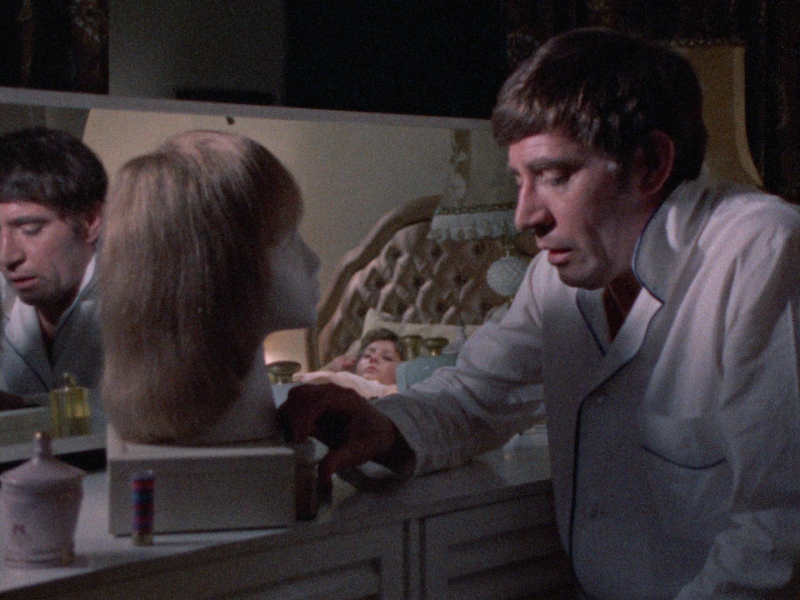 |
2020 UK BFI BD.
|
According to the included booklet, the episodes in this box are broken into two categories: those shot on video and "sourced from the best existing tape materials preserved by the BBC" and those shot on film, which are "newly scanned at 2k resolution from the original 17mm A/B roll camera negatives." Fortunately,
The Lie is one of the latter, and looks fantastic. It's presented in its original 1.33:1 and looks very grainy, something that never would've come through during its original airings. But it's very clearly encoded and looks quite impressive. There is no interlacing despite it being a vintage 70s British television program, because they went back to the original film elements. The original mono track is presented in a strong, lossless LPCM track with optional English subtitles.
The only extras are an image gallery and an 80-page full-color booklet, and of course the other seven
Play for Today episodes, which range from good to great. There's one on the troubles in Ireland that struck me as much more compelling than
Branagh's
Belfast which came out around the same time as this set, and a creepy horror story called
A Photograph. So I can understand a Bergman fan being frustrated they can't just buy
The Lie by itself, but the whole set is worth having in your collection.
Next up is a proper theatrical film (although there was an extended television version released afterwards) written and directed by Bergman: 1975's
Face To Face. Bergman and star
Liv Ullmann were both nominated for Oscars for this picture, so again, it's not like it's all lesser work that's been neglected on blu. This one's a pretty harrowing tale of mental illness, with Ullmann as a psychiatrist whose problems run as deep as her patients'. She takes on a lover, Erland Josephson again, who proves to be a far more loving companion than her own husband, and
Gunnar Bjornstrand appears as her aging grandfather. This one's pretty dark, and relatable despite risking going over the top at more than one point. And it includes some of the most believable and heart-wrenching dream sequences committed to cinema, making those famous
Wild Strawberries bits feel like trivialities.
Face To Face had only been available (English-friendly at any rate)
as a 2011 barebones DVD from Olive Films, though at least it's anamorphic
widescreen. I remember some controversy when it was released, because
people felt Olive acquiring the rights cut off Criterion from giving
this a proper restoration, and possibly both cuts. But of course it's pure speculation that
they would've done that, and certainly getting this disc was better than
the other possible alternative: nothing. But now we don't have to choose between a DVD or nothing; we have a brand new blu-ray edition (also of the theatrical version; the extended TV cut is still unavailable anywhere) from Via Vision's Imprint, due out this Wednesday.
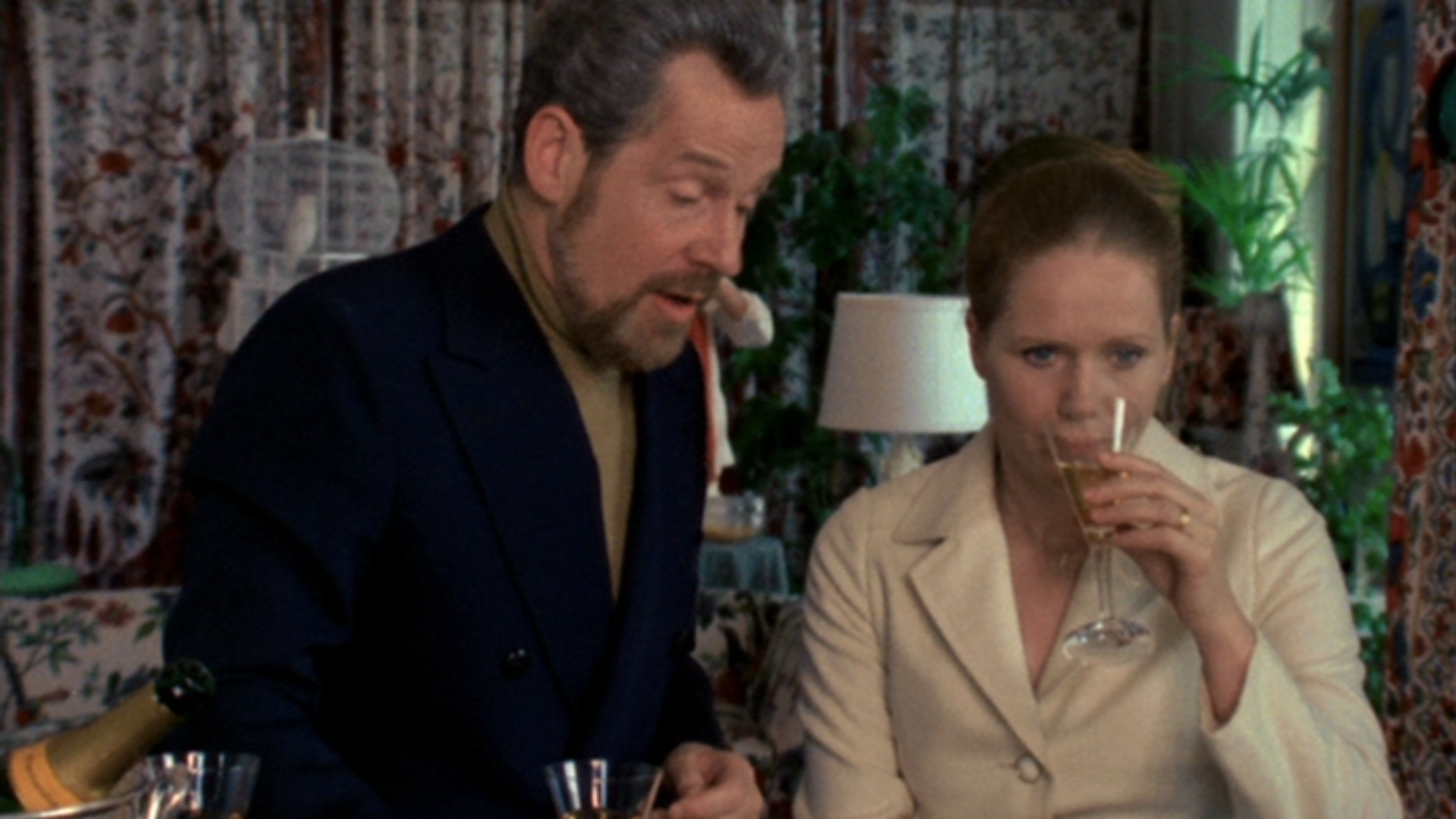
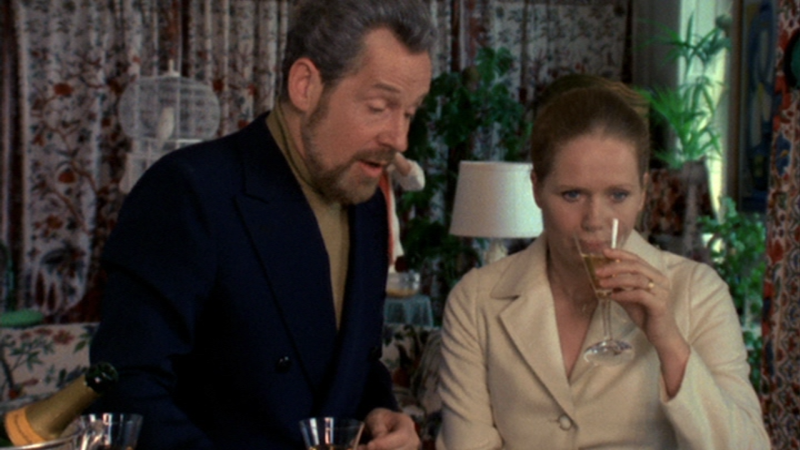 |
2011 US Olive Films DVD top; 2024 AUS Imprint BD bottom.
|
Olive presents
Face To Face in a rather fuzzy 1.78:1. It's standard def, so the hints we get of film grain are about the most we could ask for, but it sure seems like this image could be sharper, even on DVD. But the real problem is the sound. It's a static-y mess that sounds like it's been Noise Gate'd, so it's silent between words, but whenever anybody speaks, it's a metallic mess, as if you're hearing them through a bad telephone connection; and when people make small, innocuous movements, it sometimes sounds like they're sitting on their lavaliers.
Imprint presents the film in a sharper 1.67:1, giving us more vertically, though shaving a sliver off the sides. And though the film is still on the soft side (almost looking like 16mm, though I understand it was shot on 35, so I'm guessing this was taken from a later generation element, rather than the original negatives), the film grain tell us this is a much clearer look at the film source. It certainly brings detail and edges into focus. And thank goodness, they've improved the sound. It's still not perfect... it's still excessively loud when people sit on the sofa or rustle their coats, and there's slight background hiss. But it's nothing like the static-y DVD. It's also lossless now. The whole thing's a big improvement. Oh, and in both cases, the subtitles are removable.
Olive has no extras, not even the trailer. Imprint doesn't have the
trailer either, but comes in a stylish slipcase; and more importantly,
they've got some impressive goodies. First up is an expert commentary
by
Michael Brooke, and it's damn good. A lot of "expert"
commentaries and featurettes I've watched lately have been eye rollingly
indulgent if not outright wastes of our time. But this guy's pretty
great, very well informed, leaves no dead air, cites lots of sources and
is consistently interesting. I wish other commentators would aim for
this standard, even if they can't reach it every time. Also on here is a
visual essay by
Kat Ellinger, and similarly, I've been a little
let down by some of her recent output... maybe she's just agreeing to
too many projects and unable to devote enough time to them all? Or
maybe she just takes a deeper interest in some films and their special
features more than others? I don't know, but she nails it here.
Starting off very informative and citing interesting sources, then
easing into her excellently made thesis that this is an
under-appreciated (including by Bergman himself) feminist work.
My
only nitpick, and this is admittedly a petty one, is that she uses fake
film damage, jitter and projector noise... you know, that fake "old
timey" video filter that comes packaged in every free video editor. And
it's like, why spoil the rare photos she's sharing in her video for a
silly gimmick? There's never a good reason to degrade good footage with
those cheesy filters. But again, I acknowledge that's pure nitpickery;
just a little pet peeve of mine. Honestly, I might've skipped over
both of these extras if I didn't feel obligated to watch them for this
review, but I'm glad I gave them the chance and recommend all you
readers do the same.
Finally, we end with the most underrated of the three, 2000's
The Image Makers.
This is another made-for-Swedish-television project, and in this case
really looks it. It's all set in one room like a stage-play, which in
fact it originally was, although the camera is certainly moving and
cutting around. This one's directed by Bergman (and he also directed
the original theatrical production) but written by
Per Olov Enquist (
Pelle the Conqueror),
although it really, really feels like a Bergman script, to the point
where I suspect he at least had a hand in rewriting it for the screen,
and perhaps rather liberally. It's certainly an interesting coincidence
that both this and
Face To Face have an older person tell a middle-aged woman that "old age is Hell."
Anyway, it's the story of the making of the classic Swedish ghost movie, 1921's
The Phantom Carriage. The author of the original film arrives at the studio to see clips of the film
Victor Sjöström and his cinematographer
Julius Jaenzon have made of her work. However, to complicate matters,
Tora Teje,
the actress having an affair with the director and who feels the
leading part should have been hers, shows up at the same time and makes a
scene. It's on one hand a fascinating mediation on the ownership/
creation of art - how can the author, director, actor and photographer
each feel the art projected on screen is their singular vision? But
it's also a powerful human drama where the making of
The Phantom Carriage
is really just the backdrop to a forceful study of love, heartbreak,
infidelity and cruel fathers. There's a cheap shot-on-video look to the
film, amplified by the staginess of the setting, that signals
The Image Makers
as a forgettable lesser work. But when you really settle into it, it's
as moving and thoughtful a work as Bergman's greatest films.
But to date, this film has only been released on DVD in the UK by Tartan in 2008.
You may've also noticed that Tartan's release is a 2-disc double feature, and in fact the lead film isn't
The Image Makers, but the original
Phantom Carriage. It works as a nice supplement to
The Image Makers,
but as a stand-alone disc, it's not too impressive. It's somewhat
window-boxed 1.32:1, interlaced, and barebones. So in an age where Criterion
has released an impressive special edition blu-ray, this really isn't a
go-to disc for
Phantom Carriage. The reason to buy this set is
The Image Makers. But it's a damn good reason.
 |
2008 UK Tartan DVD.
|
Thankfully, even though disc 1 is interlaced,
The Image Makers' DVD is not. It's 1.32:1 just like the
The Phantom Carriage,
and apart from a handful of clips from the 1921 film, looks like it was
shot on video. If it was shot on film, then this was definitely taken
from a video master. Either way, it looks bold and clear, and about as
good as you could hope for from a master like this. It would be
interesting to see if an HD restoration from the original elements -
whatever those may be - could do for this film; but I wouldn't expect
much. The sound is a clean mono track, the subtitles are removable, and
the only extra is a fold-out insert with notes by
David Thompson, director of
Encountering Bergman.
Needless
to say, all three of the releases covered above are must-haves for
Bergman fans. And yes, it's very much worthy double-dipping from Olive's DVD to Imprint's BD of
Face To Face. Now hopefully some label or other will see fit to
continue to plumb the depths of Bergman's incredible catalog.