Lars von Trier and
Thomas Vinternerg's Dogme '95 was a film movement we may need even more now in the age of "superhero fatigue" than we did in 1995, but thankfully it's legacy can still live on; and even though the officiators are no longer judging and certifying Dogme films, there's no reason why anyone can't make a film adhering to the rules today. The idea essentially was to strip away the artifice and the spectacle of modern filmmaking, and push filmmakers to again focus on the story and heart of a movie. Shooting must be done on location, the sound must never be produced apart from the images, the film must contain no artificial action (such as murders and weapons), etc. The suggestion was never that all films should become Dogme films; and the stripped down aesthetic perhaps lured too many amateur and aspiring filmmakers as opposed to the sort of industry veterans it was intended to inspire. But the movement persisted for nearly a decade and saw the creation of several dozen films from all around the world. And these are the first four, released individually (
mostly in the US) and as a fancy boxed set called the
Dogme Kollektion in Denmark.
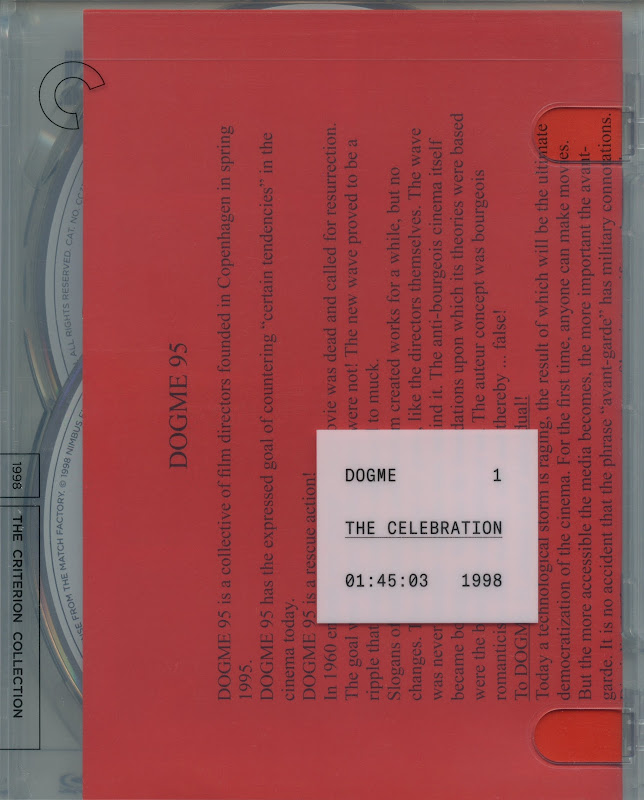
Update 3/17/17 - 1/11/22: Well, here's an unexpected development: Criterion has issued as a 2-disc special edition blu-ray. Is there any point to releasing a film, not just shot on DV, but on cheap, little personal camcorders in the 90s? Well, let's find out.
Dogme #1: Vinterberg's
Celebration (originally
Festen) is still my favorite of all the Dogme films (though admittedly I missed a lot of the later ones). There's a massive family reunion for Helge, but no one can understand why his eldest son Christian is acting completely out of control... except his sister or who shares his dark secret. It becomes a dark, brutal struggle between the rest of the extended family to stay together and Christian to reveal the truth. It's based on an original screenplay, but has since been adapted to stage on Broadway and around the world, where it's fame, particularly in London, may have since eclipsed the original film. But
The Celebration is powerful, and still holds up as a fascinating, low-fi watch you can't tear your eyes away from.
Universal/ Focus Features released this Stateside in 2004, with a straight-forward barebones edition that I immediately replaced with 2005's Danish box set from Zentropa Films. And now in 2022, I've triple-dipped to check out Criterion's 2-disc blu-ray set.
 |
| 2004 Universal DVD top; 2005 Zentropa DVD mid; 2022 Criterion BD bottom. |
So this was shot on standard definition, old DV tape camcorders, and shakily handheld at that. So it's a bit absurd to fuss over image quality. Still, the Zentropa disc does have a sliver or two of extra picture and slightly warmer colors. For those curious, which certainly includes me, the 2018 Danish 2k restoration that Criterion's using an 35mm answer print (the film was shot on DigiBeta tapes, then blown up to film) doesn't really add any fresh detail, but it does sharpen up the noise of the transfer, and the color timing hints at a little extra depth with a little less bleeding. But it sheds a few pixels of that additional picture in the process (still handily trumping Universal in that regard). Overall, it is a slight upgrade, but perhaps not one you'd recognize as such without zooming into screenshots for a direct comparison like this, and on its own, hardly worth replacing discs over.
More importantly, though, the English subtitles aren't just forced but burnt into the picture on Universal's DVD, whereas they are optional/ removable on the Criterion and Zentropa discs, the latter of which also offers the alternate language options of Danish, Finnish, Norwegian and Swedish. A point for Criterion, though: they present the original mono track in lossless PCM. So Criterion's in the lead, but they're fairly neck & neck, and far ahead of the Universal, a distance that will only stretch further as we look at the special features.
The US DVD has the trailer on it. The Zentropa has the trailer, several deleted scenes including an alternate ending, audio commentary by the director (and yes, all the extras are English friendly, by the way), an hour-long documentary on screenwriter
Mogens Rukov, an on-camera interview with Vinterberg where he explains that this is all based on a supposedly true story told over the radio by a mental patient, a half-hour retrospective documentary with the cast and crew and the trailer. And that's just on the main
Celebration DVD. The Zentropa bonus disc includes a 25-minute behind-the-scenes documentary made during the filming of
The Celebration, and a whole bunch of additional deleted scenes (one of which is over 15 minutes long), with optional commentary by the director. I mean, just the deleted scenes alone would have made this an essential upgrade for me, but this is a packed special edition.
And Criterion's release is a packed special edition, too, carrying over most of the Zentropa extras: the commentary, the behind-the-scenes doc, the retrospective, the Vinterberg interview, the trailer and the deleted scenes. When I read the specs for this release, I was a little worried they would just have one of the two sets of deleted scenes featured on the Zentropa disc, but no, they're all here, with the optional commentary. They also have the
ADP: DOP featurette from Zentropa's bonus disc. They lose the documentary on Rukov, however, and the docs about Dogme '95 in general, that are also on the bonus disc, have been replaced with a 2003 documentary about Dogme '95 called
The Purified. As you can imagine, it covers much the same ground, but for those of us who already have the set, it's nice to get something different this time around.
And that's not all that's new. They've also conducted their own, brand new interview with Vinterberg, and included two of his early short (and they're not so short) films:
Last Round (this one stars the brother from
The Celebration rather than
Mads Mikkelsen, and is a surprisingly arresting drama for an early short) and
The Boy Who Walked Backwards. It also includes a 20-page booklet with notes by
Michael Koresky. All told, it's a very satisfying collection of extras to rival Zentropa's.
Dogme #2: Everyone associates Dogme '95 with Lars von Trier, naturally; but he's actually only made one Dogme film,
The Idiots. I wouldn't hold it up as one of his better films or one of the best Dogme films, but it's certainly worth seeing once, at least. It certainly doesn't have the most likeable characters, as a collective of young adults perform a sort of communal social experiment where they pretend to be mentally handicapped to reap any benefit society will bestow upon them while reveling in the discomfort they 'cause the local community. Still, one woman is taken in by the strangely therapeutic side of their "spassing" and "channeling their inner idiot" and decides to join them. But how long can they really maintain the lifestyle?
The Idiots garnered a lot of controversy, not only for the many offensive things you can imagine would pop up reading the above description, but also for frank sex and lots of full frontal nudity. As such, it's the only early Dogme film not to have been released in the US. So us film fans naturally imported the 2000 UK disc by Tartan. But again, I was all too happy to replace it in 2005.
 |
| 2000 Tartan DVD on top; 2005 Zentropa DVD below. |
The Tartan disc is frankly puzzling. Not only are the colors quite different (possibly the result of the filters used on the film behind Trier's back and against Dogme rules that they later had stripped off) and the subtitles once again burnt onto the picture, but Tartan letterboxed it. Another one of the Dogme rules is that the film be in traditional Academy ratio and film-stock (yes, most Dogme films were shot digitally, but they all had to be transferred to final 35mm prints... despite appearances, Dogme '95 was really not a game for aspiring, amateur filmmakers). So this is clearly the wrong aspect ratio, and in this case, a particular violation. And all it does is lose picture information, cropping it to a very unusual 1.63:1. On top of that, the DVD's non-anamorphic. So yeah, I can't imagine what the folks at Tartan were thinking, with the Zentropa disc being a serious upgrade in just about every way.

And of course, that includes extras. The Tartan disc just had an interlaced trailer and a stills gallery. Yeah, it claims an interview with Trier on the back of the case, but that's just a short text-only thing. The Zentropa disc, of course, comes through for real. We get the trailer, audio commentary by Trier and several deleted scenes including an alternate credits sequence. And most compellingly, we get the feature-length documentary,
The Humiliated, about the creation of
The Idiots, which might actually be more a more important film than
The Idiots itself. And again, that's just the main
Idiots DVD. The bonus disc has a bunch more: a half-hour retrospective documentary, a featurette on the color filters controversy I mentioned earlier, a 20-minute interview with Trier, and an "Idiots All Stars" music video.
Dogme #3: Mifune. Admittedly, when I first saw
Mifune (a.k.a.
Mifine's Last Song), I didn't like it. It felt really pandering, like some Hollywood schmaltz, and it kind of is. It's about two brothers, one of whom is mentally handicapped, who are left to run a farm when their father dies. And the one brother keeps the other brother's spirits up by pretending to be a samurai named Mifune (named after
Toshiro Mifune, from all the
Kurosawa films), who he convinces lives on the farm with them. But on later viewings, I have to say the story of the prostitute and her young brother, who move in with them, is actually fairly affecting. If it's Hollywood-style schmaltz, it's at least good schmaltz. The film is well acted and the director makes things work more than they should, which is especially impressive given the strict Dogme limitations. He couldn't exactly lather on a sentimental soundtrack, for example.
Columbia Tri-Star released this one in the US, but again, this Zentropa set crushes it.
 |
| 2000 Columbia Tri-Star DVD top; 2005 Zentropa DVD below. |
We gain some ground and we lose some. The subtitles are happily not burnt onto the Columbia Tri-Star DVD, but the colors are as off as ever (overly green this time) and now we've got a serious interlacing problem. Admittedly, the digital nature of these Dogme film gives a little interlacing to each of them; but the US DVD clearly has a problem, which the Zentropa disc fixes. It also reveals a little more picture along the sides. And the Zentropa image has more detail, which is awkwardly smoothed away from the Columbia effort.
On the other hand, this is the first Dogme DVD that had some solid special features the first time around. Or at least one big one: audio commentary by the director. It also has the trailer and some bonus trailers. Well, the Zentropa disc carries the commentary and trailer over, but also adds a lot more. There's also a bunch of deleted scenes, with optional commentary, a 45-minute documentary called
On the Road With Mifune, about promoting the film, taking it to film festivals, etc, a half-hour 'making of' doc and a 20-minute retrospective.
Dogme #4: The first three Dogme films got bigger commercial receptions, but you can feel that
The King Is Alive is in some ways a bigger movie, with higher picture quality and American stars including
David Bradley,
Brion James and
Jennifer Jason Leigh near the peak of her fame. It's the story of a busload of international tourists who break down in the heart of an African dessert, and with little hope of rescue or escape, keep their sanity by putting on a performance of King Lear while they await the inevitable. This is the darkest, most nihilistic Dogme yet, which is saying something considering Lars von Trier had already made one.
MGM released this DVD in 2002, but does it stand up to the Zentropa re-release? Guess.
 |
| 2002 MGM DVD top; 2005 Zentropa DVD below. |
Picture quality-wise, it may be the closest approximation yet, but MGM's DVD has an interlacing problem that Zentropa fixes. Zentropa also finds a sliver more picture along all four sides. They also might have a smidgen more detail, but it's very close. Really, the interlacing is the only significant distinction. ...Until you get to the extras, of course. The MGM DVD only has the trailer, but Zentropa has the trailer, commentary by the director and a 23-minute retrospective.
So the Dogme box-set blows all other international releases of the first four films away. But wait, that's not even all! Discs #4 and 5 also have a wealth of documentaries and shorts about the Dogme movement itself.
The King Is Alive's disc also includes three featurettes called
The Birth of Dogma 95,
Marketing Dogma and
The Inheritance After Dogma (yes, all spelled with a's instead of e's), which range from 15-35 minutes each. They consist of on-camera interviews with all the directors and producers looking back on their experiences. Then the bonus disc has more documentaries on Dogme, this time collected from other countries. There's a silly one called
Wag the Dogma, where the director chases after Trier and other Dogme heads for interviews and turns the rules into a country song. There's a more serious, hour-long doc called
Freedogme, the aforementioned featurette about Trier's DoP,
Anthony Dod Mantle, and a short featurette about Dogme films playing at the Cannes and Berlin film festivals.
And finally, the short documentary
Lars From 1-10, which Warner Bros had released on a few short film compilations previously, is included here as well. I was happy to be able to sell my
Shorts 07: Utopia DVD when I got this set. 🙂 Oh, and there's a 16-page booklet with notes by
Peter Schepelern, which yes, is in English, too.
So the set is easily the definitive release for at least three of these four films, and it's still a fair rival for Criterion's new
Celebration blu. It's a must-have box for fans of Trier and co. or anyone interested in the Dogme '95 movement in general. Of course, back in 2005, I was able to order this set new from a number of sources. Now, in 2017, I was googling around and the
Dogme Kollektion seems pretty scarce. But I only spent a minute or two on it; if you put in a little more effort you might find a better deal. For my part, I can tell you that it'll be worth it. After that, if you still feel you want more, Criterion's
Celebration will give you an extra boost.