Brand new from the Warner Archives, it's the HD home video debut of The Texas Chainsaw Massacre 3: Leatherface. The first Leatherface from 1990, not the 2017 one. Yeah, the remakes have even started cribbing the previous films' sub-titles; and no, the 2017 is in no way a remake of the 1990 version - all they have in common is the titular character and some basic themes. So I guess it's really kind of an arbitrary distinction calling the films after The Return remakes. They're just... some more Texas Chainsaw movies.
Update 3/6/2018: A mysterious oval appears!? Scroll down to the very bottom of this post for some additional discussion (and screenshots!) about the reports of a faulty oval people have been reporting during the night shots of Warner's new blu.
Anyway, I've always liked TCM3. It's the first non-Hooperinstallment, and some ambitious elements from the original script were never filmed. Plus, the theatrical version was heavily cut, so I can see why it had a rough time winning audiences. But especially since we got the unrated version (first we got a restored, unrated cut on laserdisc... then the DVD restored even a bit more footage), Leatherface holds up as a pretty effective, bloody horror film in its own right. It's directed by Jeff Burr, a Texan director who made From a Whisper To a Scream and a fairly satisfying sequel to The Stepfather, and for a New Line franchise film, plays things refreshingly straight.
In theory, this is a direct sequel to the third film, if you can accept that Leatherface somehow found an equally murderous, cannibalistic family to adopt him and grandpa after the events of TCM2. "Like attracts like," explains screenwriter David J. Schow in the special features. Caroline Williams even returns in a silent cameo as Stretch. But anyway, this film begins a tradition of Leatherface finding himself with a brand new killer family in every subsequent film. This time he's got psycho parents, a wicked killer little girl, a Chop Top-reminiscent cousin who runs the local gas station and Viggo Mortensen as his brother Tex. Meanwhile, our protagonists the She-Wolf of London herself, Kate Hodge, and Ken Foree ofDawn Of the Dead. So overall, it's a very strong cast delivering a series of memorable performances, with Mortensen and the little girl stealing the show, and only Foree phoning it in a little bit (when a new character reveals herself, he says, 'who the heck are you," exasperated and showing no signs that he just barely survived a jump attack by a psychotic chainsaw-wielding maniac wearing human skin for a mask literally seconds earlier).
Story-wise, they do play it probably a little too safe. Another kidnapped woman is tied down and forced to participate in another gonzo dinner scene after being chased through the woods for the first half of the film. It's a bit crazy that they all just keep returning to this same set piece. For all their faults, none of the other franchise horrors, like Nightmare On Elm Street or Hellraiser, stuck to the same script so closely. In that sense, it's almost like the original Texas Chainsaw Massacres play as remakes of the first more than the later "remakes" did. But hey, if you have to rehash a scene time and again, the psycho dinner is a great one. This film (at least in its current, unrated form) is thoroughly gruesome, with some great effect gags by KNB, and has some fun, heavy metal theme music. Every time I let a few years go by and then return to Leatherface, I'm surprised by absorbing and entertaining a watch it still is.
Surprisingly, there aren't a whole ton of iterations of this film on home video. New Line updated their laserdisc version with a fairly definitive DVD edition that was ported out to different regions around the world, naturally, and served as the single, definitive edition of this film for many years. It had the R and unrated cuts, and was a fairly rich, anamorphic special edition. We didn't really need anything more. But now in the HD age, we really do. And finally, just this week, Warner Archives have delivered, with a sweet blu-ray edition. Now, typically, WA disappoints in terms of special features (Demon Seed, you make me sad); but fortunately, though they haven't produced anything new, they did port over everything from New Line's DVD (Time Warner bought New Line, so it's not like they had to license it). So let's see how much of an upgrade we've got out of this deal.
2003 New Line R-rated DVD top; 2003 New Line unrated DVD mid;
2018 Warner Archives blu bottom.
2003 New Line unrated DVD
Oh, I'd say quite a substantial upgrade! I was always happy with the DVD, but it's nice to see how much better things can be. The colors are a lot more natural - goodbye, orange skin tones. Warners has chosen to open the framing up a bit to 1.78:1 (the DVD was a slightly windowboxed 1.82:1), but this is clearly an all new scan that actually reveals more on all four sides. Also, if we take that second set of shots just two frames back, we see [left, but you'll have to click to enlarge to really see what I'm talking about] that the DVD was interlaced. It really made horizontal pans look glitchy, so it's great to see that done away with. Detail is really clarified - look at Viggo's 5 o'clock shadow, which is just a soft color distinction on the DVD. Speaking of DVD distinction, the transfers of the R and unrated cuts are identical, except for the fact that the R is missing about 5 minutes of footage; I just included both to be thorough.
Audio-wise, I suppose a few fans might be slightly disappointed. The DVD offered listeners a choice between a DTS ES 6.1 Surround mix, Dolby Digital EX 5.1 Surround mix and the original Stereo Surround stereo. Warner's blu just gives us the 5.1 mix, albeit in lossless DTS-HD. But goodbye, fancy 6.1 and goodbye presumably original stereo mix. Both discs also include optional English subtitles, though.
Again, Warner Bros didn't cook us up any new special features, but they did carry everything over from the DVD except for some bonus New Line trailers, some light DVD-Rom content and an insert with chapter titles. First, there's a packed audio commentary with Burr, Schow, Greg Nicotero, William Butler, R.A. Mihailoff (he played Leatherface) and executive producer Mark Odesky. It's so packed because the laserdisc originally included two audio commentaries, and the DVD/ blu features an edited together hybrid cut of the two. Overall, that's just fine, as it never hits a stand-still and is jam-packed with great information and anecdotes. On the minus side, the editing is a little sloppy, with two soundbites repeated twice, verbatim - somebody clearly lost track of which clips he'd already used! Besides the commentary, there's a 30-minute 'making of' with all the same people from the commentary (plus another producer), which repeats a lot of the same stuff from the commentary, but also has some exclusive stuff.
One thing that's great about the commentary and this doc is that they were recorded long after the film, and people aren't afraid to talk about what went wrong, or even openly disagree with each other. Did you know Burr, for example, was fired from this film and then rehired because they couldn't find a replacement over the weekend? Burr talks about getting fired, the producers talk about firing him. Yeah, the extras are very forthcoming, which is a treat. And sure, 30-minutes probably seems a little short for those of us used to Scream Factory's lush feature-length docs, but this is edited so tightly, it has just as much content, just shown at a break-neck speed with no leisurely credits or film clips.
2003 New Line DVD top; 2018 Warner Archives blu bottom.
Besides those extras, we get a roughly ten minute featurette on additional deleted footage. It's not just deleted scenes, as it also features on-camera interviews with Burr and Nicotero talking about what went wrong and why they didn't make the cut; but also includes the footage itself. And they include an alternate ending, which is interesting and quite different. It's hard to say which ending I prefer, actually; this one or the one they wound up including in the final film. They both have their pros and cons. And finally, they end with the famous trailer. Even if you usually skip the trailers, if you've never seen this one, be sure to check it out. It's wildly different from anything actually seen in the film. All the extras are in in the same SD condition as they were on the DVD except upconverted and happily, they corrected the interlacing. In fact, the trailer looks like it might've been genuinely restored in HD.
Ultimately, this is an extremely satisfying upgrade from Warner Archives, and I'm happy to finally put my old DVD to rest. Don't mourn the R-rated cut; it's just an inferior version of the film. And I doubt we'll see a triple-dip of this title for a very long time, so I'm quite confident recommending this edition, as well as TCM3 in general, assuming you go for this kind of film. _____________________
So okay, about this oval. I first noticed it being discussed in the blu-ray.com forums, and was a little concerned that I failed to notice something other members seemed to think was glaringly obvious. Now, some people like to immediately dismiss the credibility of members on an online forum, so how about a post with photographic evidence by one of the leaders of the industry, Don May, Jr? We've got to take this seriously. And if you want more oval photos, scroll through that blu-ray thread, and others have posted the same sighting, although frustratingly, they're all cell-phone photos of their screens/ projections, not proper screenshots.
So, like I said, I watched this film (initial watch on a 65" Sony 4k TV with a Samsung UBD-M8500, and then analyzed for PQ on my PC), and didn't notice a thing. That's kind of embarrassing. Otherreviewsaren'tmentioningiteither. But going back to the blu again, knowing about this oval, I still don't see anything. Some people are saying it's very subtle, or lowering their screen brightness got rid of it. So I'm taking some fresh screenshots - remember to click through to see them full size in complete resolution:
2018 Warner Archives blu.
For the first shot, I picked a super dark shot, so there wouldn't be much variant lighting to confuse the issue. And the last two shots are from the time-codes Don cites in the comments of his instagram post, so theoretically the oval is there. But is the oval there? It sure doesn't look like the photos people are posting. And for the record, my copy is not a "screener" disc (nobody ever sends me those... sigh) that might be different from what everybody else has; it's just a regular retail copy I ordered from Bullmoose.
It only gets more puzzling the deeper you dig into this. Check out this email reply from Warner Archives that another member posted on the blu-ray forums. They write, "We apologize for the inconvenience, I'll be honest I'm not sure if all
the copies have the same issue. I will request information so we can
send you a replacement, they can check the new copy before sent the
tittle[sic]." So, there are just some bad copies out there? That seems like it would be pretty unlikely, since we're talking about something that appears intrinsic to the disc's transfer. Certainly, my screenshots don't look like the photos people are posting (for instance, these). But wait. Let's crank up the gamma on one of my shots...
2018 Warner Archives blu with the gamma boosted by 5 in Paint Shop Pro.
There's the oval! Just where Don said it was. So yep, it's present on my copy, just like everybody else's. We're not talking about a bad batch here, so getting a replacement copy from Warners shouldn't help until they actually make a correction (hey, they could add the stereo mix while they're at it). I'm guessing its visibility is dependent on your television's calibration; and people using projectors may be getting it worse than everybody else. I spent a lot of time following online guides to adjust all the settings on my TV, and for me, the oval is invisible, which suggests how this got past Warner's QC. But obviously your mileage will vary depending on what type of set and player you've got. It's clearly actually there on the disc, so I hope Warner starts taking these concerns seriously, instead of just removing peoples' questions on Facebook. But if you're thinking of passing on this disc, bare in mind, most of us couldn't even find the oval after we heard about it, so it very well may not wind up being an issue for you at all.
In 2003, Blue Underground released George Romero's 1973 not-quite-a-zombie movie, The Crazies on DVD. And in they released a decent if unexceptional blu-ray upgrade in 2010. But between those two points, in 2008, a German DVD company called Anolis released a 2-disc special edition DVD steelbook with a bunch of exclusive extras. How do they all stack up? Well, gee, maybe we can find a website that would tell - oh! Hey, that's what we do here! What a happy coincidence. Let's take a look.
Update 10/9/15 - 3/4/2018: Blue Underground's blu was pretty good, but Arrow's stepped into the arena with a 4k scan of the OCN and all new special features. They released it late last year as part of their impressive Between Night and Dawn boxed set; but a week from next Tuesday, they'll be releasing The Crazies (as well as the other discs from that set) as solo releases. So if money's tight, or, like a lot of fans, you're just more into The Crazies than the other films, now you can get this new edition by itself. But they don't have Blue Underground's extras... or Anolis's. If you have the first blu, is it worth double-dipping? Are the extras so good that you need all three discs? Read on!
The Crazies is a dark and compelling follow-up to Night Of the Living Dead, even if it's not literally a sequel like Dawnwould be. Here, instead of the dead going crazy and killing people, ordinary people are inexplicably going mad and killing people. It takes the deeply personal, unsettling notion of us being attacked by our own in Night and brings it even further home. What do you do when your loved ones slowly start to exhibit signs of this new mental illness and become increasingly dangerous, but are still essentially themselves? When do you pull the trigger on your daughter? And in The Crazies, Romero introduces the other half of the problem - something that's since come up in tons of zombie and other horror films throughout the years, from The Walking Dead to Romero's own Dead sequels - the idea of our own government and becoming a lethal threat when our populace goes out of control. And yet I don't think any have managed to match Romero's iconic imagery of The Crazies' white clad gas masked soldiers. They're the more memorable monsters than the crazies themselves.
Not that it's a perfect film. I've heard a number of horror fans say they prefer the glossier remake. I'm not among them, but I definitely concede its problems. It features questionable over-acting, especially by some unconvincing extras, mixed production values and a soundtrack that particularly stands out as amateurish whenever they resort to stock library cues like the drum march they play during all the military-themed scenes. And the budgetary limitations are obvious, like when the story calls for a dramatic helicopter crash but they obviously can't afford to actually show us the helicopter crash. So they work around it and Romero tries to give us the next best thing, but obviously an actual crash would've better for the film had they been able to achieve it. So sure, this one isn't for the teenagers who want every movie to be a Marvel movie. But at its core, this still holds up as a pretty effective, disturbing little horror film.
1) 2003 BU DVD, 2) 2008 Anolis DVD, 3) 2010 BU blu, 4) 2018 Arrow blu.
In terms of the framing, there's not a huge difference between any of the four versions here; they're all anamorphic and slightly pillar-boxed. Anolis is a smidgen taller at 1.62, BU's DVD is 1.66, and both blus are 1.67:1. But really the framing is just adjusting slightly differently across every release, seemingly arbitrarily. Anolis has a sliver around the edges more than BU, BU's blu lowers the framing a tiny bit (look at the major's hands in the second shot). Meanwhile Arrow pans a smidgen to the left. technically, they're all different, but the shifts are so minute that practically speaking, you could say they'll all give you the same viewing experience.
1) 2003 BU DVD, 2) 2008 Anolis DVD, 3) 2010 BU blu, 4) 2018 Arrow blu.
Now, naturally The HD images also take away a little of the DVDs' softness; and between the DVDs, the Anolis is a bit visibly softer as you get in close. But neither blu exactly adds a world of new detail. The most notable difference really is that the colors are bolder on BU's blu, perhaps to the point of slight over-saturation. It's also pushing towards the reds. The major looks pretty flushed here; and when you go back up to the full-sized shots, his wall is noticeably more yellow on the BU blu than the other discs' greens. It's telling that Arrow's blu reigned them back in again. They've also cleaned up some speckling and noise, which is nice. But really, Arrow's new HD scan doesn't prove all that superior to BU's older one, apart from the colors.
The blus also have lossless audio (DTS-HD with BU and LPCM with Arrow), but all four disc's audio tracks are all sourced from the fairly flat and thin original mono track. Of course, that's infinitely preferable to some revisionist, artificially enhanced sound mix with added effects. But essentially, you're never going to get a sexy, sonic experience out of The Crazies. Both blus also feature optional English subtitles (BU's blu also throws in French and Spanish), but Anolis only has German and the BU DVD offers not at all.
Blue came up with a couple strong extras for their original DVD release, primarily an audio commentary by George Romero himself, that pretty much answers all the questions fans have had for decades. They've also got a nice, 14-minute interview featurette with Lynn Lowry, focusing on her career overall rather than The Crazies specifically. That's about it, though, apart from a couple trailers, TV spots and photo galleries. And disappointingly, Blue Underground didn't come up with anything new for their 2010 blu-ray.
They also didn't port over the new German extras, which would've been nice. Anolis's set does include the Romero commentary, as well as the trailers and galleries from the BU discs. It doesn't have the 14-minute Lowry interview, because instead they've created their own 46+ minute interview with her. They also have an all new Lynn Lowry audio commentary, which is admittedly a little redundant with the interview - she tells several of the same anecdotes in almost exactly the same way. But there's still plenty of new material across both compared to BU's brief feature. She also recorded a funny, new intro to the film for the Anolis set. There's a nice little booklet, as well; but the text is all in German. Blue Underground's DVD had a single sheet insert, and nothing for the blu.
Lowry's Anolis introduction... the video quality's higher on her actual interview.
Arrow, on the other hand, has an entirely new crop of special features. But it doesn't have any of the extras from the Blue Underground or Anolis discs. That Romero commentary in particular is a big loss. What we get instead is an expert commentary by Travis Crawford, who's knowledgeable, but a little all over the place. He's forever interrupting himself, telling us what he'll talk about later, switching topics mid-sentence, pointing out things on-screen after they're long off-screen, etc. So it's ultimately an informed but frustrating listen that's challenging to follow.
Next up, we get a great little tour of the shooting locations in and around Evans, PA. The host really knows his stuff, gets access inside some of the key houses, and the town has even got a little Romero museum there, so it's a really great little video tour. Then there's an on-camera interview with Lynn Lowry and a recording of a Q&A with her from an I Drink Your Blood screening. These are good, but if you've seen the Anolis and BU discs, you've heard almost all of this before. There's even some anecdotes repeated verbatim between the two features on this disc. There's a brief but amusing audio interview with producer Lee Hessel, who doesn't have very fond memories of the film. The remake gets a few mentions as well, which is interesting. Finally, there's a few minutes of 8mm footage shot behind the scenes of The Crazies, with some helpful audio commentary by Lawrence DeVincentz, who also hosted the Evans tour. Finally, there are two trailers, two TV spots, alternate opening credits (with the Codename: TRIXIE title card) and a stills gallery. Arrow's blue has reversible artwork and a card for another of their releases (mine was The Slayer). And if you bought the Before Night and Dawn box, you also got a 60-page booklet about the three films in that set.
So to summarize, Arrow's blu-ray is the one to watch. But it's a modest enough upgrade that you might want to prioritize other titles over this one if you've already got the BU blu or even one of the DVDs. Those German DVDs are a must for Lynn Lowry fans, with all the new content featuring her; but even if you're not so big on Lynn, it's still the edition with the best extras. If you're a real fan of The Crazies, I'd recommend pairing the Arrow blu with the Anolis set. That nets you best edition of the film and almost all of the extras. And once you've watched the Lowry intro, her Arrow interview, her Anolis interview, her Q&A and listened to her commentary, I think you'll be 100% fine with missing out on her 14-minute BU interview. But you'll want to hang onto that Romero commentary, which again, was carried over to the German DVDs.
This is a weird one. I won't be comparing Scream Factory's new blu of Gate 2, which comes out this Tuesday, to the old Canadian DVD because, even though I always knew abut it, I never picked it up. Because I've never really liked this movie. But we're looking at the blu today because I kinda had to have it.
The Gate, as far as I'm concerned, is one of the truly great horror classics of its decade. I loved it as a kid, and not only did it hold up revisiting it as an adult; my appreciation for it grew. So as soon as this sequel hit the video shelves back in '92, I was all over. The Gate never felt like a franchise film, like a Freddy or Jason film, so I wasn't expecting it, and I was super excited. And then that excitement just slowly drained out of me from minute 1 to minute 90 as Gate 2 wandered further and further from the promise of the original.
Not that it's all bad news. They were only able to bring back one of the two kids from the original, but they brought back the most interesting one. And the same core monsters were back, or at least one was, and the special effects definitely delivered. So for the opening minutes, I was in. The troubled preteen from the original is a little older, and understandably still obsessed over the literal Hell they raised in the previous film. So he's back at it, trying to master the heavy metal magic they'd unleashed before in a controlled, semi-scientific way. This time he intends to master it, but of course that blows up in his face right away. So far so good.
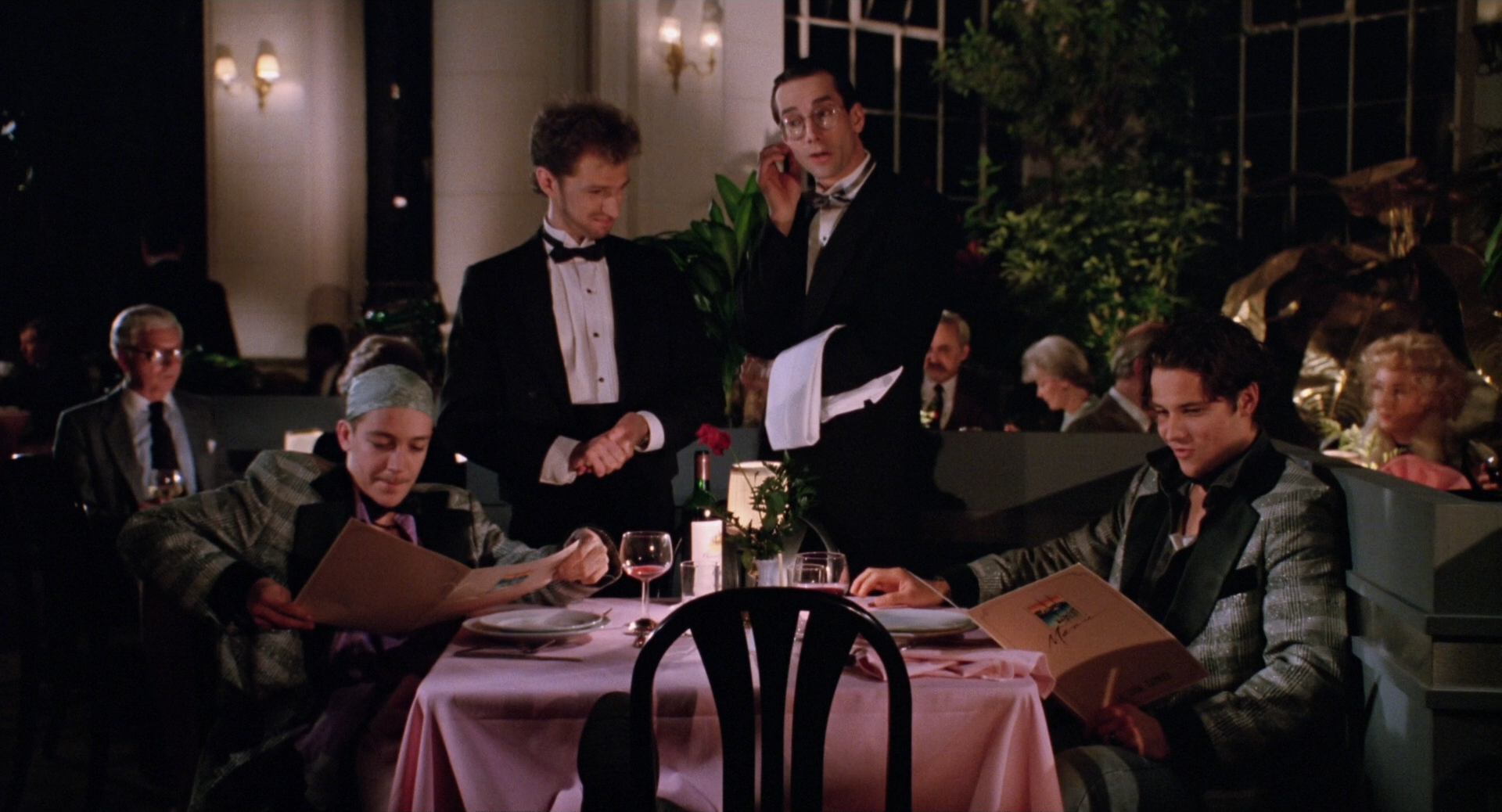
But I could tell things were beginning to go South as soon as the bullies entered the picture. These were a pair of goofy, greaser punks straight out of an 80s sitcom. Certainly, The Gate played with the mixture of horror and humor; but it grew increasingly obvious the horror was being chucked out the window in order to double down on the comedy. And this time the comedy was way more broad. Instead of an army of small creatures spreading terror to lead the way for their dark master, this time we basically just have one little monster, who our characters capture and discover it can grant wishes. So the bullies steal it, and they get a cool hot rod car and then go raise a ruckus at a fancy, upscale restaurant, replete with evening gowns, a small string orchestra and a snooty maitre d'. The bully named Moe puts his feet up on the table, mispronounces the names of the fancy food and winds up pushing a waiter into a cart of trays as everyone gasps. That's the kind of movie Gate 2 turned into.
So why did I have to have this one? Well, partially because Vestron finally made a proper special edition of the original, and this makes a swell companion piece. And, hey, I hadn't seen it since the old VHS days, when it was murky and fullscreen. Maybe finally seeing it the way it was meant to be seen would raise the film in my estimation all these years later. And it does a little bit. It actually is photographed fairly well, and knowing the film I was walking into helped me past my initial disappointments and appreciate all the little touches and moments that do work. It's not just the original kid who's back, who does deliver another worthwhile performance; it's pretty much the same filmmaking team. The same director, the same writer. So more of the character's personal story from the original is brought back here, making it feel like more of a full continuation than most horror sequels. And this film still has a fun mixture of stop motion, prosthetics and rubber creature effects. And I was surprised to recognize a young Pamela Adlon (of Louie and Better Things fame) as the young girlfriend character.
2018 US Scream Factory blu.
Scream's new HD transfer is made from a 2k scan of the interpositive. For those keeping score, that's better than a print, but not as ideal as the original camera negatives. So maybe it's not quite as crisp, but honestly, it's a very attractive picture. Grain is visible but light, the image, well, obviously an entire world apart from anything we've seen before. Admittedly, I've never seen the DVD, but I do know it was fullscreen. Anyway, the blu here is slightly matted to 1.85:1 and what really stuck out to me the most was the colors. You expect to see a little shelf-wear along the edges of a low budget flick from this many years ago, but it looks surprisingly good here. I was impressed.
For audio, we get the original stereo mix (which sounds like what it is, a little low budget and dated) in DTS-HD and optional English subtitles.
This being a questionable sequel, what really drew me into this release was the special features. Again, it was mostly the same team as the original, so that Vestron disc had me hungry for what these guys had to say about their follow-up. And probably because Scream Factory could smell an under-performer with this title, the disc is a little light on extras, but what it has is pretty much just what I wanted. The main feature is an almost half hour discussion between the director, screenwriter and one of the special effects artists: Randall William Cook. It's co-produced by Red Shirt Pictures and pretty much addresses everything you want to hear. Then one of the other effects artists, Craig Reardon, gets a second featurette all to himself, where he goes over his contributions to the film.
Those are both pretty great, but unfortunately that's pretty much it. No commentary or anything. Again, I think Scream wanted to keep their budget low in this one. But what we got works. There's also a few promotional items, like a video trailer, a brief promo video, a stills gallery, and a fun vintage audio recording for a $1000 contest that was run in conjunction with the film's original VHS release. As you can see, Scream's cover uses the original VHS art, but it also has reversible artwork, using an old German video tape cover on the flip. Two pretty neat options, with neither being that cheesy comic book style stuff they usually produce.
So look, Gate 2 is Gate 2. Not everything in Scream Factory's line-up is a masterpiece. If you're a fan and grew up with the film, though, you should be super happy with this release. I doubt we'll ever see a better edition in our lifetimes. And even if you're not particularly impressed with it - hey, it's not entirely unamusing. And like I said, when combined with Vestron's special edition of the original Gate, it feels like one complete, satisfying package.
Here's a film you missed out on if you bought Warner Bros' big 15-disc Oliver Stone Collection in 2001 or their subsequent, revamped Ultimate Oliver Stone Collection in 2004. 1974's Seizure is one of Oliver Stone's least known but still arguably one of his absolute best feature films. It's basically been languishing in obscurity until Scorpion rescued it in 2014; but being a smaller cult label, it still hasn't blipped on all the radars it should. I've just been looking back at my old copy of Video Watchdog #26 devoted to the film, which Lucas called "unbelievably good" and "the most remarkable horror film to emerge since William Friedkin's The Exorcist." That's high praised for sure, but not unwarranted. There have long been rumors that Stone is ashamed of this film, but when you read his interview you can tell he was proud of it and was very frustrated that so few people saw it because the distributors let it languish. Even the generic title, Seizure, was a forced replacement for his much more descriptive and alluring title The Queen of Evil. In fact, I've been going back through Stone's catalog, and some of his most famous films are starting to feel a little creaky and dated. But I feel Seizure, on the other hand (and Salvador, too; but that's for a whole other post), is only getting better with age.
Admittedly, Seizure is a bit of a dream logic horror film like, say, Inferno; so it's going to frustrate a lot of viewers. In fact, according to Stone's VW interview, it's based very directly on a dream of his, but enhanced with some great ideas and fleshed out characterization. In short, Jonathan Frid (Dark Shadows) is an author struggling to finish his latest horror story for children. He invites all his friends to stay with him and his family for the weekend, when they're visited upon by three figures of death. It's declared that only one shall survive the night, and he's powerless to stop them. I was just talking in a recent post about how tiresome it can get when movies continually dangle the supernatural question in front of the audience: are the ghosts real or imaginary? The Turn Of the Screw is a literary classic and deservedly so; but in lesser hands, it can be pretty tedious as the writer keeps yanking your chain back and forth between "it's real! No, it's a dream!" We don't really know here either, but the power of this film is that it doesn't fucking matter. We're trapped in this primal darkness no matter what.
There's a great contrast in this film between its bleak nihilism - we're going to watch a group of people twist and die unhappily, in the vein of films like Wolf Creek or House On the Edge Of the Park - and the almost childish vision of Seizure's iconic villains: their wicked leader The Queen of Evil, the giant executioner The Jackal, and a sadistic dwarf known as The Spider, played by a pre-Fantasy IslandHervé Villechaize, who's just terrific. Really, the whole cast is great, which really serves to elevate the proceedings. Martine Beswick plays the Queen (that's right, not Mary Woronov, who's actually cast as a fairly normal person for a change!), Joseph Sirola goes over the top but in all the right ways; and even though I was prepared for a wooden turn by the infamous Troy Donahue, he actually delivers a very naturalistic, convincing portrayal in Stone's hands. All of his famous filmmaking strengths can be found in this early, overlooked work, including some bold editing choices and certainly the writing (Stone shares a credit with a co-writer, but he told Lucas that re-writer only did a little editorial clean-up and was really involved more in a business aspect). One of the moments that elevates this script from good to great comes right near the end and is a huge spoiler, so I won't say it here; but wait 'till you get to it.
Stone made a second horror film after this, The Hand, which is a little better known and respected. It's certainly a good film with an excellent lead role by Michael Caine. But to me it feels like a more conventional, watered down version of Seizure, which he essentially had to remake because his first effort had been practically buried. I mean, don't get me wrong, it's a completely different premise and the story is told very differently. But it feels like it revisits all the same core themes and emotions because his first attempt to exorcise them before the public here was stymied. So The Hand might be a little more polished and satisfying for the casual viewer who isn't interested in being confronted by their Friday night flick. But to me, Seizure is the more important and powerful work of the two.
So, like I said, Seizure hasn't had a big life on home video. I took a film course and the professor who was talking about Stone's body of work hadn't even seen this film. It was released on VHS a couple of times by some smaller labels, but all we had of it on DVD was that same VHS transfer ripped onto a grey market disc by Substance. Still, you put up with it because it was all we got. Until 2014, that is, when Scorpion saved the day and released DVD and blu-ray editions of an all new, high-def master from the original vault elements. Unless you caught it during its rare original screenings in the early 70s, this was your first time seeing it in widescreen! Old reviews constantly deride this film for its bad lighting in the night scenes, but that's surely due to its dupey, dark video transfer, because it all looks very clear and professional now. Coming from Scorpion and not Universal, you can bet they didn't exactly get Stone in for an audio commentary or feature length documentary, but they did scare up a couple, very good special features. It's been the definitive, must-have edition until just recently, when a German challenger entered the scene. Their blu is a longer cut of the film, a composite cut of HD footage and restored scenes from German VHS release that runs about five minutes longer.
So let's talk about this longer cut. As you can see, it's fullscreen and obviously lower quality, taken from a video tape rather than original film elements. Though, for VHS-sourced footage, it's not looking too bad. Yes, the aspect ratio changes for the additional footage (a curious choice, since it's basically open matte... I'm surprised they didn't matte to match the rest of the film). But what's this extra footage? How essential to the film is it? Well, it's not absolutely critical, but it isn't superfluous fluff that deserved to be cut either. Some of the changes are minor... When Woronov comes out of the gas station bathroom, in the extended cut we just get a quick extra shot of dirty graffiti on the walls, showing us what a dive it is. But if this movie left you puzzled and longing for answers about "what the heck did I just watch" - and it is that kind of movie - this version definitely gives you some more towards that, in particular a large chunk of dialogue between Frid and Roger De Koven that really delves into the questions at the heart of the film, but still without giving away too much. Check out movie-censorship's breakdown for every single detail, but in short, I'd say the longer cut is superior, but not drastically so. It's not an eye-opening revelation... or chock full of additional exploitation elements if that's what you're after. But it's certainly the one I'll always go back to now for future watches.
Oh, and it has to be noted that Schroder Media's disc gives you the option
of watching the longer or shorter cut - both versions on on their disc.
2014 US Scorpion blu on top; 2017 German Schroder Media blu bottom.
Apart from the added inserts, it's clear both blus are taken from the same master. The film is presented in 1.78:1 with bold colors and natural, filmic look. Grain is visible and genuine, though predating the cutting edge clarity of today's 4k scans. But it looks beautiful, and thankfully hasn't been tampered with an any of the common pitfall ways like edge enhancement. It has a very natural look with attractive coloring. There are a few cases of film damage, but they're rare and not too distracting. Actually, one review I read online suggested Stone purposefully crafted them into the film as an artistic decision, but I haven't been able to confirm this; and from the German videotape footage, it appears the damage wasn't present on the German VHS... and I wouldn't think Stone was still tweaking the film after those tapes was released. Anyway, I have to point out that the two blus aren't 100% completely identical. Upon direct comparison, the blacks and shadows of the Scorpion disc are noticeably darker than the Schroder disc, which lightens them just a tad. It never actually reveals any additional picture information, though; they're not correcting crushed blacks or anything. It's just a slight distinction, and it's hard to really pick a preference. I guess Scorpion's blacks are "truer," so I'd go with that one; but it's really a pretty arbitrary call.
Audio options are pretty much the same across the board. We're given the original mono track in DTS-HD 2.0. It's very strong, though there's some hiss from the vintage elements. It's not distracting, but very evident when stopping and starting the film mid-viewing. Both discs have offer the complete English audio (yes, the added VHS scenes also have their original English audio despite being supposedly taken from a German tape), and neither disc offers subtitles of any kind. The Schroder disc offers an additional German dub, of course, also in DTS-HD, and it's completely clean, without any hiss.
So far it sounds like the Scorpion used to be the disc to get, but Schroder has thoroughly unseated it as the definitive release, right? And that may be absolutely true, but here's where Scorpion still makes a case for itself. They've got some great, exclusive extras. The highlight is absolutely Mary Woronov's, roughly fifteen minute on-camera interview. There is forthcoming and then there's this. She's very funny and very no-holds barred. She has great memories and anecdotes about this film, and it's a joy to watch. They also interview co-star Richard Cox, which is good, although they do that thing where they spend a most of the time just having him run through every film on his imdb page; and he winds up talking more about Cruising than Seizure. But he does have some good stuff to say about this film, and it's a good watch... just not on the same level as the Woronov talk.
So Scorpion has two interviews and the trailer. Not a ton, but substantially more than the German blu, which just has the trailer. It does also come in a slip sleeve, and has reversible artwork (typical of German discs, it's the same art, just without the large ratings logo). It's a numbered, limited release of 1000 (mine's #338). But I'm not sure if the whole disc is limited, or - probably more likely - just the initial run with the slip sleeve. I say "slip sleeve" instead of slipcover, because it opens from the side as opposed to the top and bottom.
So okay, let's make some final tallies. I do believe the longer cut is the preferred cut of the film, so if you don't have either disc, you're going to want to import the German blu for that. Especially since it still lets you watch the short cut, just in case you wind up disagreeing with me, or if the inserts' dip in quality really bothers you. But do the added scenes add so much that it's worth double-dipping if you already own the Scorpion version? Very possibly not, unless like me you're a really big fan of this film. And if you have the German disc, do Scorpion's extras warrant a double-dip in the other direction? Again, if you're a big fan: yes, because those extras are good 'uns. But if you just kinda like this film and want it in your collection, but aren't really in love with it, you can probably sleep at night with just one of these blus. Anyway, that's where the chips fall, so now what to get or not is up to you. But personally, I'm happy I've got both. It was the right call for me.
Man, I've got so many discs backed up I want to cover, I kind of forgot about about covering M.I.A. films. That is to say, discs that have never been released on DVD or blu anywhere in the world and really deserve to be... just in case you've forgotten, too. And this is one I've had on my list since I first came up with the concept: 1982's Don't Go To Sleep, a genuinely disturbing, long neglected ABC TV movie of the week that's better than most ghost-themed horror movies that get released theatrically today.
Scream Factory got my hopes up in 2013 when they announced their TV Terrors line. There's only so many vintage TV horror movies that hold up this well; surely it had to be on the short list. But unfortunately, they picked such klunkers. The Initiation of Sarah is at least mildly amusing in a campy way, but I'm not sure I even accept that Are You In the House Alone? qualifies as horror (or "terror"); it's more like an after school special with basically one brief scene that plays like anything from a horror movie. And look at the packaging. They're not marketing the films to their fans or selling unfamiliar horror fans with what good movies these are; it's just big pictures of televisions with the word "TV" all over it. Like that's a selling point. Nobody's going to be excited because the movies were made for TV; people need to know what's compelling about the actual films themselves. Oh, and making it DVD only well into the days when most serious collectors have gone exclusively blu probably didn't help.
So naturally, it flopped. I read an interview where someone from SF said it was one of their worst sellers. In fact, SF pretty much hung up DVD editions entirely around then. Later on, they figured it out I guess, because they released Body Bags with full-size artwork for the film and John Carpenter's name emblazoned on the top. They didn't put "TELEVISION" in giant letters across the top and a little Body Bags logo in the corner. So hopefully maybe some day they'll balls up and take another stab at releasing some cool, vintage made for TV horror. If they do, may I suggest this one?
Admittedly Don't Go To Sleep does start a bit stiffly, and it does have all the inherent flaws of a made for TV movie from the 80s. It's got boxy, fullscreen framing (unless it turns out they did film for a potential theatrical release - wouldn't that be exciting?) and it routinely, awkwardly fades to black for commercial break. Like I said, this film was never released on DVD or blu in any region, but it was released on VHS by Unicorn Video way back, so we can see how it's properly cut together without ads and TV junk. Rips of that tape are all over the internet and still widely sold as pirated DVDRs on various grey market sites, which should show the labels that there's an active market for this movie even to this day.
So let me stop griping and finally get down to what's so good about this flick. As an ABC program from the 80s, it's obviously not gory. But it's surprisingly dark and edgy. It's well written and goes places you'd never expect this movie to have the courage to go to. It's got a fantastic cast, and while again, the editing is a little clunky and you can tell this had a short production schedule, once this film gets going, we get some strong performances. Valerie Harper goes beyond her sitcom roots to deliver some strong, sincere moments as a grieving mother, we get Dennis Weaver, star of Speilberg's Duel and Ruth Gordon - Maude from Harold and Maude for God's sake. And impressively, the little boy, who was also the son in Poltergeist, steals every scene he's in.
The story's quite serious and intelligently walks the line between a ghost being a genuine supernatural and a psychological representation like few ghost stories besides Henry James' Turn Of the Screw manage. Briefly, a small nuclear family move back in with their aging grandmother, ostensibly to care for her as she grows senile. But we soon learn the entire family is in need of this regrouping because they've just suffered the loss of a young daughter, and each one of them holds themselves in some way responsible. They struggle but manage to get along until the youngest daughter, Mary, is visited by her deceased sister, who urges her to take revenge on her family, one by one.
Now, usually in any horror film where a nuclear family is under duress, they all survive okay. Maybe a nosy neighbor will get it, but a family isn't like a group of teen counselors; they usually all live. But oh no, ABC goes for it. I don't want to get into spoilers, but nobody's safe. Of course, you shouldn't expect Tom Savini-level slasher kills - although this film does make great, memorable use of a pizza cutter - this is a ghost story, meant to hit you in the emotions and generate a slow, building disturbance. So even though you might be nonplussed by the droll first act, it's worth sticking with it as it worms its way in. And while you might expect, canned, cliched library cues; they producers (including Aaron Spelling, if you can believe it) clearly sprung for a big, orchestral score.
There's no video quality to scrutinize here, as there isn't a release to judge. I've just got a DVDR I made of a VHS rip I found someplace online years and years ago. You can tell it's from video-tape, with the VHS lines along the bottom. And it's got big, chunky macroblocks, suggesting this was probably uploaded at 320p at best. It looks awful. But imagine if somebody went back and scanned the original film elements? Visually, it would be an entirely different world. No film deserves to be seen looking like this, and Don't Go To Sleep definitely deserves to be seen.