Shadow Of the Hawk, Now With More Nightwing (DVD/ Blu-ray Comparison)

Of course, ideally every movie we're interested in will have an loaded, 2-disc blu-ray special edition. But we don't live in that world. In our world, some pretty cool movies are only available on MOD (Made On Demand... official releases put out on invariably single-layer burned DVD-R discs). But hey, at least we have that! After all, plenty of stuff has never been released on any format at all. And so today's cool MOD is Shadow Of the Hawk, a highly entertaining made-for-television American Indian-themed horror film from 1976. It originally aired on ABC [or not, see the comments!], and is being bought to us now on disc by Sony and Columbia Pictures.

Update 7/9/15 - 10/27/18: We can forget all about MOD DVD-Rs now; it's out on blu!  And it even comes paired with the 70's vampire bat thriller Nightwing as a double-feature.  But can Mill Creek deliver the quality we've come to expect from the major and cult labels?
Shadow stars Jan Michael Vincent as a half-Indian; and if you can wrap your suspension of disbelief around that, you'll have no problem with the ghost and witch doctor stuff coming up. He lives in the city, but his medicine man grandfather (Chief Dan George) leaves his reservation to come find him, and just in time, because Vincent is getting violent visitations from an evil ghost in a white mask. Apparently an evil sorceress is using her powers to wipe out the two of them and all of their remaining people, and George is too weak to fight her on his own. So somehow a freelance reporter lady gets caught up in all of this, and the three of them set off on a road trip back to their village. Vincent has to learn to both accept and master his ancestral powers before the witch becomes too strong.
If you're looking for authentic lore that respects real Native American history and even teaches you a thing or two about another culture, forget it. This just feels like the writers wrote every spooky or wild Indian-themed supernatural concept they could come up with on note-cards, spilled them onto a table, and that was their script. Chief Dan George is the only true Native American involved in this film, but that's okay. This movie isn't trying to educate, just entertain, and that it does. There are genuinely effective ghost moments and campy magic attacks. There's a really impressive effect where a car crashes into an invisible wall, and a pretty fake looking snake that bursts into flames. Jan Michael Vincent wrestles a bear in this movie! Someone turns into a wolf (of course), a black ghost car chases our heroes (which tribe had those in their legends again?), and there's an evil snake dance ritual with lesbians making out... Yeah, this movie does have that made-for-TV feel at times, and that also restricts the amount of sex and blood they can play with, but if you can't find something to enjoy in this picture, you ain't lookin'!
Sony/ Columbia 2011 MOD DVD-R top; Mill Creek 2018 blu bottom.
The made-for-TV look is reduced considerably thanks to the fact that this film has been remastered in widescreen and looks great even on the DVD. It's a bit fuzzy and soft, but you're going to get that with the compressed MODs. Shadow was shot on 35mm, and for the first time ever (including, I'm sure, its original broadcast), looks the part. It's nice and anamorphic, with no interlacing issues or anything like that. The picture's in a much nicer state better than I ever expected to see it. They even slightly letterboxed it to 1.85, rather than leaving it at 1.78. Somebody involved cared. And the Dolby 2.0 audio is pretty clear and robust, too.

But things get even better this October with the new blu.  For those skeptical of Mill Creek, I'm happy to start out by reporting that this is a pressed, dual-layered disc and the audio is lossless (LPCM).  Of course, it's the same exact 1.85:1 master being used here, but that's just fine as it seems to be a genuinely high quality Sony scan, and it makes a genuine difference getting it in HD.  Instead of compression artifacts, we see real film grain.  And yes, small detail lost in the SD transfer are restored on the blu.  You might be worried about squeezing two films onto one disc, but again it's dual-layered, and there are no features (disappointing but expected) weighing it down.  So in the end, it's just a little over three hours on a 50 GB disc, which is better than plenty of single movie blus.
So like I said, and as is usually the case (though not always!) with MOD releases, there are no special features included with this film, not even a trailer.  And the same goes for the blu.  A trailer does exist - it was featured on one of Synapse's 42nd St. Forever compilations - but you don't get anything here.  At least Mill Creek's blu has a menu screen, which I guess is technically a step forward. And that's disappointing, because I'm sure there are some interesting stories to go along with this movie, from shooting all this wild stuff out on location to selling ABC on a Native American-themed horror film in the first place. And if you look Shadow up on the imdb, they list a second, uncredited director - I'd love to know what the deal is there.  Another label would've surely given us something, plus probably subtitles which are also MIA on both versions, but you can't argue with Mill Creek's pricing (less than half of what Sony wanted for their burned DVD!), especially since it comes with a whole, second feature.
Nightwing is a good choice for the double-bill, because both films have a lot in common.  It's a late 70s PG horror, which also used to only be available as a Sony DVD-R.  But more than that, it's another film about Native Americans dealing with mystical dark forces rooted loosely in their folklore.  And yes, we've got another white man in the lead role as the son of a powerful shaman, this time not even trying to play it off as "half Indian."  Nick Mancuso, star of the NBC series Stingray, is supposedly a full-blooded Native sheriff living on a reservation, which is also populated by a couple other white actors in the lead roles and authentic Native Americans in the older and supporting roles.  So they do kind of feel like sister movies.
And this one has a lot of strong points to draw you in.  Henry Mancini gives it a first class, stylish score, and the cast is rather interesting, with notables like David Warner and Modern Romance's Kathryn Harrold.  The acting is quite strong all around and they're delivering fairly respectable material, as the script is based on a novel by Martin Cruz Smith.  The locations and special effects are often quite good, though there are some very dated and even messy for the time composites thrown in the mix, too.  Really, the only major drawback is that it's so damn boring.  This is a movie I saw as a kid at least a dozen times on TV.  Because it's PG, they could play it in the afternoon.  And every time I'd revisit it, I'd think there have to be more bat attacks than I'd remembered.  But nope.  There's really just one midway through the film that really delivers the goods, and then the heroes deal with the bat horde at the end.  Otherwise, it's just an endless stream of exposition.
You've got two stories, basically, that wind up dovetailing at the end.  Mancuso's the reservation's sheriff who's shaman father, uncle or whatever has decided to end the world by casting one last spell.  And this spell is either just superstition or the cause of a rash of mysterious vampire bat attacks (most of which we don't see).  He battles with a big business owner on the reservation who wants to hush it all up so he can bring in some big business deals, a la the mayor in Jaws.  Then, on the other hand, you've got David Warner as a cross between Richard Dreyfuss' character in Jaws and Donald Pleasance's in Halloween.  He's devoted his life to hunting and killing vampire bats ("I kill them because they're the quintessence of evil!"), and followed them to this community.  So, basically, Warner represents the scientific explanation, and Mancuso represents the spiritual, with Harrold kinda floating in the middle.  Hope you find this talk fascinating, because that's what you get in lieu of bat action.  But then again, I have to say, the brief bat moments they have made a pretty big impression on me as a kid that were just as I remembered them with this recent rewatch as an adult.  The thrills are effective, there's just so damned few of them, and the movie isn't that short.
Mill Creek 2018 blu-ray.
Once again, it's another great scan, very filmic.  Grain is natural and crisp in HD, and it's a trip seeing this in widescreen (slightly matted to 1.85:1) after having grown up with terrible fullscreen television broadcasts.  The cinematography's a little on the flat side, but the landscapes definitely benefit from the proper composition.  Even the dark night skies look great.  No blocks, the colors look natural and authentic.  The audio is another lossless LPCM stereo track, and again there are no subtitles or features of any kind.  You just pick the movie you want to watch on the menu screen and off you go.
This is definitely the version to own for both films.  Of course, that's obvious given this is each film's debut in HD.  But this is more than just a bare minimum incremental upgrade, this is an unexpectedly high quality release, to a downright surprising degree for a budget disc.  Certainly some "frills" would have been nice, like subtitles and special features.  We can only imagine what the Scream Factory treatment would've looked like here.  But if you're in it for "just the movie," this is a pleasant surprise.

Bad Ronald As You've Never Seen Him Before (DVD/ Blu-ray Comparison)

I've been planning to tackle the central and most infamous in the rather demented trilogy of psychological horror films of the underrated young actor Scott Jacoby for a while now.  But when Warner Archives announced their intention to reissue the film on blu, I decided to wait.  And boy am I glad I did, because this new version, released just in time for the Halloween film, opens up a whole new chapter in Bad Ronald's life.
For those who don't know, which is surely most of the film-going world, the trilogy starts with Rivals and ends with The Little Girl Who Lives Down the Lane.  Of course, these aren't Jacoby's only forays into the horror genre - he's pretty good in the To Die For movies - but these three are joined together by a common theme of taboo-twisting murder.  They'd actually be more aptly described as dark cult films rather than horror.  And what makes Bad Ronald all the more infamous is that it was filmed and released as a made for network TV movie of the week.  What a weird thing to throw in front of mainstream viewers, but hey, it was the 70s; filmmakers were bold back then.
Bad Ronald's actually based on a book, of the same title, written by Jack Vance, which is even darker.  It tells the story of a boy who accidentally (purposefully in the novel) kills a young neighborhood girl, so his mother keeps him hidden when the police come for him.  She builds a secret room for him so he can live at home without anyone finding out, and it's just the two of them for years until one day she goes out and never comes home again.  So he lives alone, inventing a fantasy world he calls Atranta, and hiding from reality in a home everyone comes to believe is abandoned.  Until one day the property is sold and a new family moves in, replete with three young daughters, none of whom have any idea that they're surrounded by concealed doorways, tunnels, peep holes and a very lonely, homicidal occupant.
If you're looking for high production values, thrilling set pieces or glossy gore, this isn't the film for you.  There are at least as many horror aficionados baffled by the appeal of this film as enamored with it.  For one thing, this is an old TV movie, which means no R-rated sequences or bad language and a boxy, fullscreen aesthetic.  And as great as Dabney Coleman always is, he and much of the rest of the supporting cast feel out of place here, like they've accidentally wandered off their sitcom set for the day.  But on the other hand, casting couldn't get much more perfect than Jacoby and Kim Hunter as his mother.  And the girls do have a bit of classic Texas Chainsaw Massacre victim vibe to them.  Just know that this isn't about being suspenseful and scary so much as creepy and unsettling.

By the way, apparently this film was remade about twenty years later in France under the title Méchant Garçon.  As far as I know, that film's never even been translated into English; but I'd sure love to see it some day.
Anyway, unsurprisingly, this film was unavailable on home video for a long time.  It was the just the kind of neglected, off-beat flick fans traded memories and VHS bootlegs of on news boards and conventions.  So it was a very welcome surprise when Warner Archives included it in their series of MOD DVDs in 2009.  It was completely no frills, of course (just look at their zero effort DVD menu, pictured right!); but just to have an official copy was a major win for fans.  But now, presumably in recognition of Bad Ronald's immortal cult status, Warners have taken another stab at it, this time in HD, and oh man, they really got it right!
2009 US Warner Bros DVD top; 2018 US Warner Bros blu-ray bottom.
Warner's DVD was clearly taken from an old tape master; though admittedly, it's not like it would've looked much better when it first aired in '74.  But clearly, for the blu, they were able to locate some original film elements and give them an entirely fresh scan.  Where to even begin?  The DVD is dreadfully interlaced.  We're not even talking intermittent frames like most interlaced DVDs we come across... every single frame is interlaced.  Thankfully, that's completely fixed.  And the drained, sapped colors have been fully restored and brought back to full vibrancy.  The weird aspect ratio of 1.28:1 has been corrected, too, to 1.33:1, adding picture to the sides and especially the previously cramped bottom, which had been giving the DVD an odd, misframed look to it.  There's still some headroom on the blu, suggesting perhaps that the filmmakers were keeping the possibility of a widescreen transfer open, but now we've finally got a correct 1.33:1.  Film grain is soft and hard to discern, but it's a real HD image, and compared to what we had before, practically a whole new movie.
The DVD's audio was surprisingly clear given the picture, but the blu still improves things by restoring the original mono tracks in lossless 2.0 DTS-HD.  Neither edition has any special features at all (there wouldn't have even been a theatrical trailer, after all), but you can still see the extra care put into this release.  I mean, they actually bothered to make a menu this time, and chapter stops are thoughtfully placed at key scenes and commercial break fade-outs rather than arbitrary ten minute increments.  Even better, they've created English SDH subtitles, another feature the DVD sorely lacked.
I wasn't expecting much from this release... I figured I'd be getting the same old video transfer just without the SD compression.  And I only bothered because crazy little film has such cut out its only little niche in my heart.  So I was delighted to pop it in and discover Warners had done this total restoration job on it.  So if you had similar thoughts, like why bother replacing a barebones DVD with a barebones blu-ray, well, now you see why.  This one gets a huge DVDExotica stamp of approval!

Controversial Blus: Predator, With and Without Grain

You know it was only a matter of time before I covered Predator on here, considering it's one of, if not the very most, infamous blu-rays in the history of the medium, regarding botched transfers.  Happily, however, I may have waited long enough to be able to report happier news of Fox finally fixing this fiasco.  Thanks to the latest sequel (itself a huge, dumb mess; but thanks possibly to the return of Fred Dekker, it at least has it moments, which is more than I could say for the previous two or three), there's a host of new releases of the Predator films out there on store shelves.  So unless Fox has really double-down on there mistakes, we should finally have our true "ultimate Predator."

Update 10/11/18 - 11/1/18: As was pointed out in the comments below, the difference between the main two Predator blu-ray releases come down to more than just the special features and language options.  There's a distinct difference in PQ.  Crazily, the 2010 blu actually got worse.  So I decided to stop being lazy and actually throw a copy of the 2008 blu into the comparisons.
If you're not already familiar with 1987's Predator, then uh, I'm surprised you found your way to this site, but welcome.  I mean, if this early summer blockbuster vehicle didn't embed itself deeply enough into American culture in its own right, then certainly the endless series of sequels, reboots, comic books, toys and video games should have secured its status as perfectly indelible.  But a question more of you might genuinely have is: does it hold up to your childhood memories of the super bad-ass sci-fi/ horror/ action hybrid that once rocked all of our worlds?
And I'd say the answer to that is, well, mostly.  When it kicks in, the atmosphere mostly holds up, but it does sink a bit deep into the cheese at times.  And fans will rightly argue that the over-the-top machismo is meant to be exaggerated, a commentary on both the foibles of that part of ourselves and the popular films of its day.  But I don't imagine the eye-rolling one-liners, like pushing into a quick close-up of Schwarzenegger quipping "stick around" after throwing his oversized knife into an enemy soldier, is meant to steer that far into what feels like Saturday Night Live parody today.  And the celebrity of a couple of its stars, wouldn't have been so distracting at that stage in their careers as it is now.  Like, I remember Jesse Ventura striking me as just a big, intimidating dude, not a cartoonish pop culture icon. And sure, while 90% percent of the special effects still look ideal, there are a few patchy rubbery predator fingers and chintzy cloaking opticals.
But it still draws you in.  And I have to say, seeing it in its latest iteration really makes a difference in grounding it in its original, dark side.  Because the HD transfer we've been living with for over a decade really lets the film down.  Most of you guys are probably familiar and way ahead of where I'm going with this, but the original blu-ray, released in early 2008, and all subsequent releases prior to this year, are drenched in DNR.  That's Digital Noise Reduction - software designed to scrub grain and noise from an image - and I there's been debate over how much, if any, is acceptable.  I'd tend to say none at all; it's revisionist, but admittedly very mild amounts and subtle usage aren't too destructive.  And unfortunately, many casual viewers have a visceral negative reaction to film grain like they do to "black bars" on letterboxed film.  But no matter where you stand on whether a little or how much is okay; I think just about everybody can agree, Fox went way too far.  The HD print they released everywhere (not just the blus, but streaming, etc) looks like somebody set an "Oil Painting" filter over their Instagram photos.

And thank goodness, Fox has done away with that disaster for their new 4k Ultra HD release.  Grain is back in full effect; the film is literally gritty again, and that really does affect the entire mood of the picture.  And now, if you're like me, your next question is whether the blu-ray included in the combo-pack has the new scan or the old DNR version, and nope, it's the same old disc.  That's good for me, though, because I always held onto my 2004 special edition DVD (itself an upgrade over the original, non-anamorphic 1999 DVD) when I saw reviews of the messed up blu.  But I was about to go back and buy an old blu if I had to just for the sake of this article.  But nope, I got it right here in my new 2018 set.  It's the same old transfer because it's exactly the same old 2010 disc.  Yes, 2010, because technically there are two Fox blu-rays, a barebones 2008 edition and the special "Ultimate Hunter" edition, which had the special features.  But they both feature the same waxy transfer.  And that later 2010 edition actually features a distinctly worse transfer.  Anyway, that's bad news for fans who can't play 4k discs; there's no upgraded 1080p blu-ray for them.  But before I go any further, let's see what we're talking about.
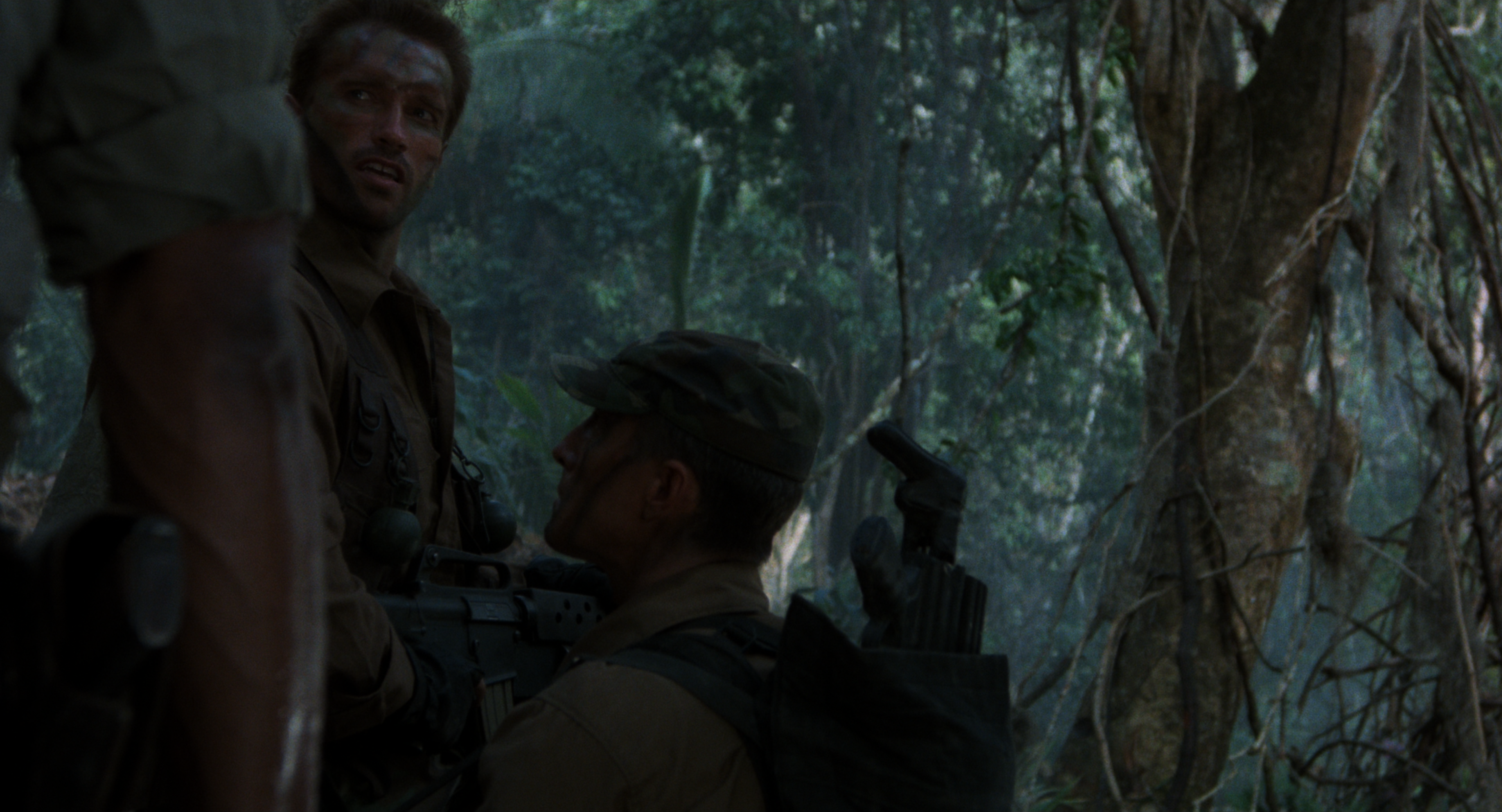
1) 2004 US Fox DVD; 2) 2008 US Fox blu-ray;
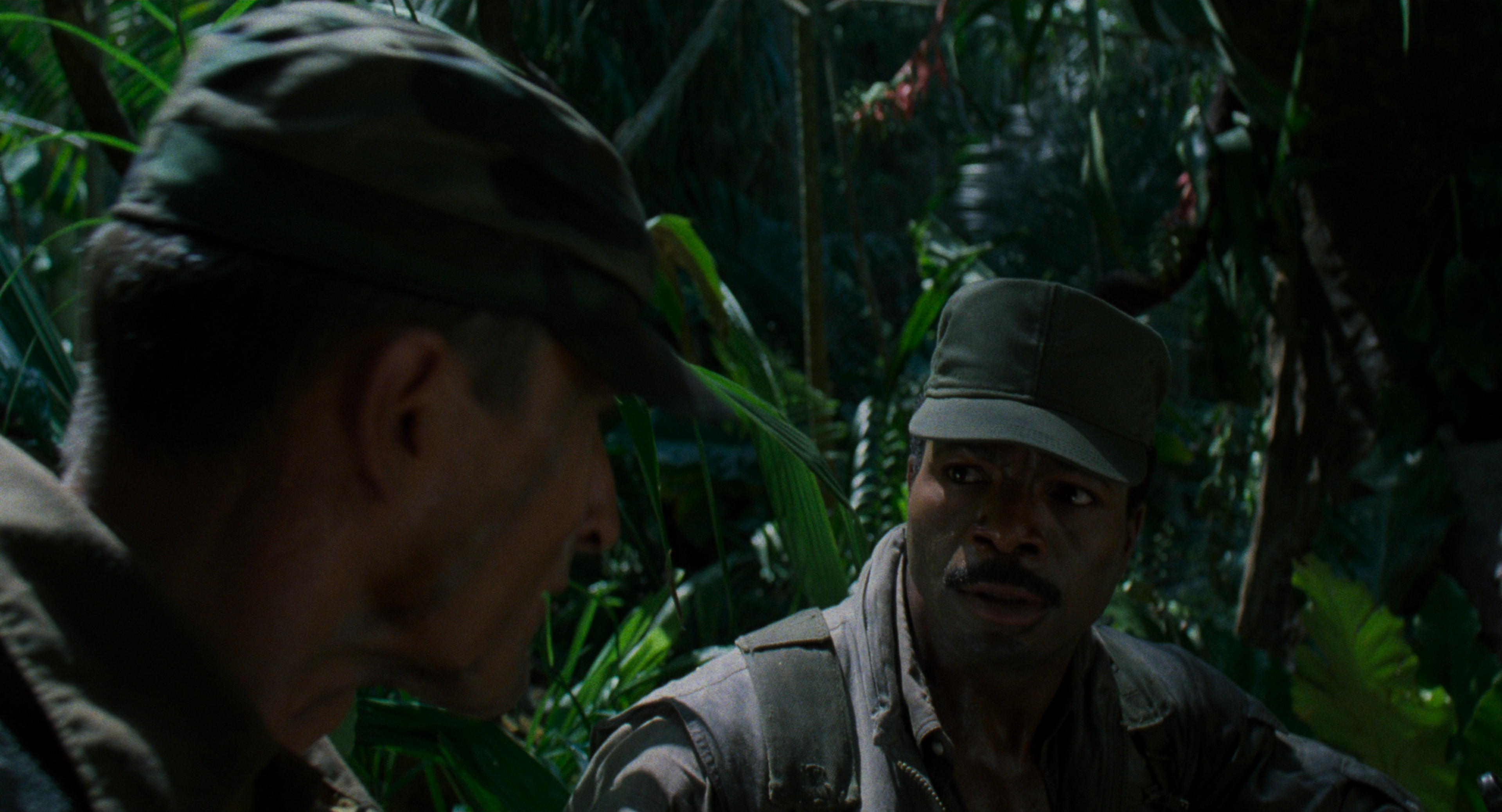
3) 2010/ 2018 US Fox blu-ray; 4) 2018 US Fox UHD.


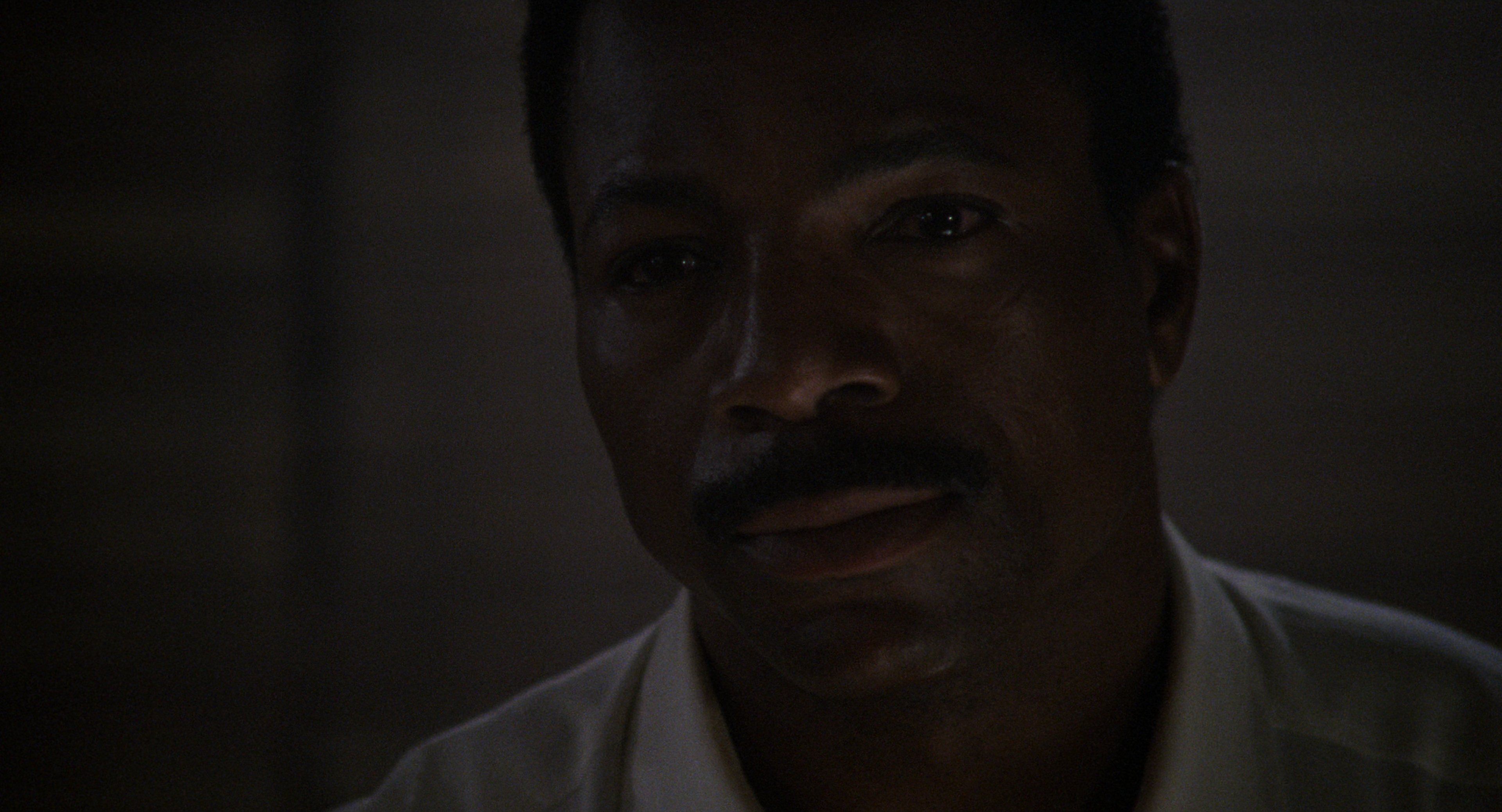
Other reviews love using the scene with that red shirt, and I couldn't help it either.  It really stands out like an oddly smooth, neon swath on the DNR's transfer.  But as you can see in the second set of shots, of course, the problem plagues every single frame of this film.  Yes, the colors pop more (even a bit too bright, if you ask me) and it's at least free of the messy compression of the DVD, but click through and look at those shots fullscreen if you're not convinced.  It's a disaster, frustratingly worse than the previous blu-ray edition, which looks to be the same master but with film grain still retained!  So the special edition was a distinct step backwards.  Honestly, the DVD was better.

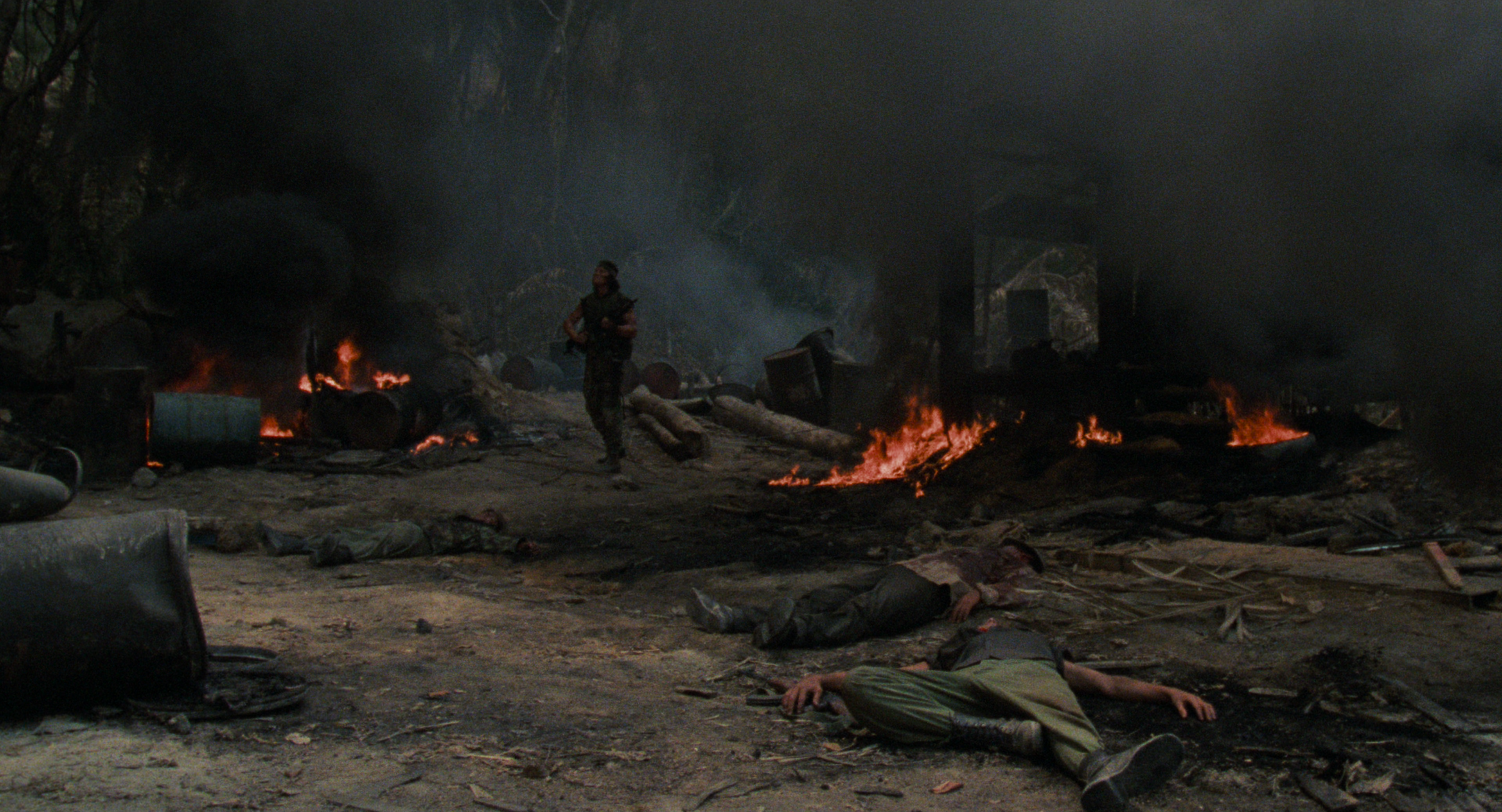
This new UHD is darker, which is probably more accurate and definitely fits the tone of the film and much grainier.  Like, even compared to other non-DNR'd films of its day, it's pretty grainy.  Otherwise, not a whole lot has changed... the 1.84:1 framing of the DVD (which is also ever so slightly horizontally stretched) shifts just a smidgen to a more correct (and un-stretched) 1.85:1 on the blu and UHD.  The DVD was basically missing a sliver on the right-hand side that would've been lost to the overscan area anyway back in its time, but that's restored on both HD versions.  There's just a nearly infinitesimal vertical shift between the blu and UHD's framing, like a few pixels high.  And of course, the UHD naturally benefits from the extra resolution.  Even with all its edges smoothed away, the blu breaks down into blocks when you upconvert it to the size of the more natural 4k.  But the key, ultra-important distinction is the restoration of the natural film grain and the fine detail along with it.

So, the original DVD gave you the fairly similar options of either 5.1 DTS or 5.1 Dolby Digital tracks, plus French and Spanish dubs and English and Spanish subs.  The blus bump those up to lossless 5.1 DTS-HD and Dolby Digital 4.0, though the foreign language options differ between them.  The 2008 blu has French and Spanish dubs with English, Chinese, Spanish and Korean subs, while the 2010 blu has all of those plus with Dutch, Italian, Portuguese and Castilian dubs and Danish, Dutch, Finnish, French, Italian, Norwegian, Portuguese, Castilian and Swedish subs (but losing the Chinese and Korean ones).  Whew.  Then the UHD carries over basically all the same audio (no new fancy Atmos track or anything) and language options as the 2010 blu, except it also adds Japanese dubs and subtitles.
In terms of special features, things are pretty straight forward.  The 2004 DVD was actually a 2-disc set packed full of some really good stuff.  Director John McTiernan does an audio commentary, and there's a solid half hour 'making of' doc that talks to just about all the major players.  Then there's a bunch of featurettes, like eight, mostly featuring on stuff like the effects and predator design.  There's four deleted scenes and outtakes, a photo gallery, some bonus trailers, and a collection of four, fun easter eggs of additional interview clips.

And that's pretty much the definitive special features package that's lived with the film ever since.  The 2008 blu-ray was had nothing but the trailer, but the 2010 one had everything, even the easter eggs, which are now just listed openly on the menu.  It also added one new featurette, which is more a promo for the latest sequel at the time, Predators, interviewing its director and some other crew members.  They do talk at first about the original Predator, but surprise surprise, they wind up turning that into how excited they are for their follow-up.  Hey, I'll take it.  And it also has the trailer, oddly absent from the DVD, plus trailers for two of the sequels.

What's new for the 4k?  Nothin'.  The 4k disc itself just has the commentary; but because the 2010 blu is in the package, you get the full collection of oldies.  Something new would've been fun, but then there's not much that feels lacking.  We don't need it to turn into one of those discs where the same people are interviewed and re-interviewed, saying the same things each time, so alright.  It also comes in a cool slipcover.
So yeah, this is a very satisfying release on its own terms.  And due to the fact that the original blu-rays are so borked, it's downright essential.  Admittedly, I suppose, the 2008 blu isn't so terrible if you're willing to live with a completely barebones edition.  But this is the first real upgrade that manages to improve one thing without screwing up another.  And it's a really appealing transfer.  It would be somewhat recommended, depending how big a fan you were of the film, on its own terms.  But given the issues with the previous blu-rays, it's a must upgrade.  Though, if you've never seen it, it's kind of fun that they give you the waxy DNR version, too, just for the novelty.

American Psycho, Thanks for the Upgrade! (DVD/ Blu-ray/ UHD Comparison)

Man, I'm a big fan of Bret Easton Ellis movies.  Obviously not all the adaptations are born equal, and some are far better than others.  But I'm on board for 'em all.  Yes, I even liked that one with Lindsey Lohan and the porn star. But American Psycho, despite some early misgivings I had with the film when I first saw it in films, is really the one that put him on the zeitgeist forever.  Even if you hate the movie and the novel, you have to admit, Patrick Bateman has become part of our cultural language.  Like Sophie's Choice, just speaking the words communicates exactly what you mean.  So, naturally, it's been released and re-released a number of times.  And frankly, I think it's time again.

Update 6/5/17 - 9/27/18: So we've had a couple DVDs, we've had a blu-ray.  But now we've got a brand new American Psycho UHD!  It was an older blu, so this new 4k Ultra HD disc should be a major upgrade, unless they mess it up somehow.  Did they get it right?  Time to put our investigator's caps on.
Did I mention issues I had with this film?  Well, yes.  I'd read the book before the film came out, so admittedly, I was a little "where's Bombadil?!" about the whole thing.  I mean, fans were all a little disappointed some of the most extreme scenes were left out, and I was too, but I also understood the filmmakers were trying to deliver something that could play in theaters.  But there were other little changes that made me feel like the filmmakers had possibly not understood the book.  Like beefing Willem Dafoe's character to turn the police investigation into a whole running subplot (there's even another one in the DVD deleted scenes), like a conventional "will he get caught" thriller.  And it probably is that to a degree, and just showing off that they got Dafoe; but now I can appreciate more that he just works as an extension of Bateman's inner monologue.  I always appreciated that they nailed the look of the film, like Less Than Zero, and the performances.  But revisiting the film more recently, I'm impressed with how thoroughly they brought the novel it to the silver screen.
And American Psycho's success with audiences is all the more impressive given that it's an indie film.  At one time Oliver Stone was in talks to direct this with Leonardo DiCaprio to star ...as well as Stuart Gordon with Johnny Depp and David Cronenberg with Brad Pitt.  It took years to eventually trickle down to Mary Hannon, who'd previously directed the excellent I Shot Andy Warhol, and Christian Bale right off of Velvet Goldmine and a small role in the Kevin Kline version of A Midsummer Night's Dream.  The budget shrunk, the theatrical run was small; but it still managed to land with audiences.  In fact, it was successful enough to garner a sequel, but the less said about that the better.
So like I said, this film was released multiple times.  It originally came out as a new release in 2000, right after its theatrical run, in both R and unrated editions.  Then Lions Gate reissued it with a bunch a slightly improved picture, a heap more special features and called it the Killer Collector's Edition in 2003.  In 2007, they released it in HD, which yes, makes it a fairly early blu-ray release.  And that's not even counting all the foreign editions, of course, like the 2001 French DVD from Metropolitan Film & Video I picked up because it had a collection of unique extras (that was before the Killer edition, so I was feeling a bit starved).  And now there's a 2018 4k Ultra HD disc and blu-ray combo-pack that just about renders them all obsolete.
1) 2001 Metropolitan DVD; 2) 2003 Lions Gate Killer DVD; 3) 2007
Lions Gate blu; 4) 2018 Lions Gate blu; 5) 2018 Lions Gate UHD.
Real quick before I dive in, I'll just tell you that the blu-ray disc included in the 2018 combo-pack is actually the 2007 disc.  I don't just mean that it features the same old transfer, although yes it does; but it's the exact same disc, with the same alternate set of special features, the same label and everything.  I'm including the screenshots from both discs just fro the sake of being absolutely thorough, but don't get it twisted.  They're 100% identical because they're literally the same discs.

So now, I no longer have my original 2000 unrated DVD since I replaced it with the Killer Edition almost fifteen years ago; but from memory, it was virtually identical to the French DVD, which used the same root master.  All the pre-2018 versions shown here are framed to 2.35:1, but the older DVD is zoomed in a little on all four sides, and slightly window-boxed.  The Killer edition essentially found the extra picture by lifting the tiny mattes on all four sides; and the blus seemed to use the same transfer as the 2003 DVD, though it naturally benefits in clarity and compression by being an HD disc.  Unfortunately, that means it shares the same issues as the older DVD, with a sharpening/ edge enhancement effect that they just about got away with in standard def, but on the blus, leaves the image looking like it's been tampered with in an unflattering way.  Like, even that shot of the business cards above has a clear and unfortunate haloing effect around all the edges.  All this, despite grain looking smoothed away.  Yes, those shots are from the blu-rays.  The edge enhancement also causes horizontal lines running along the top and bottom of the screen.  All editions also showcase some speckling and slight film dirt that's never been cleaned.
2003 Lions Gate Killer DVD left; 2007 Lions Gate blu mid; 2018 Lions Gate UHD right.
But of course now we get to go up another level to the UHD.  First of all, happily that edge enhancement and all is finally gone.  And the added resolution really looks nicer.  Look on the blu where the lines of Bale's face get jagged and pixelated, and how smooth and clear they are now.  Or just the blu's nasty macroblocks.  Gone.  The boost to 4k is sah-weet.  Film grain is a little light but finally present and much more natural than it was on the blu.  The color timing's shifted, too, ultimately looking a bit greener and darker, but on a 4k screen, they definitely sizzle more than any previous edition.  I also have to point out that the UHD is matted slightly tighter, and probably more accurately, at 2.40:1 compared to the previous releases' 2.35:1, cropping a sliver more vertical information, but unveiling a bit more along the sides. 
Curiously, one shot is mis-framed.  It's like that on the Killer DVD and the blu-ray, with black pillar-boxing bars appearing for just this one zoom-in shot early in the film.  It temporarily frames the picture to 2.22:1.  Even the older, French DVD has it' though it's less noticeable since it's already slightly window-boxed.  The bars just appear for that one shot and disappear as soon as the camera cuts; it's very strange.  It reminds me of the recent gaff on Scream Factory's Serial Mom blu.  Most viewers probably wouldn't even catch it on repeat viewings, but something's clearly awry.  Happily, the new UHD corrects this, too.  👍

Anyway, the original DVDs, including the French DVD, included 5.1 audio, but the Killer Edition expanded our options a bit by including both 5.1 and a 2.0 Dolby Surround mix.  The blu-ray, then, went a step backwards, losing the 2.0 option and just giving us the 5.1, although they offer it in DTS-HD with an alternative (lossy?) Digital Surround EX mix.  Oh well, none of the sound mixes are really amazing or terrible.  They all sound just fine.  Also, every release, except the French DVD, has optional English subtitles.  The new UHD's menu makes it look like they've dropped all previous audio options and gives us just a single, new 7.1 Dolby Atmos track.  But if you poke around with the audio options on your player, you'll find the 5.1 mix is actually tucked away on there as well.  It gives us a third subtitle option, too, making a distinction between English and English SDH subs, as well as Spanish ones.
Now, the original US DVDs only had a few, brief extras: a 5-minute behind-the-scenes 'making of' featurette, some brief on-set interviews and trailers.  That's why I imported.  The Metropolitan disc kept the featurette, trailers and interviews, as well as dug up a bunch more of those interview clips, divided into arbitrary categories like "My Life" and "Newspaper Killer."  They're all short, on-location talks, but they do get in-depth in the sense that they even talk to the costumer and other crew members usually left out of DVD extras.  It also has a video of the film premiere at the Berlin Film Festival, but it's very brief with no real substance.  But much more excitingly, they found some deleted scenes, including a noteworthy scene from the book I'm surprised they cut out.  And they had the trailer.  When the Killer Edition came out, it blew both of those versions out of the water, but didn't render them completely obsolete, as it frustratingly left off the 'making of' featurette and most of the on-set interviews.
 
But the Killer Edition came up with bigger and better stuff.  Firstly, how about two audio commentaries: one by Harron and an even more interesting one by screenwriter Guinevere Turner?  Then there's a full-length documentary called From Book To Screen, which is broken up into sections covering everything from the struggles the book found in getting published to a very VH1-like retrospective of the 80s.  They bring in a lot of interesting people, including critics, publishers and musicians.  It definitely shouldn't be overlooked.  Also, the Killer Edition not only kept the deleted scenes, but gave them optional director's commentary, and introductions by-way of a couple of those on-set interview clips.  Unfortunately, these are the only interview clips they kept, and since From Book To Screen didn't bring them back for seconds, it means we don't hear from most of the cast, who were on the older discs.  The Killer Edition also came in a cool slipcover and included a fold-out insert with notes by Holly Willis, co-founder of Filmmaker Magazine.
From Book To Screen
And the blu-ray?  Ah, that's the most frustrating of all!  They completely left off all of the From Book To Screen documentary, except for the VH1 80s chapter; the final half hour.  All the best material is left on the DVD.  And no, they didn't bring back the older interviews or featurette either, nor did they add anything new.  They've just given us less.  They even dropped the trailer for some odd reason.  I hate upgrades that take steps backwards like this!

On the other hand, I love upgrades that correct missteps like that and go strictly forward.  The new 2018 blu brings back the From Book To Screen documentary, which still preserving the 80s retrospective and deleted scenes (not restored in 4k, for the record).  And this time, they have given us something new, an additional third commentary, freshly recorded by Mary Harron.  Don't get too excited, though.  She basically says all the same things at all the points she did on the previous commentary.  I kept flipping back and forth between them and she was saying the exact same anecdotes and observations all the way through.  They should've gotten, well, anybody else, to do a new commentary instead.  But hey, I guess I'll take it over no new content at all.  The UHD set also comes in an attractive slipcover and a cool black case.  The only thing it doesn't have are those extra little interviews and stuff (including the trailer) from the old French disc; so maybe hang onto that if you have it.  Also, the new commentary and Book To Screen doc are only on the UHD, not the blu-ray, because again, the 2018 blu-ray is just another copy of the 2007 blu-ray.
When I first made this post, I was suggesting Lions Gate give this film a new scan and update a very creaky old blu-ray.  Well, they did me one better and gave it a new scan and issued it on UHD.  The new commentary's pretty pointless, but I'm glad they recovered the doc from the DVD, so this is definitely a strong, welcome upgrade in terms of the quality and special features, and the definitive edition to own.  The only stipulation, I suppose, is that if you're able to play UHDs, buying this set for the blu-ray will not be an upgrade over your 2007 disc in any way, shape or form.  But if you're 4k'd out and ready to go, this is the American Psycho for you.